
Scroll down to “Well, here we are” if you don’t want to read my thoughts on 1776 the musical, and assorted show biz ramblings.
I’ve read that the movie musical 1776 has a cult following. If you’re a member of this cult, do not read my review. It’s just one person’s take. If you haven’t seen it, go ahead and see it. It has some good things, despite my issues. Ever since last July 4, I’ve been meaning to take it out of the library on DVD. Recently, I did.
I’d never seen the whole thing, perhaps because I saw the stage musical way back when with the original cast, and I didn’t want to ruin the experience.
My family attended lots of plays and musicals from 1964 to 1972, which was a “Silver Age” of Broadway — the Golden Age being the immediate post-war era. Although obviously commercial, Broadway musicals were a furnace of originality, uncorrupted by pop culture trash1.
No matter how simplified the issues, a musical about the signing of the Declaration of Independence is on wholly different conceptual level than the “Lion King” or “Wicked.” There would be no “Hamilton” without “1776.”
Most of my memories of that theater-going are a mishmash, but not of 1776. I remember most of it clearly, which is interesting because I was never in love with the actual music. (And still am not, but I get ahead of myself.)
What was so memorable about this musical? Why does it so stick in my brain?
The actors, the staging, the physical look of the whole production. You felt you were back in Colonial Philadelphia, sweating it out in that little room. The scenery was more realistic and evocative of Colonial Philadelphia than the settings of the movie, which were too pristine and obviously created by union carpenters.
And the ending! The roll was called, the signers signed, the characters froze in place, and a translucent scrim with the Declaration written on it slowly rolled down.
Majestic, awe-inspiring. We all sat dumb-struck as the past reached out to us and touched us, viscerally.
It was a transcendent, spiritual moment, a never-forget-it moment that can only happen in live performance.
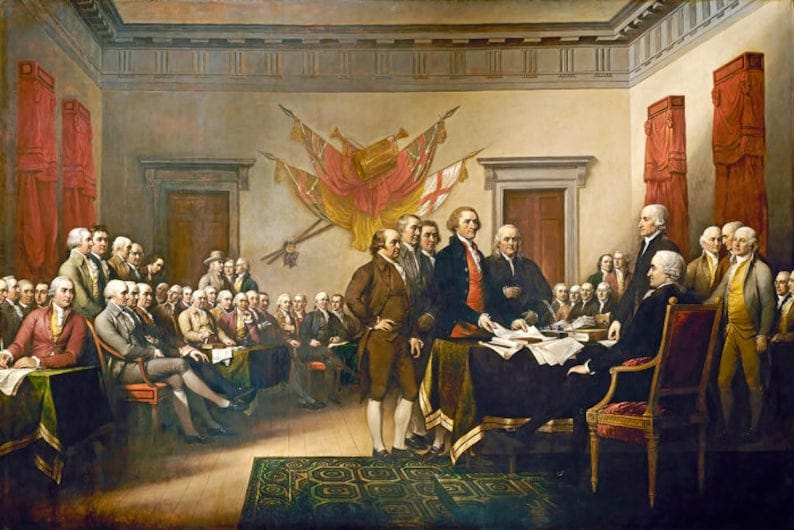
So how about the movie?
It pains me to say this, but I think it ranges from cringe to stiff. Often what works onstage doesn’t work on film and the score didn’t have the marvelous tunefulness of “Oklahoma” or “Carousel” to make up for deficits.
Onstage the Founding Fathers dancing on a stairs was a hoot. In fact, that was the scene that really “did it” for the audience: we were along for the ride. On film, not so much.
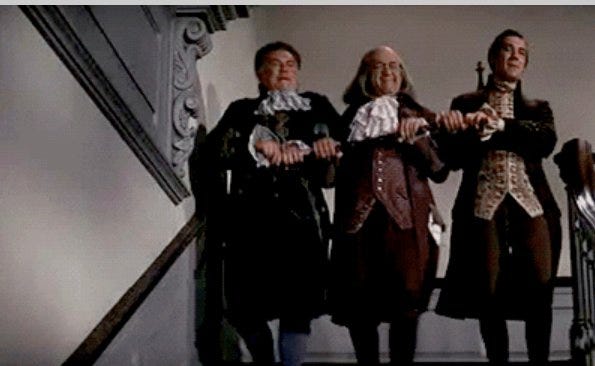
Same deal with the performances. William Daniels, Howard Da Silva, and Ken Howard embodied their characters on stage. On film, they were playing themselves playing the characters.
Onstage the female characters, sung by unmiked up trained singers, were terrific. (“Wow, she really hit that note!”) On film, they were a bit screechy and bolt on to the main action, not built in. Stage depends on supporting actors and short diversions. In film, continuity is a little trickier.
The stage version had loads of great stage business. For example: the courier.
The courier always entered while the delegates were arguing about some trivia. He shleps in wordlessly, the delegates stop and look at this nuisance, he gives the message to the secretary of the congress, and shleps off. Not a word spoken.
Maybe you had to be there but trust me, it was very funny. Later, this minor character does speak with two other characters, both little guys like him, and delivers the most emotional song in the musical, “Momma Look Sharp.” Again, on stage, brilliant. The humor and pathos of the character just didn’t come through in the movie.
Call me a sourpuss, but that’s my take on this movie. Your mileage may vary, and if you ever get to see a production onstage, go! Or see the movie, and make up your own mind. Don’t listen to me. It’s all about freedom.
I have a more substantive objection to the movie musical: Founding Father John Dickinson’s character was misrepresented to the point of slander. My God, Dickinson contributed more to the Constitution and to the Bill of Rights than Adams did!2
Dickinson’s sophisticated objections to independence at that time3 were exaggerated and distorted to produce a conventional foil. I don’t mind dramatic license—taking quotes from one place and sticking them in another to create a coherent and entertaining scene is fine. But creating a false picture of someone’s character is another.
That said, the “1776” Dickinson’s loyalty to England is moving and creates the drama and conflict that popular history requires. The fictional Dickinson’s words here are a fair summation of the loyalist cause.
Cruel repressions? Abolished rights? Is that all England means to you, sir? Is that all the pride and affection you can muster for the nation that bore you? For the noblest, most civilized nation on the face of this planet? Well, would you have us forsake Hastings and Magna Carta, Strongbow and Lionheart, Drake and Marlborough, Tudors, Stuarts and Plantagenets?
For what, sir?
Well, tell me. For what? For you?Some men are patriots, like General Washington, and some are anarchists, like Mr. Paine. Some even are internationalists, like Dr. Franklin.
But you, sir... You are merely an agitator, disturbing the peace, creating disorder, endangering the public welfare.
And for what? Your petty little personal complaints. Your taxes are too high.
Well, sir, so are mine.Come, come, Mr. Adams. If you have grievances, and I'm sure you have, our present system must provide a gentler means of redressing them short of revolution.
Yes, that's what he wants. Nothing less will satisfy him. Violence, rebellion, treason.
Now, Mr. Adams, are these the acts of Englishmen?
Adams’ response:
Not Englishmen, Dickinson.
Americans.
Well, here we are. We broke away. We declared independence on a hot day in July, and later came the Articles of Confederation and after that the Constitution and the Bill of Rights. A lot of history packed into ten years.
So let’s have a look at England, this great country the Founding Fathers rebelled against.
They have no freedom of speech — they can be arrested for a bad tweet or a complaint on Facebook. They claim to have a constitution but they don’t. And no defined right to free speech.
They have no right “peaceably to assemble” while their oh-so-polite unarmed policemen retreat in front of armed mobs of Muslims.
They have no right to bear arms.4
In sum:
They are the mercy of the state (which used to be the King5) and they have absolutely no legal redress. If they want to change things, they have to change the laws — but how? The system will not allow it.
It’s just the way things are set up there. The State is the successor to the King, whose powers, an irate Englishman during my 1989 visit lectured me, “we have curtailed.” 6
I would say to him now, “Much good it did you. You curtailed the King’s powers only to assign them to the State. You didn’t create a government which serves the will of the people. Nothing will stop your State from trampling over you and when it does, nothing can help you then.”
Like the fictional John Dickinson, I have at times questioned the wisdom of the American Revolution, especially when reading about the Civil War. Were they right? Was it worth it to break away only to be at each others’ throat a scant four generations later?
No more and never again.
Events have driven home this:
The Patriots were right to separate from the King and whatever their flaws, we must get down on our knees and bless America’s Founding Fathers because —
The King was a tyrant. And what do you do with tyranny?
You overthrow it.
The performers who took the stage that I saw as a kid sang unamplified and the majority of Broadway fare is as generic as anything Hollywood churns out.
Strangely, the best online bio of Dickinson is on Wikipedia! I guess the woke contributors to Wikipedia haven’t gotten to defaming him yet, but ever other online source about Dickinson misrepresents him on slavery.
“Dickinson knew that independence was inevitable but strongly opposed the timing. He felt the move should be postponed until the colonies were more united and could obtain foreign alliances.” LINK
Since I’m limiting myself to what’s directly relevant to 1776, in I won’t go into the horrors of Pakistani grooming gangs. That’s another story for another day.
Speaking of which, or whom, where is Charles, puttering around in one of his magnificent gardens, which the British pay for? Did he say anything to comfort the parents? I’ve looked for this and can’t find anything. One would think that this is exactly what a figurehead monarch should be doing, saying nice, comforting things in times of national grief.
During that visit in 1989, I was taken on a tour of the East End of London and shown proudly the Muslim immigrants who were pouring into the UK, as I later described here.