
Though not a conventional believer in traditional, organized religion, I have far more respect for them than I do their modern, fake knockoffs. All forms of folklore fascinate me. Perhaps this saved me from the Marxism I was exposed to from early adolescence. Some people were saved from Commie-ism by jazz and rock music. I was saved by my fascination with religion.
The modern candy-corn Halloween bears little resemblance to the triduum of Allhallowtide. A triduum is a Christian festival that lasts three days; in researching this I had to battle confusion because Allhallowtide is almost a triduum in that it consists of an evening and two full days.
All Hallow’s Eve, the vigil leading to the two core days of the triduum, is all that’s left of this rich period. It’s followed by All Saints Day on November 1, and All Souls Day on November 2.
Compounding my confusion are the loads of conflicting information on the ‘net about the triduum. Is it a pagan celebration taken over by the Church? No?
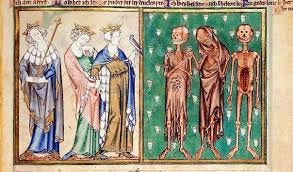
It’s probably a bit of both. What I do know is that I think that at this liminal period between seasons, when the days grow shorter and life burrows underground, we should remember our dead, both saints and the “faithful departed.”
For the next three days I’ll be commemorating the triduum by offering excerpts from the chapter “Allhallowtide” from my book, A Daughter Of Her People.
Who are your saints? Who are your faithful departed?
She sat on a duffel bag with her chin cupped in one hand, staring at the foggy horizon. Two children stood on either side of the woman; faces buried into her thin, corded neck. They seemed to be one body.
Her face wore the hard-bitten air of all settlement women, although she could not have been over thirty. They reached maturity by the late teens and soon after, their faces sank into deeply grooved impassive masks. Only the eyes occasionally betrayed the eager, lively girls they once were. Jed and Max had seen hundreds of such women in their younger years. They had all melded into one gray, seamed, underfed mass.
Jed parked on the opposite shoulder of the road.
“This could be an ambush,” Max cautioned. His hand floated over his thigh pocket.
“Don’t be dramatic, there’s nowhere to hide,” Jed snapped.
Even so, he approached cautiously. Settler women were especially unpredictable. An unhinged settler woman was a handful.
After a few seconds, Jed ventured a question. “Madam, are you waiting for someone?”
Max was a meter behind Jed, to his right, hand on thigh pocket. Just in case.
The woman didn’t answer. Jed and Max looked at one another and shrugged. The children turned their faces to Jed. They did not look alike; the girl had abundant auburn hair and sherry-brown eyes, while the boy had lank blond hair and slate-gray eyes, but their twinness vibrated with a silent, pulsating intensity. Their eyes searched the brothers with a frank, neutral, child’s curiosity.
The woman’s gaze shifted to a spot on Jed’s forehead. “Can you drive us down the road till it branches off?” She had the affectless voice of someone who existed only to get to the next place.
“Sure,” said Max. “When is that?” “About ten miles.”
The boy/ girl twin-pair scattered like petals off a shriveled flower as she unfurled her willowy body in segments. She had been sitting on a duffel bag. Their worldly possessions.
Max swung the battered bag into the trunk, and they took off.
Diagonal ribbons of shadow striped the land; in the streaks of light, dry grass the color of a crisp, astringent pale champagne sparkled. An occasional lone cottonwood stood in the distance—always in the distance, like scoping from the wrong end of a telescope.
The road wound around the hills and at each turn, Jed hoped to see a landmark, but at each turn he saw none. The further he went, the road snaked towards even vaster expanses, and he became riddled with an anxiety no alcohol replacement pill could calm. Would this land never end? He felt the shimmy in the rear axle. They’d have to look at it when they got to—where? He bore down on the gas pedal.
Max explained the right-hand rule to divert the children.
“OK, so there are three quantities, and they run along these things called axes. The x, y, and z axes. Now they stand for this: the magnetic field, velocity and force…”
The children gave little gasps of amazement and their faces were rapt with enchantment as he explained the structure of an atom, focusing on the electron.
“OK, so an electrical charge travels in a direction. It can go up a wire, so pay attention to this little electron thing…” He held his thumb up and curled his fingers. “My thumb is the wire and the direction where the electrons flow, and my fingers are the concentric circles of the electrons.”
The boy became giddy with glee, while the girl watched, experimenting on her hands. Jed glimpsed her in the mirror, practicing.
Thoughtful child.
Another hill, another endless expanse. Jed’s heart sank.
Max reached back to curve the boy’s fingers around the imaginary wire. “This looks like arid land,” he ventured.
The woman didn’t respond.
“How much rain do you get here?” he persisted, with tight lips. A rebuff from a settler woman was galling.
After a minute, she answered, keeping her eyes on the road. “Very little.”
“Do you know how little?”
“Never measured it.”
Max whispered, “bitch” under his breath and stabbed a button on the console. A song blared out. Halfway through the song, he slapped at the button and it turned off.
The woman seemed to relent. “We raised some crops,” she said, the tone of her voice conveying the futility of the attempt. “Soil’s rich and fertile. Look at this grass. But the weather’s so unpredictable you can’t plan from one year to the next. There’s rivers and creeks. You can farm the bottomlands. But these hills can’t be farmed. That’s whut saved ‘em. Only part of the prairie with the native grasses.” Her eyes never moved once from the window.
She clammed up again.
Max wanted to ask where her husband was, but the question withered in his throat.
The woman became jarringly animated. “Here it is! The turnoff! Stop!” she said, pointing to a green metal placard dating from the Before, almost flattened to the grass.
“We’ll get off here,” said the woman. “You go that way.” She pointed to the branch of the road bearing northwest. “You’ll reach an old house on the left side of road where you can stay the night. You can’t miss it. It’s at the bottom of a terrace.”
“Where are you going?” Jed asked, braking. He would have missed the sign if not for her warning.
“To the Sisters,” replied the woman. “Please, let us out!”
“Don’t you want us to drive you?”
“No.”
“A house?” asked Max, suspiciously.
“It’s empty,” said the woman, with a shrug. “Been for years, not even the ghosts bother it. It’ll be colder tonight than yesterday. You’ll have to shelter somewhere with the wind being the way it is. We need to get out now! It’ll be dark soon!” She swiveled her cranelike neck towards Jed and said with dead earnestness, “Do you want to spend another night outside?”
A hard gust snapping against the windshield supplied the answer. The woman and her children didn’t react, but Jed, Max and Hannah flinched. Jed envisioned the car blown off the road and smashed into the hills like a tin can.
“Lady, it’s getting dark,” said Max, grimly. “We’ll take you to your sisters tomorrow. C’mon Jed, let’s stop the discussion.”
Jed started the car, bore left, and sped up a short ascending road.
“Don’t park the car at the bottom of the terrace,” the woman cautioned. “Find the side road that leads to the back. Stop there.” She appeared resigned to spending the night in the house.
Jed followed instructions and parked between the house and a massive stone building. Even at this perilous moment, he wondered what purpose the gargantuan building served, but he put the thought aside as he contemplated how to get everyone to the house. The wind had picked up.
Thankful they did not have to struggle up the terraces, he grabbed Hannah’s hand and forged forward at the head of the group. Each held another’s hand and a slithering human rope, lashed by the whipping, squalling wind, forged forward. Max swept from behind. They reached the front porch. Max broke away and prepared to kick the thick carved mahogany door with desperate force.
Jed put his hand on Max’s shoulder. “Let me try first.” He tested the brass knob with a practiced touch. With a warning squeak, and a sighing rattle, the door popped open. The weary group tumbled into the foyer, disturbing the still, chill air of the house with the noise of humanity for the first time in decades. The stale, rank frigidity assailed them. Darkness enveloped them.
The woman and her children disappeared into a room to the right of the foyer. Jed, Max, and Hannah staggered into the room on the left, and they threw off the burden of travel as one body. They rolled out their sleeping bags and sank to the floor and slept, entwined for warmth, shivering, all modesty cast away in the freezing gloom.
As the night deepened, the Angel of Utopia Parkway floated above Max, watching over them, changing shapes and hair colors, from soft wavy brown to dazzling white. She wore a schoolgirl’s modest uniform and a translucent slip of flashing diamonds.
Jed heard the incessant tap of dripping water, that unmistakable noise, so small, so vital. The cold drove him back into the refuge of sleeping bodies.
Hannah gasped awake and punched. She was being suffocated. No—Jed’s arm was pinning her, and she wriggled out from under it just as Max was throwing a woolen blanket in her direction. It hit her with the force of a blow, and she threw it off, but the cold air slapped harder, and she dove back under the scratchy, thick blanket.
This was All Hallows’ Eve, the night when the five youngest men in the village kept vigil at the watchtower on the top of the mountain. They stood in a row facing east, to greet the sunrise. During the night, village men joined them at hourly intervals, and by daybreak every man in the village had assembled, and the women and children met them as they filed down the narrow trail to the town square. The whole village proceeded down to the church, holding candles, and swinging incense bells to greet All Saints’ Day.
***
Nicely done with brisk writing and foreshadowing. I'll have to read the next two chapters.