Christopher Nolan: DEI Director
A Rambling Discourse On Art and Politics

I’m gonna get to Mycenaean genetics tomorrow. For now, let’s talk about the cultural phenomenon that is Christopher Nolan. This is going to ramble and sprawl. I’m not going to try to make it neat and pretty.
Do you remember Barbenheimer?
I didn’t think so.
Barbenheimer was a mostly astroturfed but partly genuine pop culture war between the movies Barbie and Oppenheimer. It really was a battle of the sexes, the boys against the girls. And there was the overlay of Christopher Nolan’s unique place in pop culture: he’s the thinking man’s person’s director. If you were a smart or a guy, you saw Oppenheimer. If you were a girl, or dumb, you saw Barbie.1 I saw Oppenheimer simply because I was interested in the subject matter, and didn’t see Barbie because I’m not. 2
Yet I cannot say I was unaffected by the noise. Of course I was! The noise was deafening to anyone remotely connected to the culture. I also had personal reasons to see Oppenheimer - my mother’s oldest sister went out with I.I. Rabi back in Brownsville (yes she did!), and her family went down the Ethical Culture route. So I was interested in seeing how Nolan handled that stuff. (Badly, as I write, here.)
Getting swept up by hoopla does a number on your judgement. You have a massive investment in enjoying yourself. I literally willed myself to become absorbed in the movie and I wrote something about it afterward: a rambling, incoherent mess that never said what I really felt:
This movie sucked.
Why I didn’t say that then? I think part of it is this: the movie came out on July 21, 2023 — that is, before October 7. I now look upon that halycon time as Europeans look on the lovely summer before the hell of World War One broke out on July 28, 1914.
Before October 7, my attitude towards artists (mostly) was, “Cut them slack. Look at what they’re trying to do. Be generous.”
After October 7, my heart and mind shrank to this: “Cut the crap. Say what you mean to say. And when I see something I don’t like I’ll call it out.”
And I’d had reservations about him before, but my pre-October 7 feeling was that you don’t hold against an artist what he fundamentally is. That way you can always be surprised. I’m not a huge Spielberg fan, as much as I admire his technical chops. And I think War Horse is one of the greatest movies ever made. I don’t care how sentimental and adolescent it is. It’s the only movie that left me blubbering incoherently.3
I saw it at home, not in the theater, so it wasn’t the spectacle aspect of the movie. It was about a boy, a war, and dumb beasts, dragged into the vortex of human insanity (as we all are?). It was nakedly heartfelt. Yet some called it manipulative tripe.4
That’s the point: art is 100% personal. It is not objective. And when you mix the obvious commercial aspects of film criticism into the mix, you get odd results.
Did you know that Steven Spielberg was once highly regarded not merely as a slick technician, but as the great (white) thinking man’s director? Hard to remember, but he really was. Then a malaise set in and suddenly the guy couldn’t catch a break. Now is not the place to examine this granularly but his original reputation was the guy who could fuse technical mastery with emotional intelligence and moral seriousness. You could eat your popcorn and chew it over after you left the theater.
Look at this run:
Close Encounters
E.T.
Raiders
Empire of the Sun
Schindler’s List
Saving Private Ryan
Minority Report
Munich
Munich came out in 2005. After that the critical conversation around Spielberg got weirdly muted. Not hostile, it just dulled. A classic malaise pattern. He became “the old master,” which is a polite way of saying critics stopped being excited by him. The culture moved toward irony, grittiness, hard focus, and self‑consciously “difficult” art. Spielberg’s sincerity, his sentimentality, his classical style — all of that started to feel out of sync with the zeitgeist. And then it was OK to criticize Spielberg and he got some real thumpings. It was almost like pent-up demand. I’m positive that many of these critics wanted to let it rip while he was on top of the world, but couldn’t.
When a director like Spielberg exits the stage, there’s a massive vacuum. Enter Christopher Nolan.
Memento5 hits in 2001, right as Spielberg’s critical aura is dimming. Nolan’s cold precision, structural games, and self‑consciously cerebral seriousness matched the new appetite perfectly. Show biz is based on the mythic arrival,6 and Nolan didn’t just arrive, he filled a vacancy. The prestige‑blockbuster mantle passes from Spielberg to Nolan because the culture changed, and Nolan showed up offering exactly what the culture suddenly wanted. Which is not to say he didn’t help to shape it. The zeitgeist met Nolan, Nolan met the zeitgeist, and it was a “beautiful friendship.”7
Not everyone was pleased. Some critics were never fooled, as Armond White hints in this brilliant evisceration, The Odyssey — the Twisted Epic We Deserve8:
Christopher Nolan’s The Odyssey sells IMAX, not cinema.
Nolan’s use of scale (the overmarketed IMAX viewing platform) perverts classical cinema as well as the literary classics. Nolan’s insensate followers — the Nolanoids — don’t appreciate great composition; their sense of aesthetics has been dulled. In their fascination with new technology, they forget what was achieved by David Lean’s enlarged aspect ratio in The Bridge on the River Kwai, Lawrence of Arabia, and Doctor Zhivago — the singular perfectionist visual craft as in Lean’s earlier small-scale movies.
No truer words were written. Quillette’s Claire Lehmann has been a huge Nolan fluffer and has engaged on X with critics in the dumbest ways. I’ll deal with her antics later, but for now, she wrote an entire error-strewn article in Quillette about the allegedly revolutionary story-telling effects of IMAX. How can I take this seriously? IMAX is in no way revolutionary. Sound was.
I find Nolan’s IMAX obsession combined with his aversion to CGI strange. Spielberg used CGI in the first 20 minutes of Saving Private Ryan. Not a ton. He used it like Sargent used white gouache paint on his watercolors - a technical no-no. “You’re not supposed to do that - watercolor is the art of light passing through the paint to the paper.”
Sargent: hold my beer.

Let’s look at how Nolan’s IMAX obsession destroyed Dunkirk.
Dunkirk, is one of the most famous events of World War II: Operation Dynamo, the 1940 evacuation of over 330,000 stranded Allied troops using a massive civilian armada of roughly 900 ships.
The film’s emotional climax hinges on the “Miracle of Dunkirk”—the breathtaking moment an overwhelming wall of civilian boats appears on the horizon to rescue the army.
Except on screen, it looks like a modest parade of maybe two dozen boats scattered across an empty sea. This happened because Nolan prioritized IMAX over CGI. This technical fussiness created a massive logistical wall. Sourcing, restoring, insuring, and coordinating 900 actual WWII-era boats on the ocean simultaneously was impossible. The production could only secure about 12 to 20 real historical vessels for the shoot.
Instead of using seamless digital effects to fill in the missing 880+ ships — a technique Spielberg used masterfully in Saving Private Ryan — Nolan simply filmed the small fleet he had.
Seriously, what was all that about, other than arrogance? Suspension of disbelief? If so, it failed. I did see this movie in the theater. Sitting in the audience, I thought of one of my favorite childhood books.
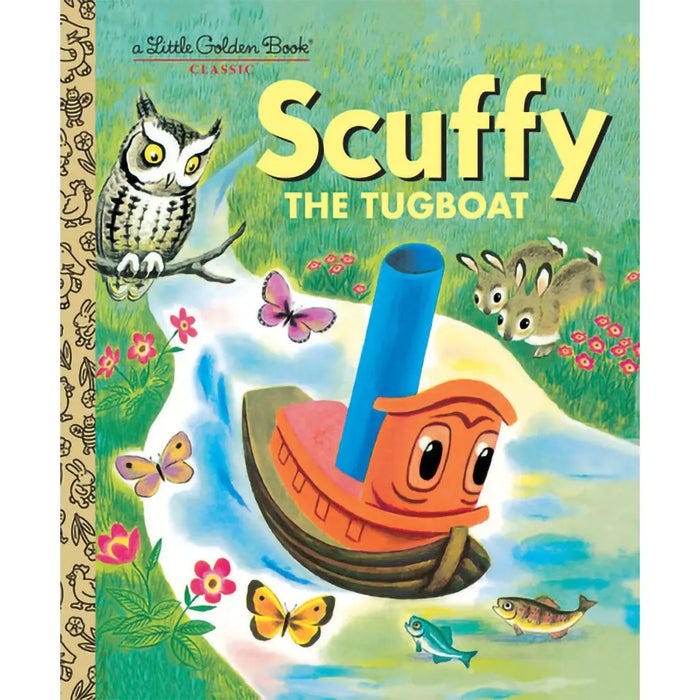
The result was a total mismatch between history and optics. By choosing camera purism over visual scale, Nolan delivered razor-sharp picture quality of a mostly empty ocean, turning a cinematic moment that required a staggering armada into a trickle of boats.
Yet I did see the movie — and Oppenheimer. Why?
Because I was still somewhat influenced by a specific segment of Nolanoids, his conservative fan boys (especially Steve Sailer, to whom I circle back in due course), and there’s something about them that we have to face head on:
Their white nationalism. These guys are very distressed by Odyssey. Steve Sailer has been tweeting and ‘Stacking about this movie obsessively. One senses betrayal. I’m going to use Sailer as my representative example because he’s the most prominent and he’s a decent film reviewer when he’s on his game, but there are others.
Here is Steve Sailer’s glowing review of Dunkirk, entitled “Nolan’s Finest Hour,” which must be read in its entirety to appreciate where they are coming from.
Less than half of the review is about the movie itself. The majority is prime Steve Sailer: industry and box office gossip mixed with culture-war and political ranting. The core is a response to a Time mag review which extravangantly praised the film. But something at the end enraged Sailer. This:
the picture is filled with great English faces. But to call them characteristically English faces is wrong. Remember, they’re supposed to be the faces of men who lived more than 75 years ago. Today, the face of England—like that of France or any other European country—is much more racially mixed. Love of country comes with no color or birthplace attached. Nolan doesn’t address that idea directly—the story of Dunkirk is almost exclusively about white men, something that can’t be changed after the fact.
Fair enough. If I had read this at the time, I’d have been enraged too. Yet is this shit enough to overlook the fact that the review was as much of a rave as his was? And that Dunkirk sucked because the first 100 minutes were turgid, dull, trash. Sailer:
“Nolan has stripped out traditional ingredients such as character backstory, motivation, and development. The central character, a very young soldier named Tommy (presumably for Tommy Atkins, the British equivalent of G.I. Joe), is merely trying to get home to survive.”
No character backstory, no motivation, no development… but it’s Nolan, so all good.
Here’s the truth.
Sailer (and other alt-right Nolanoids) worship Nolan because, in their fantasy world, he is a white man thinking white thoughts (abstraction and shit) who films white faces.
The worship is not about art. Nolan-mania is what white nationalists would give us if they ran a film industry.
And it’s a total fraud. As Tenet and Odyssey show, he wasn’t the guy they made him out to be. He’s just an ambitious director who wants to make blockbusters, and (in my opinion) not a very good one.
To call him this generation’s Cecil B. DeMille is to insult DeMille, whose movies were both ridiculous and thoroughly enjoyable. DeMille would have given us 900 boats, if he had to rope each on in personally. Or he’d have used CGI - and done it well.9
Isn’t judging a director by his (putative) politics at the expense of actually telling a story the very essence of DEI?
And isn’t excuse making also the essence of DEI?
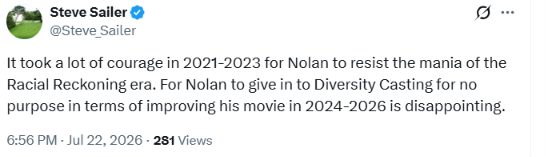
Tenet came out in 2020. It had a black leading man - which is fine, in my opinion, if it works. But not to Sailer. So he’s simply wrong on the history here.10
I warned you that I was going to ramble but there’s a time to call in the herd and I’ll wrap up now.
I admitted that I saw Dunkirk and Oppenheimer because I was influenced by the Nolanoid fanboyism. I should be honest: I share their resentments at racial bullying. My feeling about so called color blind casting (which is anything but) is: fuck this. Like Sailer, I, too, bristle at racial bullying. I am 100% opposed to DEI employment. Hollywood is now being suffocated by these rules. I hate them. So a little resentment is… OK.
But not at the expense of my genuine gut feelings. And my genuine gut feelings are that Christopher Nolan is not, and never has been a great, or even good, director.
Isn’t that what merit is all about?
I’m gonna sprawl a little more here.
I never judge art by its politics - even when I disagree with it. I don’t think necessarily the greatest art is apolitical. It can be but it doesn’t have to be. I don’t see the politics in The Wizard of Oz, or The Seventh Seal, my two favorite movies. Others might but I don’t. Nowhere. Nada.
But sometimes art is overtly political - and that doesn’t necessarily detract from it. It depends. Here is a great, left-wing movie that says everything I disagree with: l’America, by the Italian communist director Gianni Amelio.
L’america is a critique of capitalism, imperialism, and nationalism. It’s about rich bastards screwing poor people. I remember scenes and dialogue from thirty-two years ago—
I remember the whole story from beginning to end. I remember how it showed us how your very identity can be stripped from you if you lose your footing.
I remember a phantasmagoric scene of a little girl imitating Madonna.
I remember that an Albanian kid says to an Italian: “I’m going to go to Italy, change my name, and forget that I was ever Albanian.”
I remember the way Amelio goes straight to your emotions by focusing on the individual faces of the refugees on the ship to Italy at the end of the movie. I remember how the audience stuffed back tears. That montage of faces is what they show on those “Magic of Cinema” highlight reels — what the living dream of a movie can do with no special effects. Show you the human face and in a fraction of a second you see that face — and yourself.
L’america a left wing movie.
L’america is a great movie.
L’america is everything Nolan is not.
Once I stripped away the noise, the fan‑boy mythmaking, the racial resentments, the DEI trappings, the IMAX worship, the culture‑war drum banging, and my own pre‑October 7 generosity, what remained was the only thing that ever matters — my gut.
And my gut tells me Nolan was never the heir to anything. He was never the thinking man’s director, never the keeper of the cinematic flame, never the successor to Spielberg or Lean or anyone else. He was just a director I willed myself to admire until I stopped. And once I stopped, the entire scaffolding collapsed.
Next up: Mycenaean genetics.
If any of this has been useful, entertaining, or saved you from Googling something at 2 a.m., you can fuel the next installment on Buy Me a Coffee.
Which is how Nolanoids rationalize the fact that the girls won: while Barbie grossed $1.4 billion, Oppenheimer grossed $975 million, a difference of $425 million - nearly twice the budget of a tentpole. Oppenheimer’s $975 million is extraordinary for a three‑hour R‑rated biographical drama, but Barbie’s $1.4 billion is a once‑a‑decade phenomenon.
I’ve changed my mind and I will either see it at the Angelica or order it from the library.
War Horse was a horrifically difficult movie to make, as Rex Reed explains.
I can’t bear to quote from that disgusting review, but I will link to it out of intellectual honesty. Unsurprisingly, the jerkoff reviewer gave Odyssey a good review. You can look it up yourself if you care.
Almost everyone agrees that Memento is a smashing movie, even Nolan-haters like me. I can’t actually remember it - but I do remember being vastly entertained. It was a movie that said: “This is a huge talent. Pay attention.”
As Bruce Willis said: “You arrive. You bomb. You come back.”
Another apposite quote, this from Jean-Luc Godard:
READ THE WHOLE DAMN THING GUYS. YOU ARE UNDER ORDERS.
Holy frig, I just learned that DeMille’s mom was Jewish! Are we everywhere?? I honestly thought DeMille was the perfect antidote to “Jews control Hollywood.” Nope.
Steve Sailer has gone Odyssey/Nolan potty, with literally dozens of tweets about it. (I used “Nolan” as a search query so there are some strays about other Nolans but there must be dozens of relevant tweets.)