
Don’t worry, I’m not planning an untimely exit. I’m just acknowledging that today, the fifth of August, if statistics are any guide, I’m embarking on my third and final act of life.

Us old folks are supposed to talk about what we’ve learned.
I don’t think age confers any special wisdom. Many young people are far wiser than I am. Wisdom and its sister, patience, are probably genetic. I’m still the same impatient maniac I was at age five. Maybe worse. (OK, maybe not.)
The only thing I’ve learned is this: I have learned how little I know. I used to think I knew a lot. Now I see how little I know.
But what the hell, I’ll share with you some insights, and some of my favorite things. And slip in a little self-promotion.
I honestly have not cracked the code of just being myself. I’m always worried about the impression I make. Maybe by the end of my journey I will have learned to just be myself.
Which is another way of saying that I hesitate to write this but here goes.
Occasional cruelty is necessary in life. It should be rare as possible and never enjoyed, but it’s necessary. Consistently taking the high road, never wanting to engage with bastards, is avoidance and masochism. Sometimes you must engage with shits, and you will have to be a bastard. Just be smart, cool, and move on. Don’t gloat. Don’t get caught up in it. (There’s a lot of stuff written about engaging with consistently aggressive and hostile people which I won’t go into. I’ll just say for now that you need to learn this to survive.)
You’ve heard this before but you don’t believe it:
Most adversity is temporary.
NO, I am not saying “Don’t sweat the small stuff — and it’s all small stuff.” Certain things aren’t small stuff. That is beside my point.
But broken bones and stock market crashes are nothing.
(OK, not a broken hip when you’re 85, but a broken wrist… it’s nothing.)
I broke a wrist in the winter of 2011 and, being the impatient asshole I am, I was outraged. How dare my wrist get broken just because I did something stupid!
Believe it or not, I actually look back on my rehab with a weird fondness, perhaps because it was my left wrist (I’m right hand dominant) so not terribly disabling. It was in winter and I later associated the process with cozily sheltering indoors and getting stronger.
One day, it was over. I even used the experience in writing my books. “Turn pain into cash,” as Woody Allen said. Well, I’ve sold hardly any books, so not a lot of cash, but I enjoyed writing about the part where the silly heroine breaks a wrist during a failed escape attempt. Being 14, she thinks the world has ended:
Pain engulfed Hannah. She wanted to die. She was beaten.
But she survives and later looks back on the experience fondly:
She stretched her left wrist, more out of habit than need, and a warm hazy glow of nostalgia stole over her. How insane was that? Did she actually miss the cast, the debility, the injury?
Hannah recalled every detail of the accident, the terror, the memory of the pain, but somehow, every step had turned into a hilarious adventure: having the cast put on, visiting the car museum, driving through one unreal place to another with her wrist propped up, Luz’s village, cutting off the cast and exercising it with Max, pushing her wrist against his hard shoulder... It had become a warm memory that brought a smile to her lips.
The stock market (and with it, most of my crappy 401K) is in the shitter. I don’t like it but I don’t care. It’ll rebound. The Big Guys will take this as an opportunity to bargain hunt. Even if it doesn’t, losing money isn’t going to make me lose my real wealth: what’s between my ears.
Do you remember the part of It’s A Wonderful Life where George Bailey learns that his life mattered, and he runs home, and says:
“I’ll bet it’s a warrant for my arrest. Isn’t it wonderful? I’m going to jail!”
That’s how I feel now. Half my stocks crashed? I didn’t get dragged into Gaza on October 7th. I ate some ice cream today. Isn’t it wonderful?
A lot of people say that the point of It’s A Wonderful Life’s story is that suffering brings wisdom. Nah. Suffering per se doesn’t bring anything other than suffering. George has suffered all his life. There is no meaning to it. In fact, his insensible suffering has made him fragile. He covertly resents his life and when he undergoes a financial setback he wants to kill himself, ostensibly out of rage and shame, but really because he’s hated his life all along. He downgrades his accomplishments. His story is: it’s all worthless.
Then the teacher appears because the student was ready. OK, the Clarence thing is a vehicle, but the point is: George learns the meaning of his suffering, and from that, he becomes wise.
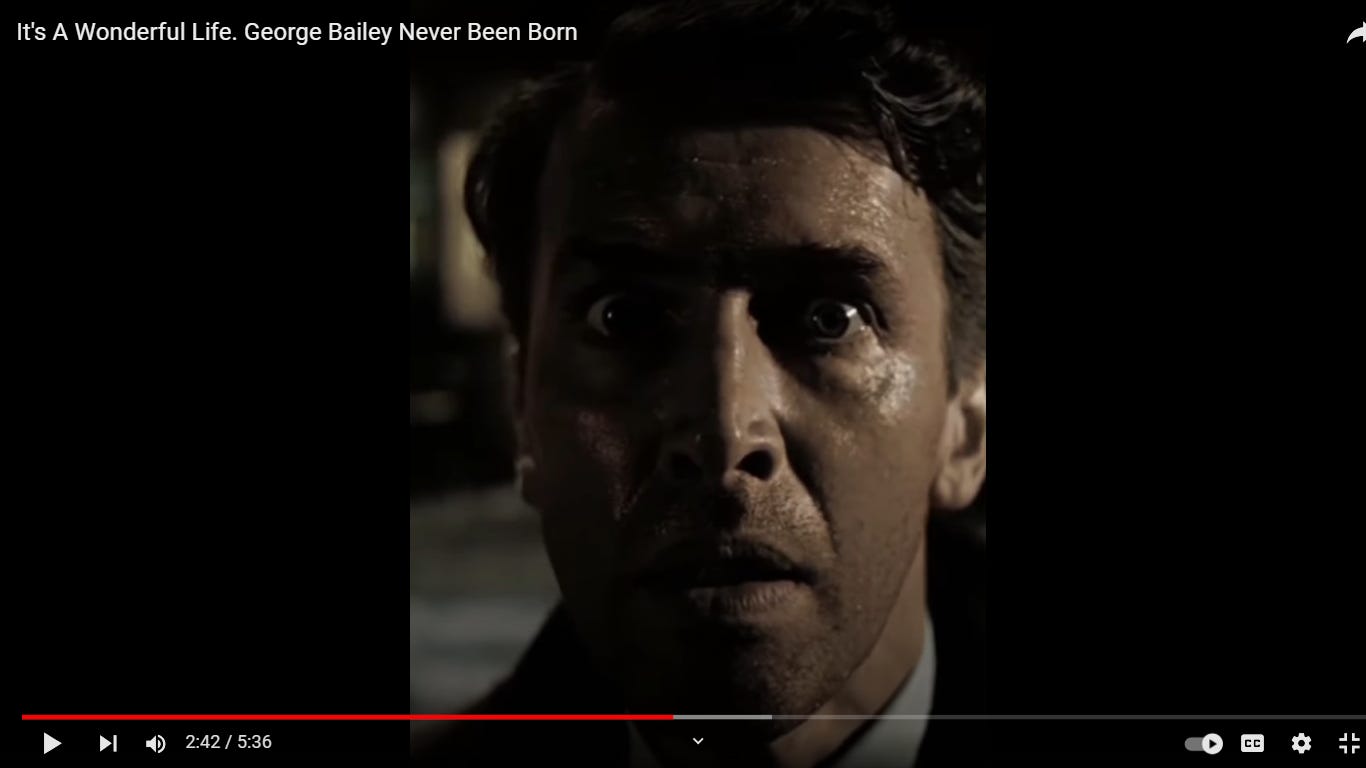
The above graphic is a fleeting few seconds from a more than five-minute long video in this great movie. In my humble opinion this is the part of the movie that makes it the transcendent work of art it is. Everything in the movie is a prelude to this — it’s that awful moment (at 02:35) after George’s mother slams the door in his face. He dashes out into the cold, looks around, and sees for the first time. He is sick. He is stunned.
Stewart does some of the greatest screen acting ever in these few seconds.
I remember seeing Stewart on TV once years ago talking about movie-making. He died in 1997 so it would have been in the early 90s. No URL, sorry.
He said that it’s not scenes that make movies. It’s seconds, parts of scenes, brief flashes here and there, that make a movie.
So true — how many movies have you watched that are composed of beautifully composed scenes, and they add up to nothing?
Maybe that’s true of all great art. Seconds, not scenes. But the scenes make the seconds possible.
I came across George Balanchine’s Serenade by sheer accident as a teenager, on television. That’s a long story for another time. Briefly, I bought a ticket to a live performance as soon as I could. It might have saved my life.
Of all George Balanchine’s works, Serenade provides as close to a spiritual experience as can be found in ballet
It is. This is not a ballet. It’s a spiritual experience.
This video was made in 1986, three years after his death. The dancers were all chosen and trained by him.
The below video was made in 1973, during his lifetime. He hated it because of all the quick cutting and jumping around, but I love it because it was made under his supervision in the early 70s, when the dancing at New York City Ballet had reached a crazy peak of greatness. Both performances are wonderful but to me, the 1973 one has that sublime Balanchine touch of the mad scientist/demiurge of the body.
Serenade was another thing I had fun writing about in my books.
The action takes place in the middle of the next century, and my little anti-heroine comes across the 1973 video. There’s no ballet in her world, no performances, nothing like this. She’s stunned by what she sees:
Hannah traced a finger across the screen and counted seventeen girls in four rows.
A crashing wave of sound burst out from deep bass strings and washed over the stage. The music ebbed and flowed, and the girls covered space with dazzling speed, as an ocean wave covered a shore and pulled back, revealing sand in different configurations. They were cool and self-possessed. These girls swam in chilly waters. They carried unknowable secrets. A girl darted out of the collective, exploded into a solo of controlled frenzy, and melted back into the ensemble as it flowed on. They were not encased in the confining cages of the bodice and tutu costume.
“I see you!” shouted Hannah. “I see you! I see you!” She shot up and bounced around the dark room in manic glee and skittered back to the flat screen— hovering both hands over the screen— joining their mystical sisterhood of satin, suffering and moonbeams. There were no black swans or white swans. There were only women.
Finally, a Joni Mitchell song.
There’s been a Joni Mitchell resurgence in the last few years. I was part of the first Joni Mitchell brigade of neurotic college girls back in the 70s. Then I got turned off to her. I couldn’t listen to her for years.
I still feel that a little of Joni goes a long way (for me), and I understand why she branched off into jazz — someone as talented as she is couldn’t keep digging the same hole endlessly — but it’s not my cup of tea.
Still, she’s a genius. Fortuitously this came across me yesterday. I’d totally forgotten it. I think it’s one of the greatest songs she ever wrote.
Also love Serenade and everything Balanchine.
Joni Mitchell... same here. Loved her, let her go and came back to her. Still love Blue and Hejira (less popular).
Sad that you are leaving here...
I wanted to respond to your Nova piece, but didn't. Will still do it if you leave it up.
I have always been myself not caring what others think. I always carry the heavy price for it and preparedness to be ostracized and to be alone.