
No offense to any wandering Aussie who happens to read these words. Far be from me to tell anyone what to think and how to handle his or her country’s history. All I can say is: we are all in the same boat. All countries are cults. All peoples are cults. We tell ourselves stories to survive. I can’t tell you what story to tell to give your life meaning. You can’t tell me. And as an American, who am I to lecture anyone?
I’m just pointing a few things out.
Let me get something about sensitivity nomenclature out of the way. I will say what I want, how I want to. This I have some experience with, both personally (see below) and with Native Americans, another story for another time. I understand that some words (“half-caste”) are hurtful. There’s no need to use them when there’s a more current word that conveys the same message. But the concept is valid. There are mixed race people. Let’s talk about it. Being mixed-race is simply different from being full-blooded and denying this is distorting.
Plus I won’t give in to the left. I know the way they work: the first order of business is controlling the language. Certain words are badthink and can’t be used.
Let me give an example that is more subtle than excluding a phrase like “half-caste” but it’s still rankles me: I’ve gathered that the very word Aborigine, a noun, has become tainted and now you must use the adjective “Aboriginal” instead. And even that isn’t good enough anymore. It’s all about discourse control. Once one term is adopted there’s no end to the rapid mutation of new correct phrases, so now “Indigenous” and “First Nations” have replaced “Aboriginal.” I’ve nothing against “Aboriginal” or “Indigenous” when appropriate, but I will never use the phrase “First Nations,” is a naked, virtue-signaling imitation of Canadian usage, and artificial there, but again, another story for another time.
Using the adjective “Aboriginal” as a direct substitute for “Aborigine” (“John is an Aboriginal”) sounds awkward to me. John is an Aboriginal what? A book? A table? Isn’t it obvious that John is an Aboriginal person, and why not simply say “John is an Aborigine”?
It reminds me of the sensitivity around the word “Jew.” Sometime in the 1950s nice liberals got the idea that calling a person “a Jew” was offensive so they came up with “Jewish person.” “Jewish person” makes me want to vomit. It’s OK, you can call me a Jew. Just don’t use it as a verb. At least, not in my presence.
Links in bold.
Today is Australia Day, but because Australia is 15 hours ahead, I’m late to the party. I’ve been brooding about the subject and nothing coherent has formed, so I’m just going to offer a few observations with no real conclusion.
From what I gather, this year the party is full of rage. The official website of Australia Day reveals some of the story: it begins with an elaborate “acknowledgement of country” and a picture of an Aboriginal woman.
Meanwhile, all the major cultural institutions big names are embarrassed about it. Ash Barty ignored Australia Day on her Instagram account. The Australian Ballet snubbed it:
The Primrose Potter Ballet Centre, on Kulin Country, is open today as our dancers and many of our staff have elected to work. We recognise and pay our respect to First Nations people who have danced their own stories on this land for millennia before us and their ongoing connection to community, culture and Country.
A dance company practicing a European art form in a society founded by Britain is apologizing for its existence? OK…
The Sydney Symphony ignored it, but they did acknowledge the Lunar New Year with a nice “Gung Hey Fat Choi.”1
I didn’t have the heart to look up any other Australian institutions. They’re probably all the same. They either ignored the day, or said something cringeworthy.
I hope I’m wrong, but I think the fix is in, and that Australia Day is marked for extinction. It’s now Invasion Day. When the right people want something, and the wrong people don’t, that’s what goes down. Have your barbie in your backyard (who knows? they might invent a reason to arrest you for that, fire codes or something) but no more fireworks, no more parades, no more celebrations in magnificent Sydney Harbor. Your story has now been disgraced and replaced.
When stories get replaced, can peoples be far behind? I don’t know, but I do know this, Kaitlyn decides these things, I do not.
Above, I almost asterisked the word “Aussie.” Robert Hughes, the great Australian art critic, hated the word. No link, sorry, but I clearly remember one article in which he sneered at the word. True, Hughes sneered at a lot of things, but that one stuck in my memory. Maybe I remember it because in the same article he used the word “Yank.” That didn’t go down well with me. I didn’t like him much when he was around, but now I miss him.
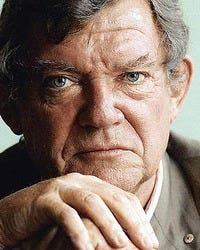
Seems to me Hughes is an almost-forgotten figure, which is a lesson in sic transit gloria mundi but in his time, he was BIG, let me tell you. He was one of those New York City-based critics who exercised enormous influence, famous beyond his field, and although he wrote for the middlebrow Time rather than the snooty New Yorker, he commanded as much respect as Pauline Kael2. You could call him the Pauline Kael of the art world, hurling contrarian, learned thunderbolts, hated, but the guy you had to read. His books sold millions, he had TV deals. The Shock Of The New was a mainstream hit.
While known primarily as an art critic, he was one of those unique people who truly are their own brand, and in 1986, his book about Australia’s beginnings as a penal colony was published to great acclaim. Because of his fame and prestige, The Fatal Shore was a “you had to read it” book. I tried. I dipped into it several times and put it aside. The subject was too demanding, too tragic, and I didn’t have the bandwidth to give it the attention it deserved. Of course, all books, even by unique contrarians, are products of their time, and something in Australia must have been changing, but The Fatal Shore decisively pushed what was once repressed front and center.
Live long enough and time catches up with you. I got to it a week ago. It’s a brilliant book and you know what?
Robert Hughes would be canceled today. The times have changed so radically (it’s that good old shock of the new) that the premise of the book, not to mention its very language, is now wrongthink. The premise being that the country was indeed founded in 1788 with the arrival of the “convict hellships”3—not sixty thousand years ago. Australian Aborigines simply do not figure in his narrative except as victims. His focus is entirely on the creation of Australia’s white working class, of which the convicts were the forgotten, repressed substrate.
Here is a glowing review published by our own Trotskyite friends of the World Socialist Website, in 1999,
A superb history of Australia's founding
In the opinion of this reviewer, a work based on The Fatal Shore would be of enormous interest—it reveals a chapter in world history that is not widely known, or that is usually presented largely in clichéd form.
First published in 1986, the book is horrifying and humorous, at times touching and at others inspiring, and is thoroughly absorbing.
The review mentions Aborigines twice.
All that has been turned upside down. The white working class is now villainized as part of the racial caste system that enslaved Aborigines. They had “white privilege.” Aborigines, once thought of as several hundred (nobody knows how many) loosely related clans are “First Nations” and Australia was founded 60 thousand—70 thousand—some claim 120 thousand—years ago by the “oldest culture on face of the earth.” (Yet another story for another day, but I have some questions about this study.)
It's not as if Hughes ignores Aborigines; they are mentioned repeatedly but always in the context of being usurped and replaced. They are victims. The effect of “invasion” (yes, Hughes uses this word, more than once)4 is absolutely represented as catastrophic for them. He is sympathetic. Hughes was writing from the post-1960s lens of a man who was steeped in post-colonial theory, even if he was a heterodox thinker. He sugarcoats nothing—but to Hughes, Australia begins with the convicts, and for this, he would be canceled.
Not to mention his interpretation of Aboriginal culture as brutal and basic, which has now gone out the window. Nope, Indigenous culture was both sophisticated and egalitarian, we are told. Endlessly.
It is always distortion to cherrypick quotes, but I will cite Hughes on the position of Aboriginal women, because this passage sums up his and every anthropological observation ever recorded:
However, the unalterable fact of their tribal life was that women had no rights at all and could choose nothing. A girl was usually given away as soon as she was born. She was the absolute property of her kin until marriage, whereupon she became the equally helpless possession of her husband….
The purpose of betrothal was not, however, to amalgamate property, as in European custom, but to strengthen existing kinship bonds by means of reciprocal favors. It did not change a woman’s status much. Both before and after, she was merely a root-grubbing, shell-gathering chattel, whose social assets were wiry arms, prehensile toes and a vagina. (Bolded for emphasis.)
Hughes, Robert. The Fatal Shore (p. 50). Knopf Doubleday Publishing Group. Kindle Edition.
Moreover, Hughes describes Aborigines as peculiarly vulnerable to domination in a way that the Maori were not. While the Maori were “brave and bellicose,” “subtle, determined and ferocious,” Aborigines were:
ill-armed, backward, and timid; most of them ran at the sight of a white face; and they had no goods or property to defend. Besides, there were so few of them.
Hughes, Robert. The Fatal Shore (p. 106). Knopf Doubleday Publishing Group. Kindle Edition.
To be fair to Hughes, the previous passage describes British attitudes and not his, but he offers no mitigating distance between his interpretation and their opinions. He seems to endorse them.
This, too, has been chucked out in favor of a resistance narrative. Now there are books about Australian “frontier wars.” I dunno. I haven’t read deeply about this, but none of it strikes me as comparable to the wars against the Comancheria. To paraphrase a famous Australian, “Now that was a war.”
Hughes is a good liberal, deeply anguished about the fate of the Aborigines, honest about their horrible treatment, but the verdict is that a powerful culture engulfed them and the results were inevitable.
Also, the subtitle of the book is “The Epic of Australia’s Founding.” You don’t write epics about genocide.5
Cancelled!
A book written in one decade, then considered to be the epitome of progressive thought, can be overwhelmed and turfed out by subsequent events.
Anyway, the Aborigines weren’t “doomed,” as Hughes said. History is full of surprises and the Aborigines are now front and center in Australia.
But what is an Aborigine? It’s a fair question to ask and therefore, forbidden. So I ask it. Increasingly, I see people like this espousing the most radical agendas.
He runs an organization that is pushing for a treaty with Aboriginal Victorians.
There seems to be a direct relationship to white blood quantum: the more white blood, the more extreme.
How legitimate this organization is I have no clue. Maybe Victorians think of him and his posse as a bunch of harmless cranks. I think that’s wrong—one group may not be much of a threat, but a lot of them can cause trouble with endless lawfare.
I don’t think they get direct public funding, but I noted that most of its activist leadership has jobs in other Aboriginal organizations which undoubtedly do. In other words, the organization is composed of political operatives with time to push a radical agenda. All paid for by the Australian taxpayer.
The more I looked at this, the more I saw that there’s an entire layer of NGO organizations that employ white people with distant Aboriginal ancestry, making identity politics demands on the Australian state and people. This is a crazy situation that can’t end well.
Symbols have substance. Once Australia Day is gone, white Australian history will have been recast as genocide and the identity of white Australians is reduced to that of a criminal and an illegitimate squatter.
White Australians will never escape this. Once it’s done there’s nothing left for them but to apologize endlessly, pay rent—or leave. (And who will take over? Take one guess.)
It’s not for me to tell other people what their national holidays should be, or to decide for them how they should interpret their past, but I have a suggestion to patriotic Australians who want to keep their culture.
Number one: stop apologizing. Stop rationalizing. Don’t brag about your “Indigenous” friends and how much you care about them and bitch about how bad things are in Alice and so on.
Two and this is more important: change the interpretation of January 26, 1788. It’s the date the First Fleet arrived, 750 convicts in tow, trailing their shackles, having survived a hellish eight-month voyage chained belowdecks. Four months in port, followed by eight months on the open seas. Three times longer than the ghastly Middle Passage that brought Africans to the New World. And they didn’t even have the advantage of being precious cargo. If they died, so much the better.
Celebrate that. They want to talk about “Survival Day”—fine. Celebrate your survival.
And mark the date that Australia created its own citizenship January 26, 1949. After nearly half a century of federation and giving more than your share in two world wars. Celebrate that.
Changing the interpretation strengthens your case, your identity, and undercuts their logic—but they won’t stop, because their goal is to destroy Australia.
They not only hate Australia and want to destroy it, they hate white people, with a completely racialized hatred. All the acknowledgements in the world will not satisfy them—on the contrary, it just whets their insatiable appetite for more. They don’t want justice, which would be to take their place along other Australians as equals.
Power is never satisified. There’s always a new horizon.
Happy Australia Day.
Happy Survival Day.
The bottom of their website has the now customary genuflection: “Sydney Symphony Orchestra acknowledges the Gadigal people of the Eora Nation, the traditional custodians of this land and water. We pay our respects to their Elders past, present and emerging.”
Kael, too, has been covered over by the sands of time, but (and this is a reverse of the way things usually work, gender-wise, she had a group of male acolytes—”the Paulettes”—who have tended her flame, while Hughes died very much a lone wolf.
Anthony Burgess, from I forget where. One of his essays.
“Hundreds of tribes existed at the time of white invasion—perhaps as many as 900, although the more likely figure is about 500.” (Hughes, Robert. The Fatal Shore (p. 40). Knopf Doubleday Publishing Group. Kindle Edition.)
Hughes did a TV series about Australia in which he dismissed the notion of any comparisons between what happened to the Aborigines and the Holocaust quite testily, while having total sympathy for the sense of Aboriginal alienation from mainstream Australia.