
I’m still shaken by what happened to Debrina Kawam. I’m gathering my thoughts.
In the meantime, here’s something about a forgotten movie from 1974, Harry and Tonto, which I saw when it first came out in 1974. I’ve loved it, hated it, and now I’ve made my peace with it. I saw on television a few days ago, which brought this on. The movie is about a lot of things, among them, aging and homelessness, which meshes with Debrina’s horrible fate. But for Harry, homelessness becomes an opportunity for a journey, while for Debrina, it was the abyss.
I’m also still gathering thoughts about Elon, MAGA, H1B, and the grooming scandal in UK.
If I told you the Oscar nominees for Best Actor in 1975 were Art Carney for Harry and Tonto, Albert Finney for Murder on the Orient Express, Dustin Hoffman for Lenny, Jack Nicholson for Chinatown, and Al Pacino for The Godfather II and I asked you who won, you would probably say:
“Nicholson. For sure. He won Best Actor at Golden Globes, BAFTA, New York Film Critics, and National Society of Film Critics. The movie’s a classic. It was directed by Roman Polanski. John Huston was in it. C’mon!”
I’d say, “Sorry, no.”
“Hmm… OK, it was Pacino. Godfather II, Coppola, another classic. Definitely him.”
“Guess again.”1
I’ll cut to the chase. The man who won the Oscar for Best Actor in 1975 was Art Carney for Harry and Tonto.
Now you’re saying, “Harry and Tonto? What the fuck is Harry and Tonto?”
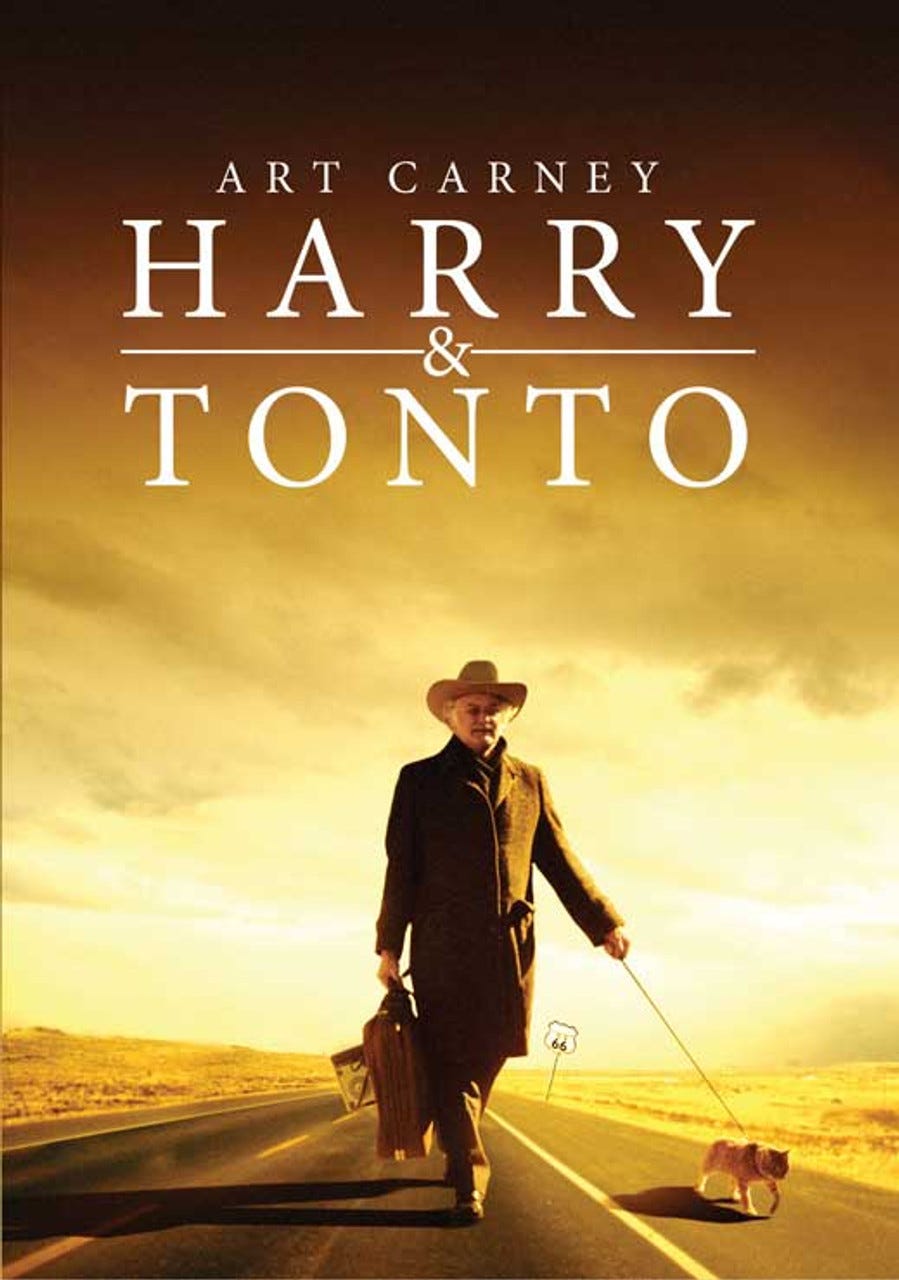
It’s a movie directed by Paul Mazursky, released in 1974, and Art Carney won the Academy Award for Best Actor, beating possibly the most prestigious competitors in the history of the competition. That’s what it is.
But to fully answer that question, let’s back up and set the scene.
The 1970s is often called Hollywood's “Second Golden Age.” An amazing explosion of talent: Scorsese, Spielberg, Coppola, Robert Altman, Hal Ashby, and others emerged, blending personal vision with studio resources. American directors pushed boundaries with grittier, character-driven stories, often influenced by European cinema (which had been heavily influenced by post-war American film noir2), a case of mutual cultural cross-pollination.
Paul Mazursky was firmly in this mix. His films often had a more comedic and humanistic edge compared to the intense realism or cynicism seen in, say, Taxi Driver or The Godfather. Mazursky was known for capturing middle-class anxieties, relationships, and generational conflicts, blending humor with emotional depth. Films like Bob & Carol & Ted & Alice (1969) signaled the changing mores of the late '60s, while Harry and Tonto (1974) and An Unmarried Woman (1978) were key contributions during the New Hollywood era.
Harry and Tonto is an especially interesting ‘70s movie: a road movie about an old guy and a cat. It’s one of my favorite 70s movies, although some of it makes me cringe, and there’s a major credibility issue in the story line. It’s often called “an understated gem” — when it is referred to at all. Usually if it is remembered, it’s to point out the unlikeliness of Carney’s win as Best Actor against a slew of New Hollywood heavyweights.
The film tells the story of 72-year-old widower Harry Coombes, a retired teacher now living alone in an apartment in the crumbling ruins of 1970s Manhattan with his cat, Tonto. He spends his days kibitzing with friends in the park, avoiding muggers, and being the wry observer of life. He’s the epitome of the ordinary, decent man. When his building is knocked down to build a parking lot, Harry and Tonto take refuge with Harry’s son in the Jersey suburbs. That doesn’t work out and thus begins the odyssey of Harry and Tonto, who go off to look for America.
Harry is not rootless; he has three children, to whom he has close, albeit fraught, relationships, and his reconnection with all three (the aforementioned New Jersey suburbs, Chicago, and Los Angeles3 ) provides the loose structure of the movie.
Mazursky’s films had a bittersweet quality, making them critical favorites but not candidates to achieve the cult status of flashier contemporaries. Harry and Tonto is a tender exploration of aging, independence, and the search for connection, but its quiet tone doesn’t resonate with today’s audiences who lean toward more bombastic storytelling.
I’ll describe what I especially liked, then I’ll give my reservations.
I thought the sense of place, or rather places, was spot on, and that’s a rare talent in a moviemaker. I remember NYC from that era as if it were yesterday. Mazursky captures it uncannily well and not merely because he filmed in NYC. I've seen lots of movies that were filmed in NYC and they don't necessarily convey the feeling of a lived-in place. You just see a place on film and due to the magic of photography, it looks real. But it doesn’t necessarily look lived-in. In the early scenes, the ineffable feeling of NYC-ness in the 1970s is overwhelming.
There's one scene in which, after being evicted, Harry trudges up two flights of stairs with an equally elderly landlady to look at a dreary one-room apartment in a crappy tenement. It's shattering to think that this cultured, genteel man is going to end his life in such a dump. You can almost smell the musty air and feel Harry’s despair at the prospect of living there — and his quiet elation at being told pets aren’t allowed.
The sense of authenticity carries throughout the movie. I’ve been to all of the locations except Chicago and I can vouch. From the New Jersey suburbs to the Southwest, to Las Vegas and onto Los Angeles — in each place you really feel that you're there.
He looks up an old girlfriend in Indiana, first going to a run-down working-class part of town where a woman of the same name lives. She turns out to be a different woman, a black grandmother who Harry catches coming back from a hard day’s work cleaning houses. She always gets the old girlfriend’s mail and tells Harry where the old girlfriend is: in an old-age home across town.
A scene like that (white man lost in a careworn black neighborhood) can go badly wrong. Not here. Mazursky nailed it, physically and emotionally. Harry’s journey is a textured tapestry of real places, filled with both beauty and decay.
He finds the old girlfriend and the emotional weight of revisiting the past, time's unrelenting passage and how people and places change, usually not for the better, is shattering.
Here’s what I didn’t like.
At the beginning of the movie, there’s quite a bit of cheesy banter between Harry and his Polish friend about their past sexual exploits and current lack thereof. I get the idea but here, it felt out of place. I thought Mazursky was trying too hard to inject “edginess” into the dialogue and it clashed with Harry’s proper demeanor. Harry doesn’t seem like someone who would be comfortable engaging in those types of exchanges, so it felt forced or inconsistent with his personality.
On the other hand, you could say that Harry was simply humoring his old friend, who was clearly a bullshitter. That works. But later on, when Harry buys a used car, it happens again. Those crude asides aimed for a slice-of-life moment, but repeated throughout the movie, they veered into enough already territory. It’s like Mazursky didn’t quite trust the subtlety of Harry’s journey to hold the audience’s attention and leaned a bit too much on this recurring motif of aging and sexuality, which felt heavy-handed. I think I’m on firm ground (sorry) because there was a highly unrealistic scene with a prostitute — but I’ll leave that out.
I have a more serious objection. Ginger, the hippie girl he picks up hitchhiking, is a 16-year-old runaway. Her age is stated twice: once to Harry, once to his daughter. Both register shock. Yet she continues with Harry to Colorado, in fact, accompanying one of Harry's grandsons to a commune. It’s simply false to say that people became aware of the age of consent recently. In 1974, the age of consent in Illinois was 17.
This was a glaring lapse in realism, not to say moral accountability. Harry is proper and conscientious, so for him to essentially brush off such a serious issue is deeply inconsistent. Even if Mazursky was trying to make a point about generational clashes or Harry’s evolving openness, it feels like an irresponsible narrative choice.
In one scene they share a motel room. Of course, she flashes her tits at him, being a hippie, and he delicately turns away. Nothing untoward happens, but the optics alone — an elderly man traveling with a 16-year-old runaway — are pretty squirmy. Harry’s passivity in the face of such a serious situation undermines the careful character work Mazursky did in other parts of the film. It almost feels like the film is too focused on the quirky road trip vibe and ignores the real-world consequences of Harry’s actions.
Honestly, it’s a flaw in the storytelling and I’m not sure if it’s fatal, but it is a flaw. If both Harry and his daughter are visibly shocked by Ginger’s age, that acknowledgment should come with some kind of action or at least a deeper reckoning. Their reaction shows they understand the gravity of the situation, yet the film just... moves on? That’s irresponsible, both in terms of character development and the broader moral stakes of the story.
Mazursky wanted to have it both ways: acknowledging the uncomfortable truth of Ginger’s age to make the characters seem grounded and aware, but then sweeping it under the rug to preserve the whimsical, episodic tone of the movie. That kind of tonal dissonance is jarring, especially in a film that otherwise strives for emotional authenticity.
I don't think it undermines Harry's character, but Mazursky didn't exercise discipline, restraint, or judgement. He was trying to throw it all in there in a big countercultural stew.
He could have changed her age to 18. He could have easily had a short scene where Harry takes Ginger to a police station and says goodbye. Changing Ginger’s age to 18 would have been a simple fix that wouldn’t have altered her character arc or Harry’s dynamic with her. Alternatively, showing Harry taking her to a police station would’ve been a great moment of integrity and decisiveness for his character, while still maintaining the bittersweet tone of the film. Either option could have resolved this ethically and narratively without derailing the story.
Mazursky let his ambition get the better of him here, trying to cram in too many themes, characters, and storylines without fully considering how they all fit together. (Later in the film when Harry is shown being the object of a gay pass that he doesn’t understand. Realistic, but maybe that, too, was a darling that should have been killed.)
It’s entirely realistic that a 16-year-old was on the road in 1974. I just don’t think that it was realistic to have Harry facilitate this. A real Harry Coombes would have said, “Ginger, I’m taking you home.”
That said, I recommend Harry and Tonto for its strengths and flaws. Ironically, making Ginger underage does point out the bad parts of the counterculture. It had a lot of great things but ultimately it couldn't form the basis of a stable society.
So, it’s worth watching not just for its strengths but also as a reflection of its time, flaws and all. Ginger, while problematic from a storytelling perspective, does unintentionally highlight one of the darker aspects of the counterculture: its cavalier attitude toward boundaries, responsibility, and societal structure. The ideals of freedom and self-discovery were inspiring, but without a foundation for stability, or respect for basics like age of consent, those ideals exposed vulnerable people to tremendous harm. Ginger was lucky she ran into Harry. She could have ended up in the trunk of someone’s car.
It’s ironic, too, that Harry, the stand-in for the older, more traditional generation, doesn’t step in to impose those boundaries. It almost underscores the idea that the counterculture’s influence had even reached someone like him, making him passive in a situation that would normally demand action.
Lastly, Harry and Tonto was made in 1974 and although much has changed, this 1974 movie is still, I think, recognizable as part of the present. There’s a continuity between then and now.
I happened to see another movie recently, The Inspector4, a British thriller made in 1962, with Stephen Boyd and Dolores Hart. Although it was made only twelve or thirteen years before Harry & Tonto, it looks like, and was, from a totally different era in filmmaking and society. It might as well have been made 40 years before Harry and Tonto, not a dozen.
1962 and 1974 are so close chronologically, but culturally and cinematically, they feel worlds apart. The early ’60s were still steeped in the post-war sensibilities, with more formal filmmaking styles and narratives, whereas by the ’70s, the counterculture and social upheavals of the ’60s had thoroughly reshaped how stories were told.
The Inspector carries that polished, almost stage-like quality of many early ’60s films, where there’s a clear sense of structure and restraint. In contrast, Harry and Tonto, with its looser narrative, flawed characters, and gritty realism, is firmly in the land of New Hollywood. Twelve short years. A different world.
The present era of movie-making is often lamented for its dependence on cartoon-based “tent-pole” superhero (and heroine) extravaganzas. Maybe it’s the only way that filmmakers can escape from the 1970s and tell stories in their own voice. What a pity.
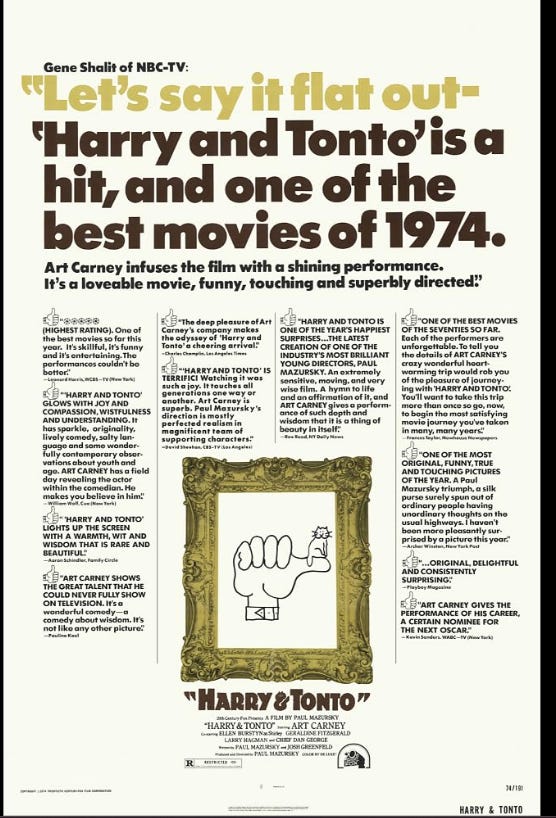
More fun facts: Celia, the woman who is feeding cats at the end of Harry and Tonto is played by Lenny Bruce's actual mother. Eileen Burstyn, who played a supporting role in Harry and Tonto, won best as best actress for Alice Doesn't Live Here Anymore, a real 1970s classic.
Interesting that a quintessentially American film genre is known by a French name, non?
Larry Hagman plays the flashy son who lives in LA, and in my opinion, gives not only the standout performance of the movie, but one of the best performances of the 1970s.
Released in the US as “Lisa.”
Well done. I'll have to see it. Arty Carney was always a fav in my parent's house for his roll in The Honeymooners. In the 1970s my friends and I often went downtown to the movies and saw some great ones. It truly was a golden age in that regard.
Your writing is always a superb injection of wit, erudition, philosophy and perception, into my "every day is like every other day" life. This one was excellent, as always, but I must confess to experiencing some emotional residues dripping from an occasional word, phrase or thought. Tomorrow is the anniversary of the death of the only beautiful part of my life, my beloved wife. And so as I read about this film - which I have never seen - thoughts of the Art Carney character somewhat resonate. I am older than the film character, have zero family, still have several cats and a few dogs from my animal rescue days, and occasionally wonder why I keep trying. The answer is, that I must take care of my wee flock, lest they be left as orphans. And admittedly, my mood is chilled by the icy outside temperature piercing this very old house, and my having another attack of a charging rhinovirus, which reduces my normally positive outlook. But all that having been said, I suppose this was just my way of saying how marvelously your gifts and talents serve in touching deep reaches within the reader, bringing forth thoughts, reflections and even moments of wonder, and for that, I thank you quite humbly. Oh, and the old phrase, "Kill Your Darlings" would have been perfect as a title for an Agatha Christie novella.