
First, I’d like to thank the people who have donated on Buy Me A Coffee and taken out subscriptions. I appreciate it tremendously.
We don’t know yet who is the suspect in the Jackson, Mississippi synagogue bombing and I refuse to guess at motive because of that. That’s the way to end up with egg all over your face.
This was put on X, and then it turned out that it was an image from France in 2024.
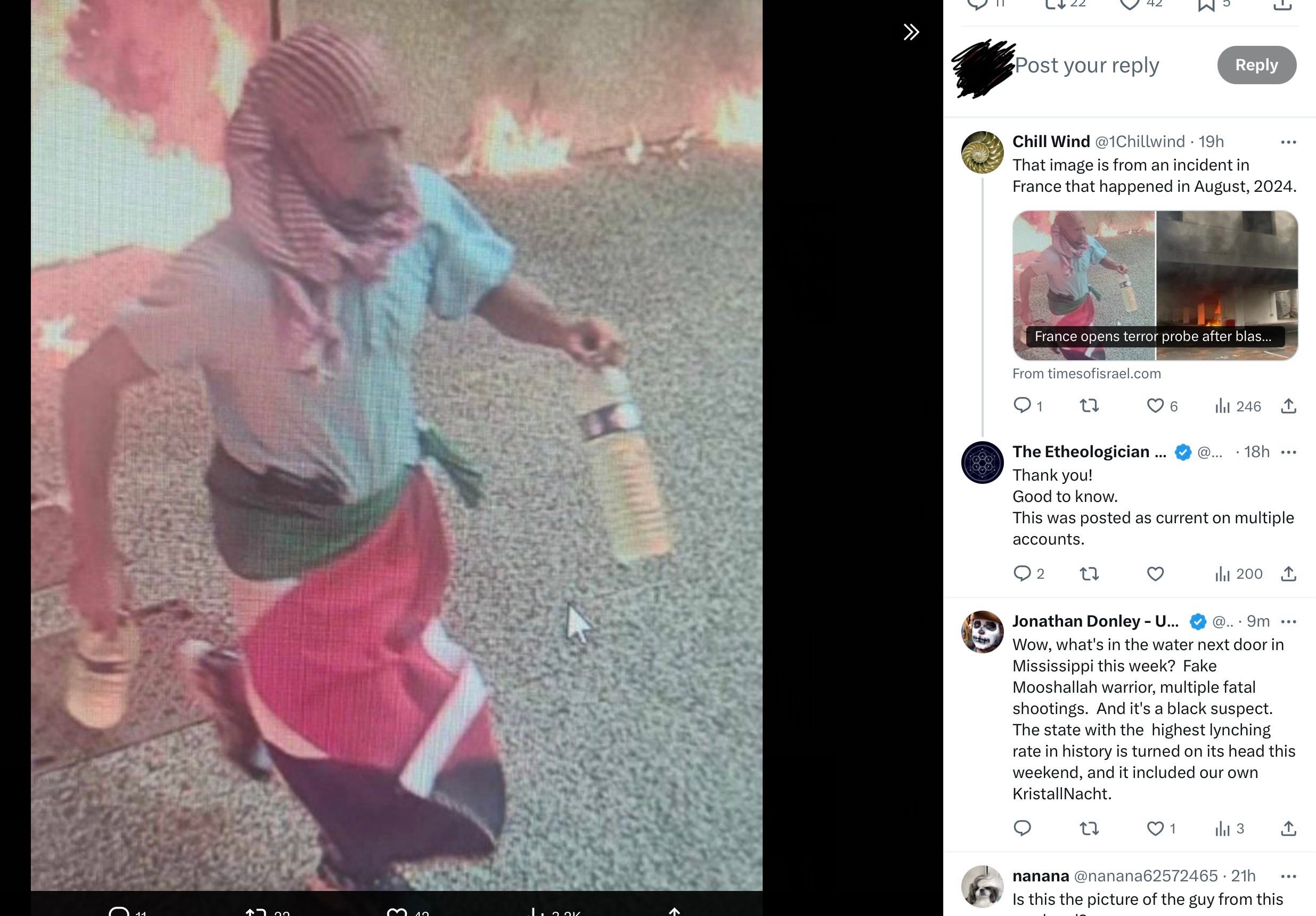
Let’s wait to form conclusions until the suspect has been named. I hope it’s soon.
It’s been noted several times that the synagogue was bombed in 1967 by the KKK because the rabbi was outspokenly in favor of desegregation. The article quoted a congregant, who “lives in Madison, a suburb north of Jackson, with his wife and five children.”
This piqued my interest. Why would there be a synagogue in Jackson with a congregant who lived elsewhere?
White flight. The rabbi made have preached desegregation, but the Jews of Jackson voted with their feet.
Following a 1970 court decision that mandated the full desegregation of Jackson Public Schools, white parents in the area increasingly sought other options. Many Jewish families participated in the exodus, either enrolling their children in private schools or relocating to the growing suburbs. Jackson itself began to lose population around 1980, a trend which continued into the 21st century. The 1993-1994 religious school roster for Beth Israel Congregation reflects both the process of white out-migration from Jackson and the city’s heightened role as a hub for Jewish Mississippians. Of the 108 religious school students listed, a majority (66) lived in Jackson, with 31 from nearby suburbs and the remainder (11) from more distant small towns.
In Selma, the epicenter of the modern civil rights religion, site of the Edmund Pettis Bridge, there’s a disused synagogue, Temple Mishkan Israel.
For more than 120 years, Temple Mishkan Israel has stood on Broad Street in the heart of Selma, Alabama’s downtown corridor, serving as the spiritual touchpoint for the thriving Jewish population that called this Black Belt city home. Today, only three Jews are left in the city of Selma – but the historic Temple Mishkan Israel structure remains, serving as a rare and stunning monument to Jewish life in the Deep South.
If only three Jews are left in Selma, use of the present tense (“serving”) doesn’t apply.
Selma, Alabama is one of only a handful of cities in the nation where the Southern Jewish experience intersects with a place so synonymous with the American Civil Rights Movement. In recognition of these interwoven narratives of history, The Selma Temple seeks to help usher in a new chapter for Selma.
OK, but Selma is a mess, and the Jews of Selma weren’t necessarily on board with the civil rights movement which, like other Southerners, they regarded as an intrusion of Northern culture and power in their way of life. I don’t agree with them, just pointing out that many Southern Jews felt that way.
Jews were extremely prominent in Selma civic life. Extremely.
At the same time that Jews encountered success in the business world, many became civically involved in Selma. In the late 1800s and early 20th century, Jews populated municipal positions like City Attorney, Water Commissioner, the Selma City Council, and the Selma School Board. Selma has seen three Jewish mayors: Simon Maas from 1887 to 1889, Marcus J. Meyer from 1895 to 1899, and Louis Benish, from 1915 to 1920. Born in Bavaria in 1845, Simon Maas was a dry goods retailer, while Marcus Meyer was also a German immigrant and owned the M.J. Meyer Stable and Harness Company on Water Avenue. Unlike the other two, Louis Benish, who owned Benish and Meyer Tobacco, was a native-born Alabaman.
Like other southern Jewish communities, most of Selma’s Jews maintained a complex relationship with both the segregationist and integrationist camps during the civil rights movement. In January of 1956, members of the Selma B'nai Brith lodge issued a declaration urging groups like the American Defamation League and American Jewish Committee to avoid intervening in affairs outside of the Jewish community, particularly on the issue of civil rights. This statement represented a broader antipathy of southern Jewry against northern-dominated Jewish groups’ intervention in their affairs. Yet, sociologist Marshall Bloom estimated that less than a fifth of Mishkan Israel’s congregants during the era could be described as segregationists.1
As individuals, Selma’s Jews held a wide range of stances towards the civil rights movement, from opposition to tacit accommodation to outright activism. Sol Tepper, a member of the Selma Jewish community, was an ardent segregationist. A member of Mishkan Israel and a WWII veteran, Tepper was a vocal foe of integration efforts in Alabama. His role as a spokesman for the segregationists transcended the boundaries of the Selma Jewish community as he wrote dozens of editorials for the Selma Times-Journal. When Martin Luther King arrived in January 1965 for his now historic voter registration campaign, Tepper, as part of the County sheriff’s posse, helped make many arrests of activists. His zealotry against civil rights workers was so intense that the sheriff’s deputy remembers having to restrain Tepper from handling his M-1 rifle at a demonstration. From the first inklings of the Civil Rights Movement in the 1950s to the aftermath of “Bloody Sunday” in 1965, Tepper unwaveringly represented white resistance in Selma, even as he did not represent the views of most Selma Jews.
Like I said, complicated.
More about Selma here.
I still don’t care about Renee Good, excuse me, the honored graduate of Vibes U. We’re not supposed to “say her name” — this phrase is reserved for black women only.
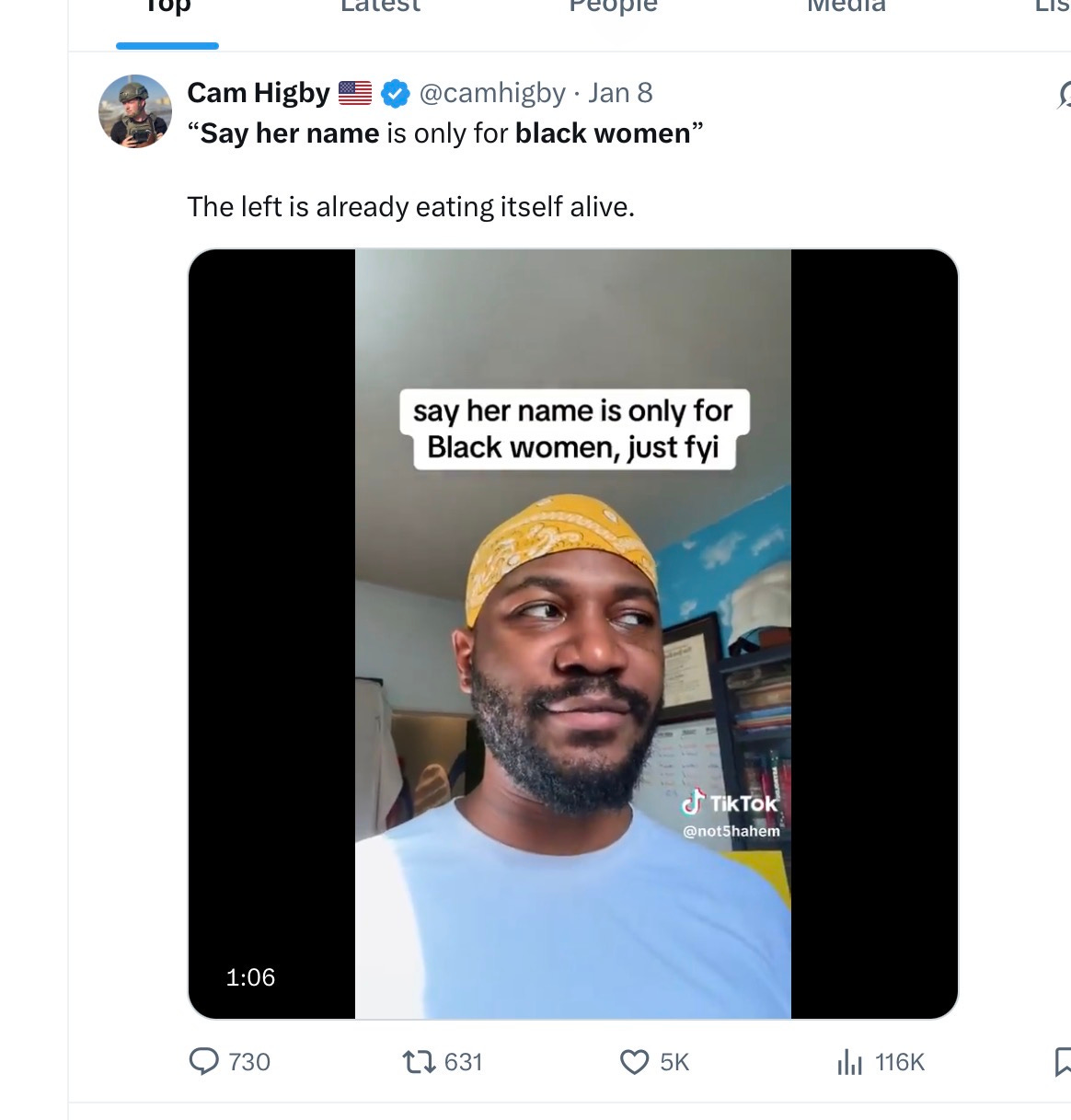
I’m OK with that.
I’m a hard core believer in optics. I had a fight with Jupplandia about optics, or as we used to call it, appearances.2
Sending heavily armed men into residential neighborhoods doesn’t look good, and to the extent we don’t need it, we should stop it.
Also: bullying Denmark looks bad. I wish Trump would cut that shit out. Denmark is our ally and friend, and a model European country. I’m positive we can work out a deal where we put a friendly footprint in Greenland. This is Bad Trump. It makes it so hard to support him, and I don’t care about impressing Mean Girls. I only care about squaring Trump support with my conscience. This makes it hard.
Odds and ends. Placeholders.
I think Naomi Wolf is onto something here.

Honestly this reminds me of something Anthony Burgess wrote about in The Wanting Seed: he foresaw a war fought by men on one side and women on the other. It doesn’t seem so crazy now.

Finally, Shipwreckedcrew on what’s really going on here: a fight for sovereignty. And right now I think Trump is winning battles and losing the war.
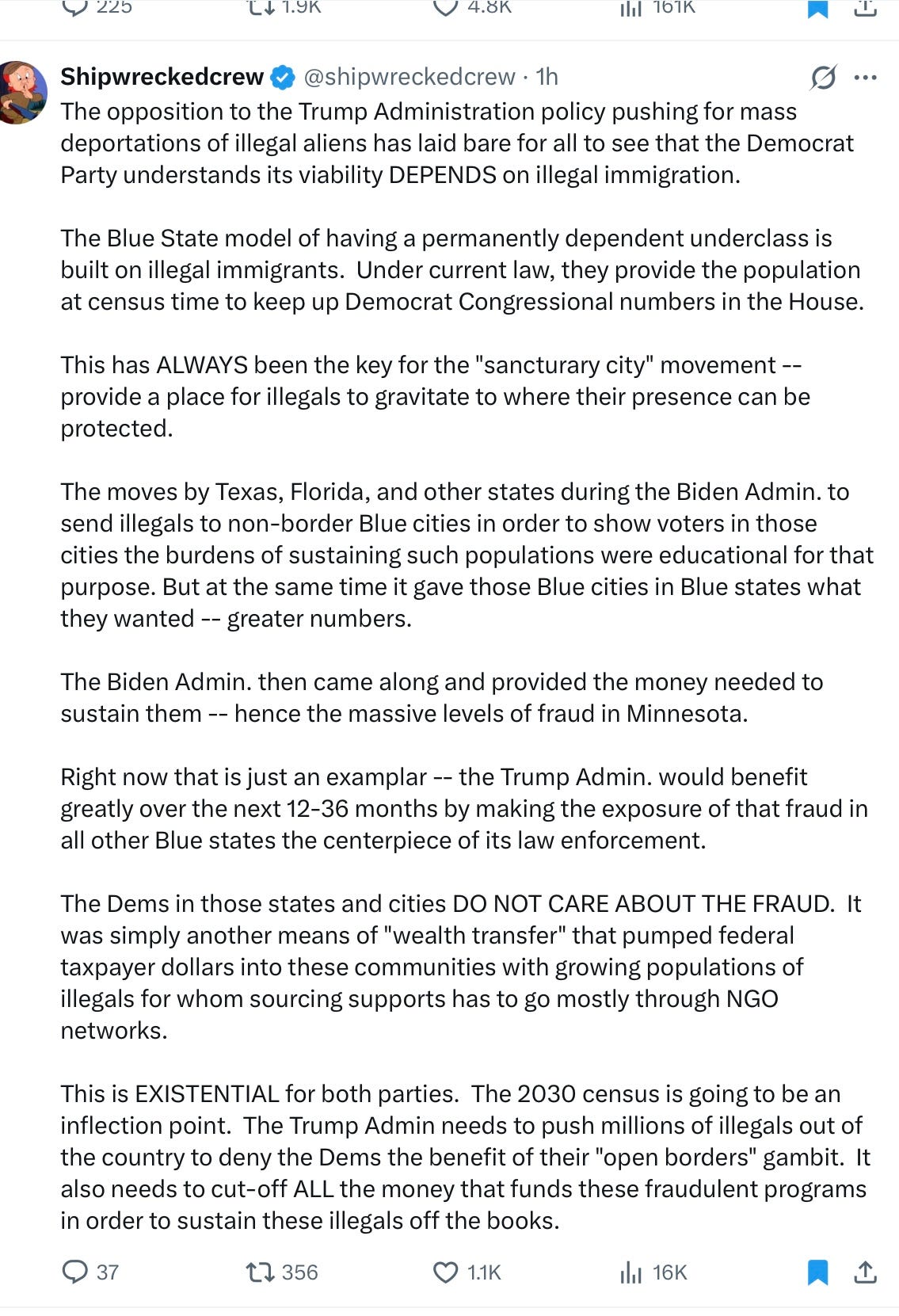
The sole reason why Eric Adams, an otherwise conventional and cowardly Democrat, was attacked by the Dem establishment was because he vocally opposed this. For that one act of political courage, he was indicted and his career aborted.
Interestingly, he hasn’t gone off to die. He’s still making waves. I think he’s planning a comeback. I might actually vote for him, although I thought he was a clown when he actually was mayor.
I would much prefer to vote for a sane Republican but that’s too much to ask for the party in NYC. So Adams it might be.
Fair, but it depends how the word “segregationist” is defined. Keeping the old (illegal) Jim Crow laws? Against. Leaving after desegregation? In favor. Also, Bloom was hardly objective. He came with biases and confirmed them. Jews were not “tokens” in Selma — they were pillars of a racially segregated society.
He’s great, I agree with him about most stuff, but I think optics are important. Our fight was about Zelensky’s humiliation in the White House — I thought it was mean spirited. Also, he contradicted himself, criticizing Zelensky for attending a meeting in the White House dressed in fatigues. I agree; he should wear a suit. So, aren’t optics important?