
Thomas Friedman is now in the news because of the Adelaide Writer’s Festival. When I think of Friedman I think of the first Gulf War, because of something he wrote, which has stuck in my mind since I first read it.
No sooner did I hit “publish” than the suspect in the Jackson, Mississippi firebombing was named. I’m not discounting the societal influences (we should look at his online activity — did he guzzle up Candace Owens? Fuentes?) — but he was 19, the prime age for schizophrenia onset. Also, on X, which could be totally wrong, someone said that he suddenly quit playing baseball. This is a signal symptom of schizophrenia — withdrawal from social activities.
The usual monsters and ghouls on X snidely blamed his upbringing, but I doubt it. I grieve for his parents. The synagogue will rebuild. His parents lives are shattered.
The Gulf, the Jews, and Israel
This has languished in my “drafts” pile for months. I was motivated to bring it up now because one of the most tenacious groyper myths is that our “forever wars” were because of Israel.
It is true that Jewish neocons have been obsessive about hectoring us into wars. I have used the word “warmonger” more than once to describe them. But since we have entered Tuckerland, where facts are your feelings, let’s review what really happened between Gulf I and Gulf II. What follows is one average person’s memories of how things unfolded. Perhaps in the corridors of power things were different, but this is how I saw it.
Saddam Hussein invaded Kuwait on August 2, 1990. Bush Senior was president. He condemned the invasion but was reluctant to intervene militarily. The world was shocked, but a war wasn’t the first thing on the table. People forget that.
The US ambassador to Iraq was April Glaspie. Never was there a more representative example of a US foreign service Arabist than this lady. On the very day of the invasion (it went on for a few days), she had a meeting with Saddam. This quotation became notorious:
“We have no opinion on your Arab-Arab conflicts, such as your dispute with Kuwait. Secretary Baker has directed me to emphasize the instruction, first given to Iraq in the 1960s, that the Kuwait issue is not associated with America.”
That really hit us like a thunderclap. There was a vague assumption that the US would “do something” and this was such an open admission of realpolitik it was simultaneously covertly applauded — and publicly condemned.
Glaspie was accused of having given tacit approval for the Iraqi invasion of Kuwait, which took place on August 2, 1990.
“Accused of having given tacit approval…” Indeed she was, and I distinctly remember thinking that whole thing was incredibly unfair. Glaspie was not a policy-maker, she was a diplomat tasked with communicating US policy. She was being blamed for framing a policy of what was termed “appeasement.” And again, covertly, we all thought that what she said was common sense. Someone really should write a book about this crazy juxtaposition of public disapproval and private relief. Maybe someone has.
The point is: the situation was very fluid. People were shocked, didn’t quite know how to react… and the man in the White House was a measured diplomat who wasn’t screaming hellfire and brimstone. He was feeling out the situation. His Secretary of State, James Baker, was a crafty guy who didn’t give away much. (He was without doubt the guy who told April Glaspie what to tell Saddam, and who hung her out to dry.)
This was all BI: before the internet. Cable was well established, as was talk radio. Rush Limbaugh had millions of listeners, but he was focused on domestic issues and didn’t get involved in foreign stuff much. And in any case, he was more a follower than a rabble-rouser. I can’t remember one time where he got in front of the president. That would have been thought, in those ancient days, insubordination. There was no X, not even Usenet newsgroups. Public opinion was then relatively “pure” - not contaminated by influencers.
In the midst of all this the UN did its thing but that’s not my game here, which is to give you what I remember.
On August 8, 1990, George Bush gave a televised speech announcing the deployment of U.S. troops to Saudi Arabia under “Operation Desert Shield.” He did say: “No one commits America’s Armed Forces to a dangerous mission lightly... There is no justification whatsoever for this outrageous and brutal act of aggression.” Again, I remember it. His tone was firm, but not bellicose. He emphasized peace, international law, and regional stability. There were no lectures about democracy. The idea at that point was to show force. Saddam was not to go one inch further. Nothing dramatic.
The turning point came on August 26, 1990, Margaret Thatcher said, “This is not the time to go wobbly, George,” in a phone call to Bush. And the rest is history.
Again, I must stress that perhaps this is the story we underlings were fed from the major media. Who knows whether classified documents show a different picture? But that’s the way I remember it and the records backs me up.
What were the Israelis doing in all this? Not much.
Here’s where my terrific memory for details and my strange new respect for Thomas Friedman, who was then the Times’ Beirut guy, come in. I had a hard time finding this, but I did. You can find it on Proquest.com, in the NY Times database. I accessed it with my New York Public Library card.
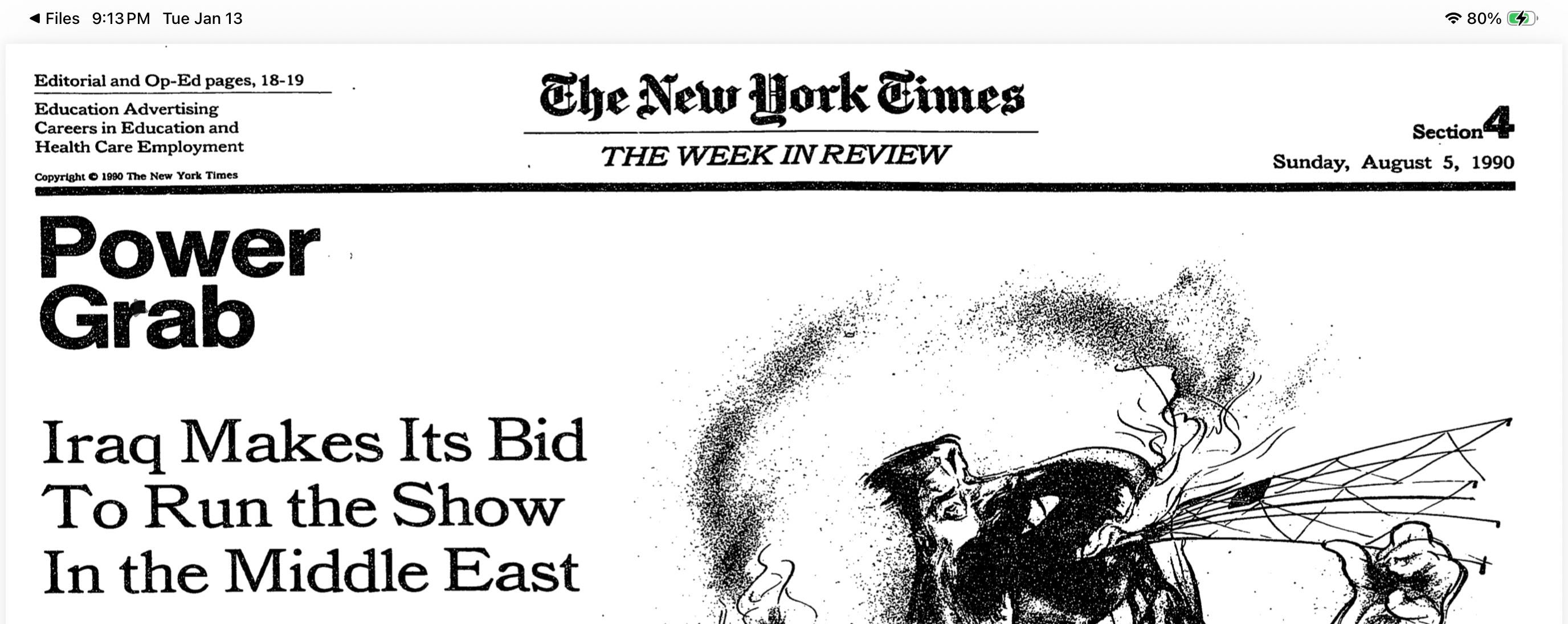
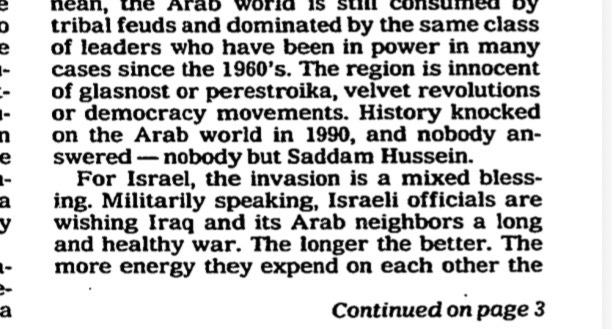
LOL, “Israeli officials are wishing Iraq and its Arab neighbors a long and healthy war.”
In other words: “Stay out of it. Not our business.”
And after the shock wore off, that was really the feeling on the street, in NYC. It wasn’t just isolationists like Patrick Buchanan and Joseph Sobran who thought it was none of our business. I don’t know one person who was waving the flag about bringing democracy to the Middle East. That came later.
The run-up to the war dragged on from August 1990 to January 1991, during which “published opinion” was actively and aggressively being shaped. The Administration thrashed about for a rationale. At one point James Baker said, “Jobs jobs jobs.” Oil was explicitly rejected as a rationale because that was too crass. But ordinary people were savvier than the pundits. I remember the lady at the desk next to me at work saying, “We need that oil.” Of course, in retrospect, it wasn’t just about oil. It was about power. Whose Gulf was that? Ours. Not Saddam’s.
It took a lot of top-level diplomacy to put together that coalition and find a rationale. They finally settled on the old standby: Saddam was the next Hitler. No one really fell for that. But the die was cast.
The propaganda was hot and heavy. The Kuwaiti babies BS, right in front of Congress. That was a big water cooler subject. People fell for it! I would have except I was going out with someone at the time who called bullshit.
“What’s the first casualty in a war?” he asked. (Truth.)
During the shooting war, Israel was hit with forty or so missiles in a couple of dozen attacks but there were only a few indirect casualties and some injuries. The Scuds were very inaccurate. Under PM Shamir the Israelis exercised restraint and did not retaliate. The difference between the silent, disciplined Shamir and Netanyahu, who injects himself into every discussion relating to the Middle East, is breathtaking.
In March 1991, immediately after liberation by coalition forces, Kuwait expelled 287,000 Palestinians in one week to retaliate against Yasir Arafat’s vocal support for the invasion. Some had fled beforehand. Another Nakba.
American Jewish support for Gulf I was high, but no more than the rest of the country. (That changed in Gulf II — I don’t want to get ahead of myself — but the supposedly trigger happy Jews were against the second Gulf War.)
Now, here’s the most important part: although the victory was smashing (and shocking, people like Edward Luttwak predicted a defeat!), we felt a bit cheated. After building Saddam up as the next Hitler, leaving him in power felt fake. Many Americans—especially in military and conservative circles—felt the war had stopped short of its logical conclusion. That feeling, “we didn’t finish the job” was real, widespread, and politically consequential. I think it contributed to his loss at the hands of H. Ross Perot — another story for another time — but it should be noted.
This is where Bush the Elder’s weakness as a communicator come in. Mostly his foreign policy was wise. He just didn’t bother to explain it to the people. He was not a Trump figure who had a mystical connection with a base. He was a patrician establishment figure.
That was the prologue to Gulf II. To be continued. Revisiting this is draining.
TL;DR: War fever got ginned up; the war ended with a military victory but a moral defeat, and the people were itching for a second act. Simultaneously an articulate, well-placed clique in Washington was given a Cause they could rally around. They spent the next eleven years churning out articles about it. Then came September 11 and they had their irresistible hook.
Why the strange new respect for Thomas Friedman? It’s a bunch of things but mostly it relates to his unpopularity among hasbaristas. I’m totally fed up with their gatekeeping. He was right about Gaza turning into a quagmire. He’s full of shit on some stuff but he’s been right about a lot. I refuse to preface a quote from him with a prophylactic excuse.