Last Tango In Gotham
An Elegy, by Luke Ziminski

Part One: Zohran Mamdani, Irishman
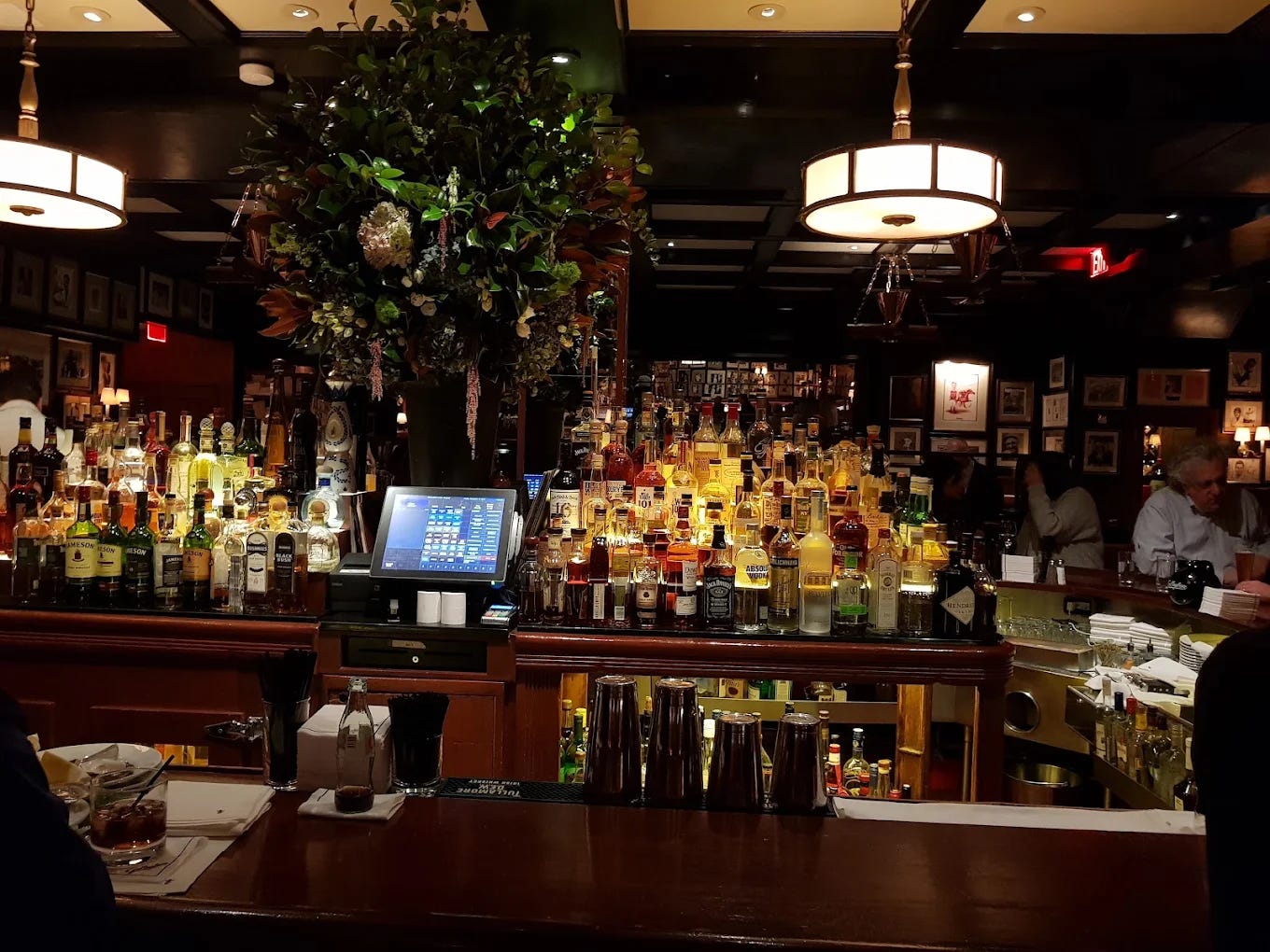
Gallagher’s Steakhouse, West 52nd Street, Manhattan
Almost the same ambience as in the previous nights. The buzz, the lights flashing off expensive liqueur bottles in the back bar shelves, the haze of cigarette smoke and expensive Cuban cigars.
But there’s a slight difference in the air. The place has seen its best days. Nor is it trendy and retro. It’s been years since Henry Fonda was a regular and Sugar Ray Robinson held court, since Marilyn Monroe sashayed through the bar to the dining room, Arthur Miller in tow. The people seem middle-aged and touristy. It’s simply worn out.
The door opens and a young man enters, accompanied by sounds from the street: loud angry sounds, voices screaming, like a demonstration.
“Gaza! Gaza!”
The door closes behind him, shutting out cold air and the sound of the crowd. The young man stops at the maître d’s desk. He’s tall but not gangling, slender and finely built. Casually dressed in a sports jacket, shirt collar open.
The maître d says: “Sir…” but before he can say another word, the young man takes out a crumpled tie from a pocket and, with a charming boyish smile, knots it and walks into the bar area. He has an easy, confident, athletic gait. He’s never been to Gallagher’s but he owns the place. At the end table where Hamill, Breslin, and Zion are sitting, he stops.
“Mind if I sit?”
Zion and Hamill say nothing. It’s left to Breslin to give permission.
“Sure, kid,” he growls.
Hamill remains coolly impassive. Zion keeps his cold gray hawk’s eyes on clamped on the kid, his foolproof method of disconcerting people.
Finally Zion speaks. “Actor, huh?” he says, none too nicely, exhaling a puff.
Chuckling, the young man replies, “Guess again. I’m in the book trade.”
The three newsmen perk up ever so slightly. They have agents and publishing houses but it’s always good to meet a new face. You never know if you’ll be dropped.
“Publishing?” asks Zion, skeptically. This kid doesn’t look like an editor. He looks like an actor.
“Agent. But I do some writing on the side. I’m familiar with your work, gentlemen. I grew up reading it. I read your columns about the new mayor.”
“Yeah, wudja think?” Breslin can never resist asking for an opinion. He’s certain of adulation. He hasn’t been criticized in forty years.
“To be honest, I thought you two” — he indicates Hamill and Breslin — “wrote pablum. Superficially entertaining, made a few good points, but at the end of the day, forgettable and rote. Mr. Zion here wrote something at least interesting and useful, although I don’t think he really engaged with the core issue.”
Zion puffs his Montecristo. Hamill sips his Scotch. Only Breslin reacts. He’s like a pot-bellied teakettle full of boiling water. They have, what, a hundred and twenty years years of combined experience writing columns, and this wet-behind-the-ears punk, this pisher, sits down as if he owns the place and calls their work pablum? Pablum!?
“OK, Mr. Critic, can you do a better job?” he rasps.
“Well, I did try my hand,” says the young man. He takes out his tablet, jabs and swipes the screen, finds what he wants, and is about to read when he stops himself and explains, “This is called a post. I have a Substack. I recommend it highly. I’ve already got three thousand subscribers. Here we go.”
Last Tango In Gotham
An Elegy, By Luke ZiminskiHello, Readers. By this time, you all know that Zohran Mamdani has won the election to be mayor of New York City.
I’m not going to write my usual. You’ve been reading me for months and you know where I stand. I want to point out the significance of this election, and what we race realists should learn from it.
First, congratulations to Zohran Mamdani for seeing an opportunity and going for the prize.
All the experts, smart money, and pundits say that Mamdani won’t be able to do any of the things he’s promised, and maybe that’s true. But everyone’s missing the big picture. Which is that Zohran Kwame Mamdani is doing the promising, and not Andrew Cuomo.
The machine, bereft of ideas and personalities, might as well have come up with Dracula. The electorate said, “NO.”
This is about the decay of tribes, and the way elections validate how power flows from one tribe to another. There are a million Jews left in New York City. Once two million strong, they got swept aside. Some Jews voted for Mamdani but the old machine is gone. No one’s asking their permission anymore. That’s a first in modern US political history.
The city that once spoke with accents from Europe now speaks in the accents of India, Pakistan, Uganda, and Ethiopia, not to mention TikTok.
It’s not just about political power. This election was about the power of definition—who gets to say what’s taboo, and what’s on the table.
And that’s the real story: who gives permission, and who asks. Power.
It’s migrated. It used to be in the hands of people who prayed to Jesus or who bowed to Jerusalem. Now it’s in the hands of people who practice Haitian voudou and kneel to Mecca.
I don’t say this with bitterness. It is what it is. History is a transfer of energies. One tribe grows, another flows into the ether.
I walk through the old neighborhoods and see the ghosts. Names that once meant something carved into libraries, endowments, theater walls. Their descendants tweet about the latest fashions and bread recipes while the streets belong to someone else.
And so, for those of us on the so-called ‘race realist’ side, the lesson isn’t that this is a loss. Mamdani won because the city no longer needs permission from its old caretakers.
And if he can stop asking, what stops us from doing the same?
Ziminski puts down the tablet.
There’s a look of stunned incomprehension on Hamill’s and Breslin’s faces. Zion sits, puffing, still staring at Ziminski, sphinx-like.
“Pretty good, kid.” He rubs the paper band from a Montecristo between his thumb and forefinger, then drops it on the table.
Behind the bar, Enzo picks up the phone and dials the local precinct. “Send over a squad car. Breslin needs a ride. Hamill, too.” Both men are nodding off.
“You need a ride, kid?” says Zion.
“Well… I live all the way downtown. Lower East Side—”
“No problem. I can drive you.”
The lights dim.
The restaurant’s buzz fades to silence, replaced by the swelling din of the demonstration outside.
Blackout.