
What do old people have to offer the young, apart from cookies and kisses?
Memory.
It doesn’t matter whether the young spurn the lessons of these memories, it’s our job to remind them of certain things, chief among them:
Life Goes On.
Frame that.
One day, I’ll write a post describing how many times my rusting hulk of a memory has been vindicated, but not now. For now, you’ll have to trust me. Here are a couple of gems that I’ve been thinking about lately.
In 1972, David Pryce-Jones’1 now-forgotten The Face of Defeat was published.
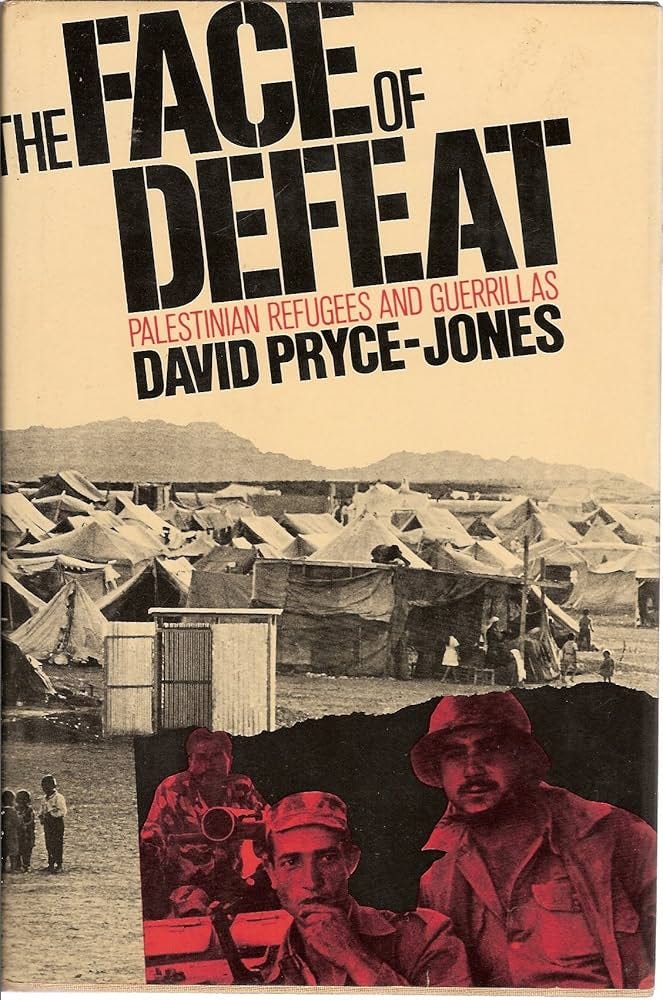
Here’s the AI overview:2
The Face of Defeat: Palestinian Refugees and Guerrillas by David Pryce-Jones is a journalistic account of the lives of Palestinians in the early 1970s following the Six-Day War. The book explored the Palestinian refugee crisis and interviewed guerrillas and civilians in places like the West Bank, Jordan, and Lebanon.
While not widely read today, it was praised upon publication for its literary style and insightful, humanizing portrayal of the Palestinian perspective.
Overview of the book
Focus and setting: The core of the book features Pryce-Jones’s observations of Arab life on the West Bank under Israeli occupation, a region where propaganda had begun to collapse in favor of a new reality.
Approach to reporting: Pryce-Jones, a novelist by training, used a narrative of vignettes and imagery influenced by T.E. Lawrence.
Narrative style: Although the “literary” quality sometimes overshadowed its serious reporting, the book was effective at a psychological level, capturing the complex emotions and hidden pressures of the people he spoke with.
Sources: His research included interviews with UNRWA officials, guerrilla spokesmen, and Israeli military administrators.
Criticism: A Commentary review noted that the book sacrificed a clear chronological account of events for a more evocative, character-driven style.
Critical reception and lasting relevance
Contemporary reviews praised The Face of Defeat for bringing a humanizing, if often bleak, perspective to the Israeli-Palestinian conflict in the years following the Six-Day War.
Humanizing the perspective: Pryce-Jones’s work contrasted with the political rhetoric of the time by highlighting the psychological and human dimensions of the conflict for ordinary Palestinians.
Psychological depth: By capturing the nuances beneath the stock political positions of his subjects, Pryce-Jones offered a more complex picture than typical journalism of the era.
A historical document: Though less well-known now, the book remains a valuable snapshot of Palestinian life and the geopolitical landscape of the early 1970s, offering insight into the early stages of a conflict that remains a focal point of Middle East geopolitics today…
Brief context: in 1973, the Palestinian cause was openly the cause of the hard left, and the hard left was a lot harder than it is today. Again: this is something that requires a book to describe, it’s impossible to convey the totalizing reality of it now.
But alongside that, the PLO was a proscribed organization in the US. And here was this Brit writing a sympathetic book about, if not them, their cause.
Of course, I read it, through gritted teeth. I didn’t want to read anything humanizing those fedayeen devils.
I thought it was a good book.
Reading the Commentary review, I see again how prescient it was:3
The real core of The Face of Defeat, however, is not the Palestinian guerrilla movement but Mr. Pryce-Jones’s descriptions of Arab life on the West Bank, under the Israeli occupation. Here, on the West Bank, the propaganda illusions that sustain the refugees across the river or the fedayeen in Beirut have altogether collapsed. What remains is hard to define. There is a surface level of cooperation with the Israelis, arising from a very long history of submission to conquest. A second level of hatred, shame, resentment lies shortly underneath. And beneath that, a third level at which the strange and sudden meeting of half-known enemies must have its effect. Mr. Pryce-Jones attempts to fathom this third level:
This was written in 1973, before the Intifadas.
I mention this only for one reason: in 1972, the Palestinians really did look defeated. From the Commentary review, link in footnote:
When Mr. Pryce-Jones returns to the fedayeen in a later chapter and on a later visit, they had been ridden out of Jordan, abandoned by the press, and reduced to factional bickering and polemicizing.
That didn’t stop the left from glamorizing “the fedayeen”—but at that point, they were, operationally, a nuisance. Lethal, yes, but not a serious threat to Israel’s existence.
Fast forward to 1982.
After the Israelis raced up the coast and took over Southern Lebanon and Beirut, Daniel Pipes wrote, “This is the last war in the Middle East for the foreseeable future, maybe ever.”
Yep, he wrote that. Trust my memory.
To put it mildly, that didn’t age well. Israel’s engagement in Southern Lebanon, its efforts to ally with the Maronites, were a fiasco, also to put it mildly. I’m not going to go into that here. I’m simply reminding you that triumphalism is folly.
So take a breath, surround the living hostages with a massive collective hug, and get ready for the next round.
Hamas can rename itself “The West Des Moines Ladies Bowling League.” I don’t care—it will be the same organization with the same goals.
And remember: underneath the face of defeat lies the will to survive and triumph.
This, from the Commentary article, is painful to read:
To many Israelis, the West Bank economic policy is a strategy aimed at producing an Arab working class that will speak in its own right.
I remember that sentiment well. I would look at Israelis who said this and feel such a distance and didn’t have the heart to say anything because I realized that they were saying this to keep up morale. Why bother puncturing someone’s illusions? Life will do that.
I hope that this tactical victory doesn’t enable the same Shalit-colored cobwebs to fog Israel’s eyeballs, now dyed Bibas-orange, to regrow.
And here we are.
Pryce-Jones is technically half-Jewish, halakhically fully, but in that upper-class British way that I frankly do not understand.
For those who reject AI on principle, buzz off. I don’t have time to scrape the internet for what AI can give in 5 seconds. I don’t let AI do my thinking for me, just basic research. But if you really object to AI, here is a review of the book from Commentary, August 1973.
Although the review does acknowledge that Pryce-Jones interviewed only the English-speaking elite; one can only imagine what was going on among the rest.