
Whenever I hate being American, I remember this guy.
The poem is from a work in progress.
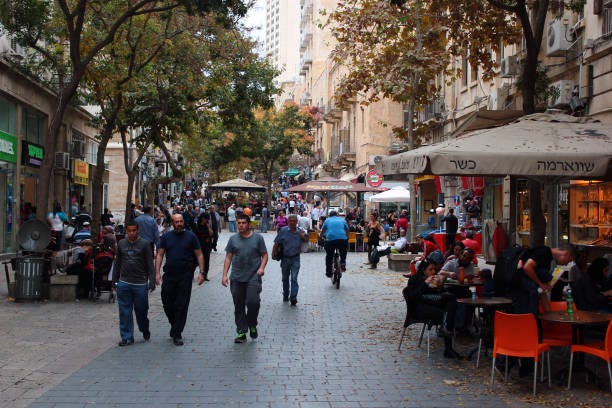
Brooke and I are sitting at an outdoor café in Jerusalem drinking coffee, early in the morning. It’s May 30, 1996, the day after Bibi Netanyahu was first elected prime minister of Israel.
We met on a three-day hike in the Judean Hills. The week before that, I’d hiked in the Sinai — a brutal hike that nearly killed me — but after a few days of R&R in Tel Aviv I was ripe for more punishment, so I went on another hike. A bunch of us hit it off and headed for Jerusalem together. I’ve forgotten where the guys went; it’s just Brooke and me that morning, drinking coffee together.
Brooke is a Lebanese Christian American. She is fascinated by Israel, how it managed to be Middle Eastern and modern. She’s visited Lebanon as a teen and hadn’t liked it. Being Lebanese was impossible to explain and she wanted to escape from it. Both of her brothers were gay. She felt a lot of pressure to be a nice Lebanese girl and have a lot of kids because of her brothers.
With her light brown hair, striking blue eyes, fair skin, and sharp little features, no one could look less Levantine than Brooke. She’d been a dancer before tearing a meniscus and still has a dancer’s trim, muscular body. I’d asked her if she’d had problems getting into the country or getting around with her obviously Arabic surname. None. She loves Israel. She’s had the best time here. In fact if she didn’t have to return and finish college she’d stay indefinitely. She wants to figure out a way to come back after graduating. I said her Arabic language skills would help.
The day before was probably the strangest day I’d ever spent anywhere. For the first time in Israel’s history, they were going to vote for a prime minister by majority vote (an experiment since abandoned). There were young soldiers everywhere milling around, goofing around, lazing around.
Years later, I read that the government had deployed twenty-five thousand soldiers to protect against terrorist attacks and enforce order. Although I didn’t know the number at the time, when I later read that number, I could believe it.
Bibi Netanyahu won. Nothing happened. Things happen only when you least expect them, as another Lebanese has taught us.
That day, life was normal in the way that life is normal in the wake of an aftershock. Rabin had been assassinated less than a year before. The phrase “suicide bombing” became normalized. Now this political earthquake.
Look at him, Brooke mouthed to me. I followed her eyes. A handsome man just approaching middle age was sitting at the table next to ours, reading a newspaper, sipping coffee. I smiled at Brooke and nodded yes.
She manages to catch the man’s attention and start a conversation. He’s at that stage right before middle age, hair thinning a bit, but has a great body. Wedding band, of course.
We talk about this and that, and then the conversation turns to the inevitable: politics.
Did Bibi’s election have anything to do with the spate of terrorist bombings?
Of course, he said, almost chuckling at the absurdity of the question. Not a happy chuckle, a bleak chuckle. Those terrorist attacks had been in places just like this, outdoor cafes where people read newspapers, drank coffee, and were slaughtered.
I got the feeling he wasn’t overjoyed about Bibi’s election. Not unhappy either, just philosophically accepting of a bad situation that wasn’t going to get better no matter who was elected.
The conversation, as it usually does between Jews, shifted to ancestry. Brooke watched and listened.
His story was typical of many Ashkenazi Israelis: grandparents escaped Central Europe, the prime killing ground, in the thirties. Whenever I meet someone like that I think, “If their grandparents hadn’t gotten out by the skin of their teeth, we wouldn’t be having this conversation.”
And you? He asked.
I told him: Odessa on my mother’s side, Kovno and Vilna on my father’s. They emigrated early in the 20th century, before both wars, before the revolution.
Straight to the US? he asked.
Yes.
You’re lucky, he said, finishing his coffee. Then he got up, said some “have a nice trip” pleasantries, and left.
Brooke stared at him as he walked down the street and disappeared.
“Wow,” she said. “Are they all like that here?”
The Golden Shore
My childhood was a kaleidoscope
Of sights and sounds and dreams—and more—
A seamless parade of visions
Gleaming from a golden shore.
Obey! They said. I did.
I sailed past the golden shore.
But here and there I’d stop to look
And every time I touched the sand,
The glittering grains slipped through my hand.
Now I’m old—
And all the sights I didn’t see
All the languages I didn’t learn
All the alphabets I didn’t read
All the music I didn’t hear
All the points I didn’t score
Still beckon from that golden shore.
Nice.