
It takes a certain talent to make depression interesting and I don’t have it, but this is my ‘stack, so I’ll say this and move on: I’ve been in a deep ditch, caused (mostly) by my own mistakes, which are now compounded by dealing with the reality of the Covidian society1, which is characterized by an astounding level of incompetence. I keep battling, and I’m glimpsing the threshold, but it’s a drain.
Anyway…
I’ve been thinking about this for a while. Here are two movies that I think would benefit from a remake. I fully realize that this won’t happen, as the film industry is now in a state of deep decay for zeitgeist reasons, but a girl can dream.
Links in bold.
Moviemaking is tricky enough and remaking movies is a thousand times more so. On the whole, I’m against the practice. Leave well enough alone. Make up something new. Even then you’ll probably fail but at least you’ll have failed originally.
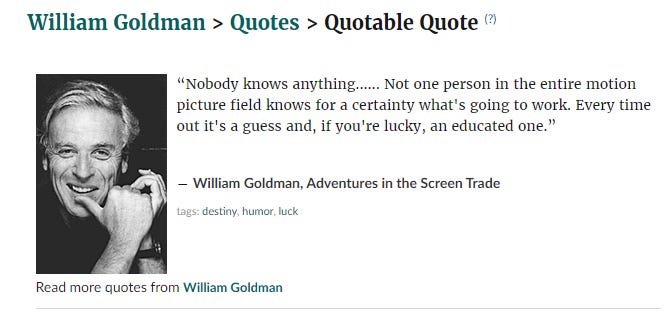
The 1995 Sabrina remake illustrates the hazards perfectly. When this “sure-fire hit” bombed everyone professed ignorance but, contra Goldman (who was right, in general) I knew the reason why it bombed: women were outraged on behalf of Audrey Hepburn. It wasn’t a remake—it was a violation!
The Coen brother’s True Grit succeeded because it really wasn’t a remake (see below) and because John Wayne is controversial and because the Coen brothers have such prestige. As many people hate the Duke as love him. But I do know Duke-lovers who wouldn’t go to see the second True Grit out of loyalty to the old lion. I can’t argue with that any more than someone can argue with me about Audrey. Actors occupy a peculiar place in the human mind. People love what they love.
But they love in their own ways, and although I love Katharine Hepburn, Humphrey Bogart, and James Stewart I think that The African Queen and The Man Who Shot Liberty Valance are due for remakes.
My mother had an extensive library. In it was a copy of the novel The African Queen. I devoured it in one marathon sitting. I told my mother how much I loved it, and she told me about the great movie based on it, and who was in it. That puzzled me. In the book, Charlie Allnutt is a Cockney.
I said, “But how could Bogart do the accent?”
“They changed him to a Canadian.”
I didn’t like that.
Mom: “Oh, no, it was wonderful!”
I remained skeptical.
“You have to see it!”
And I did. In a theater, not on a TV screen, so I got the true movie experience, and like my mother, I fell in love with this great movie. See it! What more could you ask for? Bogie, Kate, Huston, Theodore Bickel doing a great cameo, Africa. See it!
But I never quite got over that Canadian business. Even Hepburn’s accent struck me as a bit too New England meets the Home Counties.
I think it should be remade with Kate Winslet as Rose and Christian Bale as Charlie. They can nail the accents, and both can inhabit those parts—I’m sure of it.
It will never happen except in my dreams. Meanwhile, I have the Huston-Bogart-Hepburn movie, and that ain’t bad.
Liberty Valance is based on a novella by an overlooked Western author named Dorothy M. Johnson. Yep, a woman wrote this lean, mean hardcore western tale—and a bunch of others.
First off the bat: all credit to John Ford for seeing the possibilities in this wonderful story and for crafting a compelling narrative.
My problem is the casting.
What?! Two of Hollywood’s greatest leading men in the twilight of their careers? How could that go wrong?
Plain and simple, they were both too old for their parts and this ruined the narrative. Both were supposed to be young men during the main action. The film begins in the present, with the 50-ish James Stewart made up to look older than he actually was. Then the main action starts in an extended flashback, with both Stewart and Wayne playing younger men—while both are in their 50s. If this sounds confusing, it’s because it is, and you have to suspend belief to go with the flow, and I never did.
When I saw the movie, this nagged at me. So I read the story and indeed, their youth is an implied but integral part of the narrative.
The only age-appropriate actor is Lee Marvin as the sadistic Liberty Valance. He was in his late 30s at the time and what a performance he gave.
Woody Strode, one of Ford’s rep company, played an extraneous character created for the movie, a minor but distracting flaw. I like Strode, but his presence in the movie was inauthentic, an early case of “woke casting.” Strode would have been better cast as one of Valance’s bad boys. It was sheer directorial ego, and I don’t like that.
All this said, Ford added two elements to Johnson’s story, which I would keep.
One, emphasizing Valance’s sadism. The book implies it, the movie brings it out. Of course, you’d have to get an actor like Lee Marvin to do this the right way and they ain’t making them like Marvin anymore, but just saying. I’m sure he actually read the story.2
Two: the famous line, “When the legend becomes fact, print the legend” is from the movie, not the book. I wish that Johnson had written it, but as someone who is dedicated to fact, not legend, I must point this out. It’s a great line, and it sums up the story perfectly.
Here’s another problem with the movie and it’s something Ford couldn’t control. I can’t escape the feeling that this movie, made in 1962, is too much a product of its time, and its time was a peculiar one in Hollywood moviemaking: the weird period from roughly 1960 to 1968 where the old entertainment industry guard was hanging on, while tectonic plates were shifting under their feet. (Maybe we’re in one of those now.) Tarantino hit this nail right on the head with Once Upon a Time in Hollywood. Everything was in flux. Many movies from this period are just strange, neither here nor there. This is one of them.
One final thing: fidelity to the writer’s style. Johnson’s style was bone dry, Jack Spratt spare, genetically Western-American, so minimal that it leads some to think there isn’t much “there” there. For one, this writer, to whom the story is a “light little thing, not much at all.” I beg to differ.
Johnson’s story is like an atom which, when split by the reader’s mind, detonates majestically. I really don’t think Ford caught that. Maybe that wasn’t his goal. He was John Ford and John Ford was going to make a John Ford movie, not film some writer’s story. If that’s your dish, great, but it’s not mine.
The juxtaposition of youth and age is poignant by definition. We couldn’t see that because of the age of the actors. Ford focused on the Western legend thing because he was a a great cog in a legend-making machine. That was certainly part of the story, but Johnson was really telling us about a man who had gone through many transformations, as well as the reality of those transformations and how they differed from his image. Not in the movie. At least, I didn’t see it.
The Coen Brothers are the only directors who could convey the drama and the understated power of Johnson’s writing. Come to think of it, they didn’t remake the Hawks’ True Grit, they bypassed it entirely, went back to the source: Charles Portis’s book.
Maybe they could do the same with Dorothy Johnson’s hard, flinty little gem. If only…
Actors? I don’t know. I’m not up on the younger crowd. Just no one over thirty.
When he was filming Rosemary’s Baby, Roman Polanski said, “Some directors change novels. I film them.”
That’s going from memory, and when memory becomes fact, print the memory.
I won’t call it “post-Covid,” because it’s not. We are stuck firmly in the world Covid made, and we ain’t getting out of it.
In real life, Marvin was upper-class, erudite, and of course, troubled.
Excellent piece, thank you. I love gleaning new information - especially about movies and music - and you have provided plenty.
Re the "ditch" in your intro. In my case definitely not my own creation. It's all my Holocaust-wounded parents. Though God gave me a big enough frontal cortex to beautifully compound, deepen and perpetuate the misery!
Lastly: fully agree with your final assessment on living in a Covid-created world. That too shall pass but it will take two generations. When. I was in Germany in 1971, a quarter of a century after the war, I had the feeling the country had not yet fully escaped the national socialist escapade