
We’ve survived a massive, brain-cracking series of heat waves in NYC and I’m relatively functional again.
So much to write about, in between watching videos of AI cats and 50 different ways of making lemon curd and fretting over Caitlin Clark’s groin injury.
I really will write a big, beautiful, post about Zohran Mamdani, pulling together ideas from Colin Woodard, Anthony Burgess, and my native’s eye view of NYC politics, but right now, I was inspired by Wesley Yang’s brilliant tweet to edit my earlier post about Second Wave Feminism.
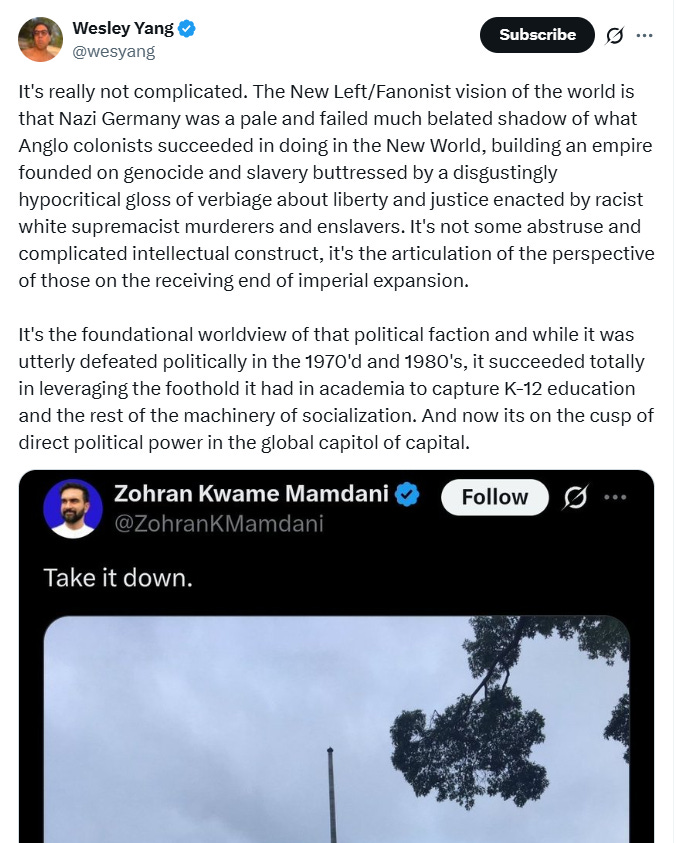
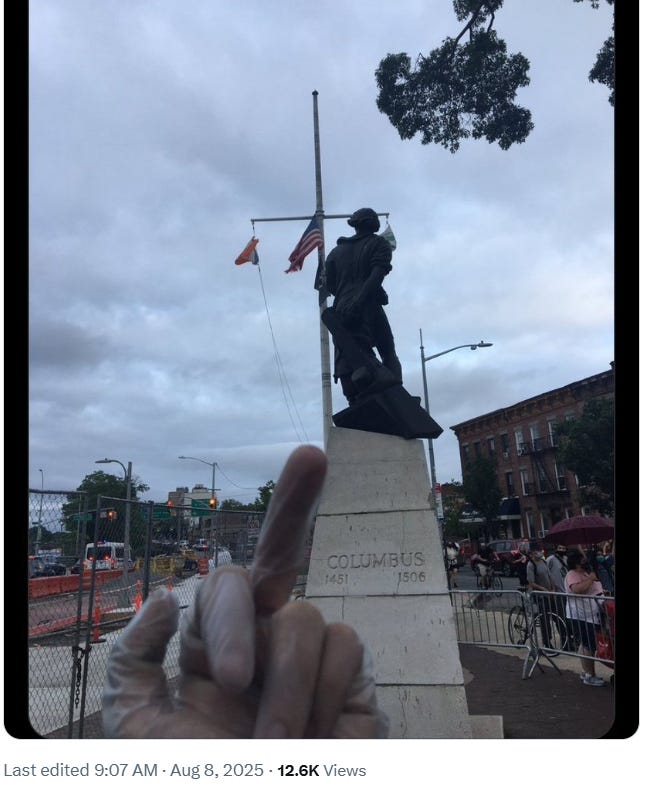
Here is Wes’s tweet, in full:
Following this is a shorter version of:
Sister Diana Explains It All For You

I wrote this a long time ago—right after we invaded Afghanistan. Every so often I update and edit it. Since feminism won’t leave us alone, it’s time for a new buffing, polishing and rollout.
Second Wave Feminism Was Always a Tribal Movement
First Wave Feminism was about rights. It extended liberal Enlightenment principles to women: suffrage, contract law, political participation. It was universalist, legal, and strictly rights-oriented. It succeeded.
Second Wave Feminism also succeeded but at great cost, because it wasn’t about rights. It was about identity.
Second Wave Feminism redefined women not as individuals seeking equality under law, but as a political class united by grievance and loyalty to each other over everyone else—including husbands, brothers, fathers, and sons. The old bonds of family and kin were recast as oppressive. “Sisterhood” replaced blood.
They never said it outright, but they didn’t have to. Their slogans, manifestos, ruptured families, and “consciousness-raising” sessions made the message clear: you are a woman before you are a daughter, wife, or mother.
This wasn’t a call for fairness. It was a tribal allegiance. And like all tribal movements, it demanded purity, obedience, and sacrifice. It took the language of liberation and cloaked a moral reordering: loyalty to the tribe of women before loyalty to your own kin.
But here’s the problem. Sex is not like race. The radical feminists tried to graft the logic of the civil rights movement onto sex, but it never fit. Racial identity is a combination of legitimately intrinsic and context-dependent. Biological sex is entirely intrinsic and it’s the bridge between family, reproduction, and kinship. Trying to build a mass movement around the idea that half of humanity should distrust and de-link from the other half that it breeds with and springs from and gives birth to was bound to fail, or to devour itself.
And yet, it worked superficially. Not because the ideas were sound, but because feminism became a profitable brand. Every ten years it reinvents itself. Porn is feminist. Pop stars are feminist. Stilettos are feminist. Everything is feminist—except acknowledging that most women care more about their families than about abstract global sisterhood.
That’s the contradiction Second Wave Feminism has never resolved: it tells women to disown the bonds that actually give their lives meaning. And they do not.
You don’t have to like patriarchy to see that feminism didn’t liberate women from oppression. It just offered a new form of loyalty: ideological over familial, tribal over universal, theatrical over lived. That’s why so many of its adherents are caught in an endless cycle of redefinition, disappointment, and rage. The dream never delivers. Reality won’t comply.
Second Wave Feminism failed to liberate women because what it promised, freedom from kin and blood, is a fantasy.
And yet it’s everywhere. Why?
Because it offered elite women the validation of rebellion’s moral prestige. Revolution replaced virtue. That’s the why.
The how is what Wesley Yang describes in the tweet screen shot above. Like the New Left it shadowed, feminism lost politically but embedded itself in the machinery of culture—education, media, the academy—so it never needed a majority, it just needed gatekeepers. What began as a movement about identity became a pipeline for institutional power. It didn’t win by persuasion. It won by meme reproduction. When all of your teachers are feminists, you’ll write feminist papers. When every paper is a feminist paper, well, “studies show….”
The uber-feminist tract, The Handmaid’s Tale, was actually widely-ridiculed when it was first published, and the prestige movie adaptation was a total fail. But it survived by being required reading in women’s studies (later gender studies) departments, and its moment came when Trump was elected and Hulu adapted it.
It would be impossible to read a critical review of a feminist book nowadays such as Mary McCarthy, writing in The New York Times Book Review (Feb. 9, 1986), who wrote a famously ambivalent review. While she admired Atwood’s intentions, she found the novel lacking in depth and consistency.
“Some of the characters, like the Commander’s Wife, are straight out of Stepford Wives… The writing is flat and uninflected… Atwood's dystopia lacks the imaginative rigor of Orwell or Huxley.”
Second Wave Feminism failed to liberate women because you can’t liberate people from blood and kin. But it appealed to elite women, and that was enough. As Wesley Yang notes, it didn’t win politically; it captured the institutions that shape what winning even means.
Here we are. It’s this context of total elite capture of institutions that will inform my Big Beautiful Mamdani Post.
Groin injury? I thought it was a Griner injury.
I agree with so much of this. I think you underestimate how much women love feminism. I don’t know if I know any woman besides myself who wouldn’t take feminist positions on most things, even if they contradict her other beliefs (religious) or if it goes against their best interests. It’s really alluring.
And it’s an excellent way to convince women of anything-dress up the opposition as anti-woman.
How many essays undermine every point of feminism but then end with, of course I’m still a feminist. I can’t not be a feminist?
I was reading a 1984 edition of The Feminine Mystique with a 1984 forward by Betty Friedan and it’s ridiculous. The entire book is absurd. I was determined to write a point by point refutation but I felt like I would lose IQ points if I didn’t stop reading it and/or my brain would melt and leak out my ear.
She blames all of women’s problems on not working or stopping their education to have a family, but working women have these exact complaints today. And she thinks that men are really women but sadly repressed into being men from childhood.