Rainmaker: Book Impression
Tiger Tiger, Burning Bright

Book reviewing takes a talent that I don’t have, which is why I call this a book impression. This is the second in a three-part installment about the sports biz.
I return to the three-part series that I began here, reflecting on my years at Mark McCormack’s International Management Group, at that time the largest sports management company in the world.
Around the time that post was taking shape—or perhaps right after—an amazing synchronicity occurred: I discovered that Hughes Norton, the head of IMG’s golf division, had just written Rainmaker, a memoir of his career at IMG. I immediately borrowed it from the library. I was shocked and surprised by what I read.
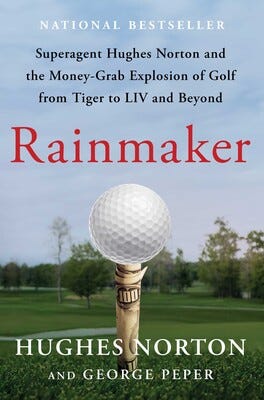
Hughes was one of McCormack’s wonder boys. He had it all: an eight-handicap golf game, the right lineage, Ivy League creds, and experience in broadcasting. Starting as an executive assistant, Hughes quickly climbed the ranks to become head of the golf division—the company’s bread and butter and the division closest to McCormack’s heart, as IMG had begun as a golf promotion company. He had a keen eye for talent and a deft hand with challenging clients, such as the notoriously prickly and demanding Greg Norman.
Along the way, he noticed a skinny, Coke-bottle-glasses-wearing 13-year-old named Tiger Woods. Woods was a prodigy, but given the unpredictability of physical and mental development, no one could have foreseen just how great he would become and even Tiger Woods experienced a few bumps in the road. Norton deserves credit for recognizing Tiger’s unique potential and dealing with Tiger’s touchy, protective father in just the right way. Perhaps Hughes had a sixth sense for something beyond mere talent: the will to greatness that even as a wee cub Tiger had in spades.
The rest is history. Norton presided over Woods’s professional debut and guided the young golfer into the golden trifecta of riches, celebrity, sporting glory and through the unique experience that was Tigermania.
On September 28, 1998, only a year after Hughes referred to Tiger as a “little brother” for the Harvard Business School alumni magazine, the following phone call took place:
“Hey, Tiger, what’s up?”
Tiger (voice emotionless): “I’ve decided to make a change. I no longer want you as my agent.”
Hughes: “What… Why?”
Tiger: “I don’t want to go into it.”
Hughes: “Whoa, we can’t do this over the phone; let’s sit down and talk about it.”
Tiger: “Nope, it’s over.”
Hughes pleaded for a meeting. Woods reluctantly agreed. Hughes flew to Florida.
Tiger instructed me to meet him at the front door of the Isleworth clubhouse. I figured he wanted to avoid sitting down at his house, so we’d find a private spot in the clubhouse to talk. When I arrived, he was standing literally at the front door, his eyes zombie-like and his face expressionless. “Can we go inside and talk?” I asked. “No,” he replied. “I told you it was over. My mind is made up. We’re through.” With that, he turned and walked away. In the twenty-five years since, I have not heard a word from Tiger Woods.
I should clarify that Hughes was still formally the head of IMG Golf and that Tiger couldn’t “fire” him from that, but when Tiger Woods says he won’t work with an agent, that agent is dead.
Hughes spent a few months as a company ghost, twisting in the wind, doing nothing. A few months later, McCormack put an end to his misery, booting him during a breakfast meeting with a golden parachute. Summarily. Like: now, goodbye, it’s over. Twenty-five years of loyal service, which included discovering and guiding the greatest golfer since Nicklaus, went up in smoke.
Shattered, Norton disappeared from the sporting world, resurfacing twenty-five years later with his side of the story.
Anyone interested in a crisply written behind-the-scenes look at sports management should read this book. It’s detailed without being tedious. I devoured every word; each resonated with my memories. It doesn’t always happen that two people remember the same place in the same way. In this case, Norton’s description of IMG totally coincides with my memories. He perfectly captures the strange culture of McCormack-idolatry that was IMG.
You also pick up some gossipy tidbits about many top names. I was amused to learn that Billie Jean King avoided IMG because she didn’t like McCormack and only joined when the big guy hired the warm and likeable Bob Kain to handle tennis clients. Billie Jean was a good judge of character.
It’s not heavy on psychological insight, but Hughes does provide ample clues about the outsized personalities he worked with. There are many such clues about Tiger. He had a rat pack of high school and college buddies that he enjoyed pranking around with. (In other words, apart from his freakish talent he is a pretty normal guy.) He liked video games.
But the most astonishing clue is this: Tiger never took endorsement money seriously.
The way Tiger saw it, the only money that mattered was what he earned playing golf. The rest was “paper money” earned for him, and it didn’t matter whether the contract was for $100,000 or $100 million. If it required a significant time commitment, it was more trouble than it was worth. If it brought a pain-in-the-ass time commitment, it was more trouble than it was worth.
I don’t know about you, but I find this amazing and yes, admirable. Isn’t money what it’s all about? “Show me the money” — right?
Not to Tiger Woods. He sure didn’t turn down the money, but the only thing that he cared about was the game. (This is total speculation, but perhaps his later breakdowns were his way of telling the machine to leave him alone—at a terrible cost.)
Apart from downtime with the guys and video games, Woods was fanatically devoted to golf, to improving his game and developing his body. He wasn’t a colorfully lazy Mantle/Ruth type who relied on talent on loan from God. He studied the game and worked obsessively to perfect his skills, even hiring a coach to tinker with his swing, which most golfers are reluctant to do.
After winning his first Masters in which he “set or tied a total of twenty-seven Masters records, including the lowest seventy-two-hole total and widest margin of victory” his reaction was: “Look at that swing, it’s horrible… Ohmygod…”
Geez. Absolutely without ego. Mad respect.
Even as a kid, he never cared about trophies or accolades. Referring to his childhood trophies:
“They’re gone,” Tiger said matter-of-factly. “By the time I hit eleven, there were a hundred and thirteen of them around the house. Mom made me give them all away. I don’t care.”
Wow, I thought—how many thirteen-year-olds would agree to that? It struck me that this kid was more focused on the process—the grind, the competition—than past accomplishments. The only important trophy was the next one.
What do you think of that? His mother didn’t want all that shit in the house, so she got rid of them. (I wonder how much money they’re worth on Ebay.) And he didn’t care.
At that moment, I said to myself, “I love this guy.” Tiger, I mean. (And his mother.)
Since Rainmaker is written from one man’s POV, there’s a mystery at its core: the other party. Unlike Greg Norman, who was motivated by two things that we lesser mortals can identify with (money and ego), Tiger is a sphinx, inscrutable, because he was and is motivated by something that we lesser mortals can’t fathom: the relentless quest for perfection.
Apart from the rupture, Hughes paints a largely positive picture of a complicated, troubled, brilliant man1 and after reading it I was intrigued by Tiger and held him in far higher regard than I did before. Norton bears no resentment toward him—just puzzlement and hurt.2
McCormack is a different story. The book is really all about him. It depicts McCormack as a frank egomaniac and Rainmaker brims with resentment toward him. I enjoyed this resentment because I share it, but I wonder if it’s doing Hughes any good. Not that McCormack doesn’t deserve it: Hughes devoted twenty-five years of exceptional service to an ungrateful wretch only to be kicked to the curb. But does Hughes?
It’s also true that even a kinder person than McCormack would have had to let Hughes go after his most important client indicated an unwillingness to work with him, but it could have been done in a more decent way.
In “The Emperor McCormack” I confessed bafflement as to the fate of IMG; it’s hard to verify what happened solely by using the Internet which, as we’re learning, is not a way to learn much that’s essential. Norton clarifies the story.
After McCormack’s somewhat untimely death, the company changed hands multiple times, each time eroding its client base. Today, IMG is an “event management” company that bears no resemblance to McCormack’s original empire of great personalities.
And the IMG name itself has virtually disappeared—not the legacy Mark McCormack envisioned.
Repeatedly Norton torments himself over why Tiger fired him and what he did to lose his job. I surely can’t answer what soured his relationship to Tiger, but I think I know what happened with McCormack.
Hughes forgot that he wasn’t working for Tiger—he was working for McCormack.
Everyone at IMG was. Including Tiger who, as it turned out, disliked this. Firing Hughes enabled the kid to exert control. Tiger changed agents but stayed with the company, however:
Tiger’s continued loyalty came at a steep price to IMG… as he negotiated a significant reduction of his commission fee.3
Clever. Firing Hughes was a way for Tiger to tell McCormack: I am the master of my fate. I don’t work for you. I work for me.4
So, what “shocked and surprised” me?
I know this is stupid, but that someone as important as Hughes could be treated so shabbily shocked and surprised me. Yeah, I know: these stories are legion. But they never fail to shock and surprise me.
Going from being Tiger Woods’ agent to a company non-person and then a ghost in the industry devastated Hughes. It took him twenty-five years to recover—if indeed he did. I just got unemployment and moved on. I was luckier. The smaller they are…
What’s the takeaway? We all work for a Mark McCormack. They run the world. The only people they can’t fire are the Tigers. Since we can’t all be Tigers, we’ve got to be smart. You mean nothing to your boss beyond the next dollar you can earn for him, and woe betide you if you forget that.
This interview sensationalizes the book and possily distorts what Hughes actually said. He both criticizes Greg Norman’s obsession with material wealth and implies that Tiger’s lack of interest in that made him “narrow.” I’m familiar with how interviewers, by leaving out key words, can twist a subject’s words. Read the book and make up your own mind. I think the portrayal is largely positive.
This contrasts with Norton’s attitude towards Greg Norman, whom he loathed and whose ego (when compared with his golf achievements) is depicted as ridiculous.
According to Hughes the commission fee was 20%—but I distinctly remember my boss telling me it was 40%. Yep—40%. That’s very steep, but 40% of a lot is better than 0% of a little. And with IMG handling literally everything, all the athlete had to do was show up. The complications of a non-team sports athlete’s life are legion: travel, qualifying for/enrollment in tournaments, and taxes alone would eat up 28 hours of a day. IMG made a lot of athletes that you’ve never heard of very rich.
Actually, his parents as well, including the remarkable and overlooked Kultida, the one who made him get rid of his childhood trophies—but that’s another story for another day.
Interesting. I'm not too into sports, but I do like the intrigue and this article. I'm more interested in the big Book Machine, the Publishing Biz, the Writer Grinder. I've heard stories, sad ones like this, from other writers in the biz. I'm currently reading 'The Bestseller' and loving it. It's about the UK Publishing Biz.
Anyway... good one!