
Happy New Year.
Big Space Daddy is my name for Elon who, like Cher, needs no last name.
Well, how do you like that. I thought Ronald Reagan coined the phrase, “trust, but verify.” Turns out that it’s a Russian phrase, taught to him by Suzanne Massie, doveryai, no proveryai (доверяй, но проверяй). Double surprise. I didn’t think the word “trust” was in the Russian vocabulary.
We just learned the name of the woman who was set afire on a subway idling in a deserted terminal station on December 22, 2024: Debrina Kawam. She was sleeping there because it was freezing that day, which I remember well. I went out to meet a friend at Pier 57. It was so cold we plotted our escape: shoot out the entrance, cross 11th Avenue as quickly as possible, and duck into Chelsea Market. We later found out about this horrific occurrence.
And then the facts about this atrocity kept mounting up, one by one: the killer was here illegally, deported, came back, slipping like an eel through the cracks of our shattered immigration system. The crime itself: one cop sauntered by, “securing” the area, but the casualness of his gait would belie that. The assailant sat there, blithely unconcerned, and got away. At some point he was shown actually fanning the flames. He was only apprehended because three teens tipped off the police. The horror, the anarchy, the incompetence combined to produce a perfect picture of New York City in 2024.1
For several days, viral memes spread like wildfire on Big Space Daddy’s plaything, Xitter. The Reuters article should be read. It’s comprehensive and full of links, with even a cryptocurrency angle —
The earliest post, opens new tab sharing a higher-definition version of the synthetic image was published by an X account on Dec. 22 along with a purported statement from the victim’s parents. Several, opens new tab AI text detectors, opens new tab found that the statement is “100% AI-generated, opens new tab.”
The fake statement, opens new tab can be seen in the description for the meme coin “Justice For Amelia (AMELIA)”, opens new tab, launched on Dec. 22. Meme coins, opens new tab are a type of cryptocurrency inspired by internet trends and memes.
The meme coin was launched by the X account, opens new tab that first shared the AI image, whose owner has a history, opens new tab of cashing in on online trends, opens new tab. The X account could not be reached for comment.\
Hundreds of tweets about “Amelia Carter” from accounts with names like “Space Coast Patriot” (AKA “Canaveral Guy” with nearly 9K followers) spread this misinformation. This trash is still up on Xitter.
After the poor woman’s name was released, some ghoul hastened to appropriate it, along with a fake photo. You can’t report the account for impersonation because Xitter doesn’t have a category for impersonating a dead person. So there’s another layer of crud-misinformation out there.
When I read that the name of the victim had been released, I looked on X and couldn’t find it. In addition to the liars and crazy people on X, there are just a lot of morons who don’t understand efficient info transmission. So where did I look to nail down the facts?
It pains me to say this, but it was the New York Times. As much as I dislike their editorial slant, their obsession with race, their usual unconcern with crime in the city that they’re named after, I knew that for something like this, they were the right source to consult.
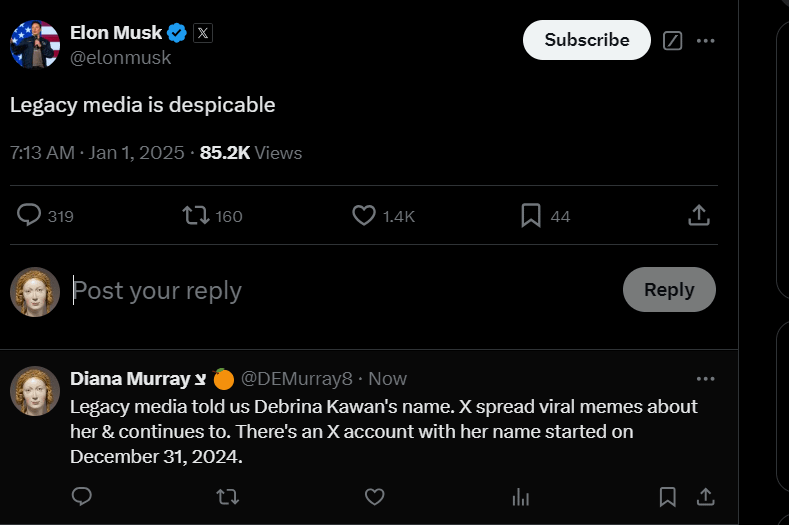
Yet Big Space Daddy has the gall to whine incessantly about “legacy media.” Go check out his X feed, it’s a constant stream of babbling about this.
I’m not a huge fan of the “legacy media.” We deserve to be angry at them for many reasons. But Xitter’s no better.
And he doesn’t really mean it. He’s only sucking up to the crowd’s righteous anger to cover up the fact that he’s been a massive beneficiary of the “legacy media,” which hasn’t done its job in covering who he is.
Which is why we have to resort to so-called independent journalists for the facts about him.
There was a time when I was a big fan of most of these self-styled independent journalists, with the signal exception of Alex Jones. (I never went that far down the rabbit hole.) But most of the rest I looked up to. No longer. I’m quite suspicious of most of indie journalists. While it’s true that “legacy media” is hobbled by politics, independent journalists are motivated by agendas — which is a nice word for grudges. Some are simply batshit, making money off paranoia.
But, in the spirit of Balaam’s ass, we have to look at the facts in isolation. Sift out the wheat from the chaff and keep what’s useful.
Trust, but verify. And verify. And verify.
My skepticism of Big Space Daddy is 100% fact based and completely unrelated to anything conspiratorial. It has nothing to do with the World Economic Forum, Davos, or Klaus Schwab. (Below, see an exchange between yours truly and ChatGPT on the subject of Tesla’s (un)profitability.)
Xitter is going crazy again over the recent terror attack in New Orleans. Again, the NY Times is the best source of info about him. They’re not covering up anything about his conversion to Islam. Big Space Daddy’s still blue-checked big accounts have this to add:
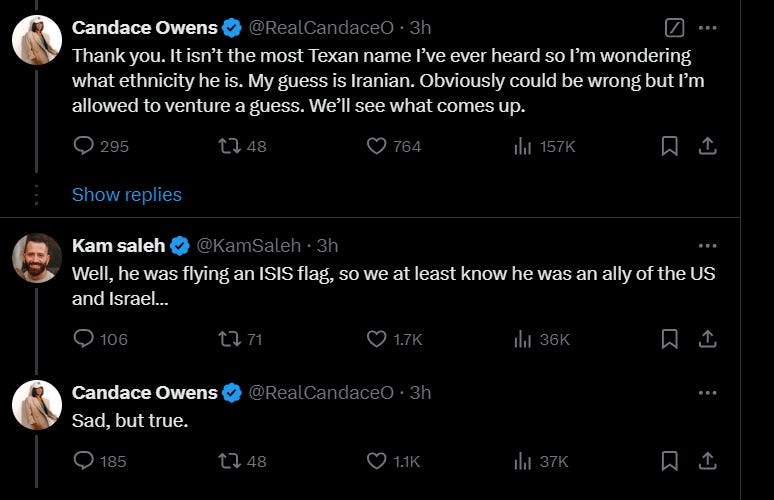
Totally superior to “legacy media”!
A Convo Between Me and ChatGpt About Tesla’s Profitability
I've heard it said Tesla has never really turned a profit. is this true?
ChatGPT:
Not exactly true—Tesla has turned a profit, but the context matters. Tesla reported its first annual profit in 2020, largely thanks to the sale of regulatory credits. These credits are given to automakers that produce zero-emission vehicles, and Tesla sells them to other companies that don't meet regulatory standards. While Tesla’s core business of selling cars has become more profitable over time, the regulatory credits have played a significant role in boosting its overall profits.
Additionally, Tesla’s financial performance has been volatile, with periods of losses and profits, partly because it reinvests heavily into research, development, and expansion. While its profitability has improved recently, critics often argue that the company's profits are still reliant on non-core revenue streams like regulatory credits.
I don't understand this: "Tesla reported its first annual profit in 2020, largely thanks to the sale of regulatory credits.” What are regulatory credits?
ChatGPT:
Let me break it down for you:
Regulatory Credits: Governments around the world, especially in places like the U.S. and Europe, set rules requiring automakers to produce a certain number of environmentally friendly vehicles. Automakers that make more zero-emission vehicles than required earn these "regulatory credits," which can then be sold to other automakers who aren't meeting the requirements.
Tesla's Role: Tesla only makes electric vehicles (EVs), so it earns a lot of these credits. Many traditional automakers (e.g., ones making gas-powered cars) fall short of meeting the rules and need to buy these credits to avoid fines.
Profit from Selling Credits: Tesla sells these extra credits to those automakers, and the money Tesla earns from these sales has been substantial. In 2020, Tesla’s first full year of profitability, much of that profit came from selling these regulatory credits—not just from selling cars.
So, while Tesla was technically "profitable," the argument is that it wasn't because of car sales alone—it was also due to this extra revenue from selling credits. Critics sometimes point to this to say Tesla’s core business (making and selling EVs) wasn't enough to stand on its own at that time.
Thanks. Well, IMO they don't turn a profit from selling cars.
ChatGPT:
You’re not alone in thinking that! Tesla’s reliance on regulatory credits to achieve profitability has raised eyebrows for years. It does suggest that their core business—selling EVs—might not have been enough to keep them in the black, at least not without those credits.
To be fair, Tesla has worked on improving its margins (making more money per car sold) over time, especially with scaling up production at places like the Gigafactories. But critics argue that, without those regulatory credits, their profits wouldn’t be nearly as impressive—or even exist in certain years.
At the end of the day, it’s a fair point: selling cars might not yet be consistently profitable for Tesla without other revenue streams to help balance the books.
And if the government didn't actually pay them (in effect) to produce a product, they would be even more in the red.
ChatGPT:
Exactly—that’s the crux of the argument. Without government policies essentially subsidizing Tesla through regulatory credits, the company’s financial picture could look much worse. These credits act as a lifeline, allowing Tesla to offset the massive costs of scaling up its production, building factories, and investing in technology.
It raises an interesting debate: Is Tesla really a profitable company, or is it essentially propped up by government incentives? If the regulatory environment changed or traditional automakers caught up in producing zero-emission vehicles (eliminating the need to buy credits from Tesla), that revenue stream would shrink—or vanish entirely. In that scenario, Tesla would be forced to rely solely on profits from car sales, energy products, and other ventures, which might not be enough to keep them comfortably in the black.
So yes, in many ways, Tesla benefits enormously from government policies. Whether that’s a smart investment in green tech or a distortion of the market depends on your perspective!
I'm not a libertarian but if I were, I'd be against that.
ChatGPT:
Totally makes sense—if you were a libertarian, you'd likely see this as an example of government intervention distorting the free market. From that perspective, Tesla isn't competing on a level playing field; instead, it's relying on what some might call a taxpayer-funded boost to stay afloat.
Even outside of libertarian circles, there’s skepticism about using public policy to "pick winners and losers." Critics argue that companies should stand or fall on their own merits, not because they’re strategically aligned with a government agenda.
But on the flip side, proponents of these policies might argue that incentivizing green tech is necessary to address climate change, and Tesla’s growth has pushed the whole industry toward electrification. It’s a tricky balance—supporting innovation without creating a dependency on subsidies.
It’s a debate that gets to the heart of how much we should rely on markets versus government to drive progress. Do you think Tesla would’ve achieved its dominance without those incentives?
It's an open question, but no.
ChatGPT:
Yeah, it’s hard to imagine Tesla reaching its current scale without those incentives, especially given how capital-intensive the auto industry is. Building factories, developing EV technology, and scaling production take enormous amounts of money, and Tesla burned through billions in the early years just to get off the ground. Without regulatory credits—and, arguably, Elon Musk’s knack for attracting investors and generating hype—they likely wouldn’t have survived, let alone thrived.
On the flip side, maybe that’s part of why the incentives exist in the first place. Governments wanted to speed up the EV transition, and Tesla happened to be in the right place at the right time. The question now is whether they can stand on their own if the regulatory gravy train slows down.
What’s interesting is that Tesla’s success has forced traditional automakers to catch up quickly, so the market might be closer to "real" competition now. But if those credits dried up tomorrow, Tesla’s profits might evaporate, which would confirm your point about their dependence.
"What’s interesting is that Tesla’s success has forced traditional automakers to catch up quickly, so the market might be closer to "real" competition now." I don't understand that.
ChatGPT said:
What I meant is that Tesla's rise has pushed traditional automakers—like Ford, GM, Toyota, and Volkswagen—to take electric vehicles (EVs) much more seriously. For a long time, these companies were focused on gas-powered cars and only dabbled in EVs. But Tesla’s popularity and dominance in the EV market forced them to invest heavily in their own electric car programs to compete.
Now, we’re seeing major automakers release EV models that are directly aimed at Tesla’s market (like the Ford Mustang Mach-E or the Volkswagen ID.4). This increased competition could eventually make the EV market more balanced—Tesla wouldn’t be the only dominant player anymore, and its ability to rely on regulatory credits could shrink as other companies meet emissions targets themselves.
In short, Tesla’s "first-mover advantage" forced the rest of the industry to adapt, which could mean Tesla faces more competition and less government support in the future. Does that make more sense?
Well... sure. But you could make the case that EVs aren't worth it - another story for another day.
ChatGPT:
Absolutely, and that’s a whole other rabbit hole to dive into. The case against EVs often revolves around things like the environmental impact of mining for lithium and other rare earth metals, the challenges of scaling battery production, and whether the energy grid can handle a massive shift to EVs. Not to mention the actual carbon footprint of manufacturing EVs versus gas-powered cars—sometimes it’s not as "green" as people assume.
It’s definitely a nuanced debate, and one that’s more about trade-offs than clear answers. If you ever want to unpack that side of the story, I’m game—there’s a lot to chew on there.
"Double surprise. I didn’t think the word “trust” was in the Russian vocabulary" - i like that. And so would Chekhov.