The New Order, II
May 29, 2026

Upshot: The bipartisan architecture that once insulated Israel is not eroding. It has collapsed. Jews have a choice: they’ll go with the party that wants to destroy Israel, or they’ll join the party that doesn’t.
Yesterday, in “The New Order,” I argued several things: that the two major parties function as opposing cultural machines, that the Democrats, due to the immigration which is their purpose, have become irremediably hostile to Israel, and that the Democratic Party will offer candidates who will seek to disentangle the many ties that bind Israel to the US. I didn’t go into how much this will harm Israel’s ability to function, leaving that to the imagination. I just listed them. That was bad enough.
I argued that this is a function of the identity of the the Democratic Party — the country’s intake system—the party of cities, immigrants, churn, and constant demographic change. Historically they absorb newcomers, manage (and exploit) ethnic friction, and operate as a composite coalition of disparate groups. They occasionally force the US to outright rupture, as they did in 1861 and the 1960s.1
Republicans are the ballast, the party of the long‑settled core, oriented toward “the sacred union,” holding the center together. They are the home of people who feel ownership of the national narrative.
In this model, American politics is a recurring tension between a party that processes demographic transformation and a party that stabilizes the national story.
One thing I didn’t go into yesterday: neither party has a fixed relationship to centralized power or states’ rights; those positions shift with circumstance. Democrats once defended states’ prerogatives in the Jacksonian and antebellum eras, then became the architects of federal expansion in the 20th century. Republicans began as the most aggressively centralizing party in American history. The party of Lincoln crushed secession but later adopted the language of devolution and local control. These reversals aren’t contradictions so much as coalition management. “Federal power” and “states’ rights” are costumes the parties wear depending on what their coalitions need at a given moment.
What is stable is the deeper structural pattern: Democrats are the animal that eats, metabolizes, and lives on demographic and cultural churn, while Republicans are the force that stabilizes and consolidates.
Democrats build outward from urban, factional pluralism, and use federal power when it helps manage a diverse, conflict-prone coalition.
Republicans build inward from continuity and even when they speak the language of decentralization, it’s in service of protecting that story from fragmentation.
The emotional centers of the parties are opposites: one welcomes flux and diversity, the other stability and commonality. This is conservatism, US style: not landed gentry but the sacred Founding of the Republic.
That stabilizing instinct in the Republican Party has is genetically linked right back to Hamilton: the belief that the Union is prior to the states, that national coherence is a moral good, and that the country is one thing, not a negotiable compact. Lincoln inherited that metaphysics and turned it into a civic religion during the Civil War. The modern GOP still carries it, even when its rhetoric points in other directions.
Democrats inherit the Jeffersonian instinct — plural, local, centrifugal. It’s worthwhile to remember that Jefferson loved the bloodiness of the French Revolution. He was committed to the Jacobin terror. Adams abhorred it. So did Hamilton.
Right now, as we speak, that tension is being enacted with new ethnicities. Jews have simply been turfed out of the Democratic Party. You can’t change or fight this anymore than you can pacify an earthquake.
This is not a prediction, it’s a description.
The Democratic Party already contains a fully developed anti‑Israel faction. It’s not fringe. It’s the beating heart of the rising coalition. This isn’t about policy disagreements or repudiating Cold War realpolitik. It’s a moral crusade.
The Ben Rhodes generation — the urban liberal intellectuals who shape Democratic foreign‑policy thinking — sees the U.S.–Israel relationship as a moral blot on America’s conscience, no less than a previous generation saw South Africa. I’d go even further. South Africa was always a business relationship. It was never a “special relationship.” There was no guilt over what might or might not have been done in WW2, there was no fervent devotion of an American demographic. Our relationship to South Africa was about commodities prices.2
Demographic change has cleared the runway for them. The old urban ethnic machines that once tied Democrats to Israel are gone; the new coalition is younger, dominated by immigrants from the Third World (many of them Muslim. They hate Israel. Not its settlement policies. Its existence.
They already have the entire disentanglement playbook mapped out. They don’t need to invent anything. All they need is a competent, non‑crazy politician to carry the banner. That person will appear, because the constituency is already there. They successfully installed a mayor in New York City. What next?
I know that many Jewish Democrats are saying they’ll fight for their party. This is a fool’s errand. Look what happened to Jake Auchincloss.
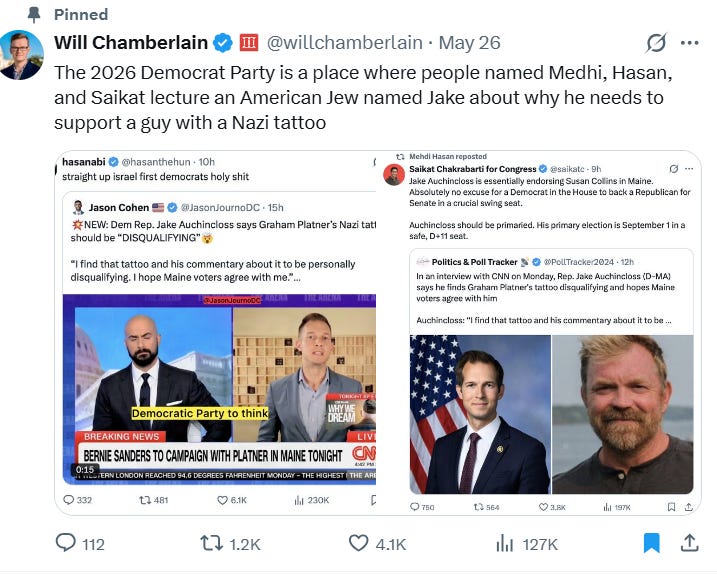
Every day I see another example of humiliation and degradation of Jewish politicians in the Democratic Party. The latest is Jake Auchincloss who expressed dismay at Graham Platner’s Nazi tattoo, for which he was reprimanded by Hasan Piker as an “Israel-firster.”
Hasan Piker. Slamming a Jewish politician for criticizing a man with a Totenkopf tattoo on his chest as an “Israel firster.”
He might as well have called Auchincloss a filthy kike.
Auchincloss apologized.
Sanders is beneath contempt, but all these Jewish politicians crowding the trough like pigs, competing to kiss Jew-haters’ asses is something I’ve never seen in American politics.
I don’t think I can remember a black politician ever apologizing to a Dixiecrat for anything.
It’s beyond disgraceful.
Scanning the news about the Democratic party’s latest shenanigans is a daily exercise in horror.
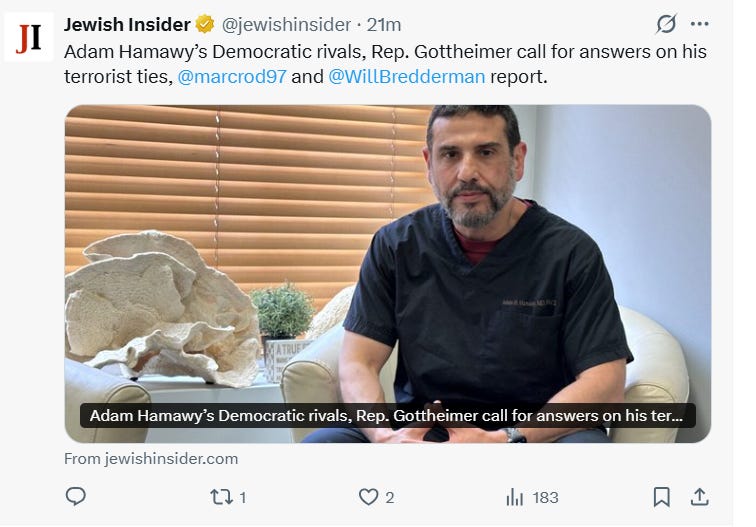
Adam Hanawy, like Bassem Youssef, is an Egyptian-American. Like Youssef, he is a physician. We get the best Muslim immigrants. Not like those British chip shop owners.
AOC, who gives in to every quirk of the radical left (she used to call women “menstruators”) campaigns to all male crowds in a hijab.

I wonder what these guys think of Jews.

No one is going to “take back” the Democratic Party from this crowd.
They are the Democratic Party.
What will American Jews do? I make it a rule never to say “should” here because it’s silly. There is truly nothing more pathetic than a guy on Substack telling people what they “should” do - it’s the equivalent of a drunk banging on the bar at 2:00 a.m.
But I’ll say it: I think Jews should become Republican. I think all Americans who care about the actual country and not a jostling crowd of foreigners who happen to be in the republic should.
But they won’t. Because to become Republican is to become of America and not merely in it. The Democratic Party has been for American Jews a buffer zone, a place where they could LARP as Americans but not really be Americans. Times’ up for that, guys.
Choosing the Republican Party would mean giving up something, though.
The Republicans, too, are changing, and the next generation of Republican politicians will not be shaped by the old evangelical attachment to Israel. The emotional core of the GOP — the Hamilton‑Lincoln instinct to protect the Union and subordinate foreign entanglements to national coherence — is now expressed through an “America First” lens. That doesn’t produce the Democrats’ moral hostility, but it does produce a cold, transactional skepticism: every alliance must justify itself in terms of American interest. No sentiment, no mythology, no special pleading. A future Republican politician formed by this worldview will not call for “disentanglement,” but they will absolutely call for a reframing: a narrower, harder, more conditional relationship defined by American priorities alone.
That’s the choice: a pragmatic relationship and demonization.
During the post October 7 agony, a strange pattern3 emerged: the noisiest and most vicious pro-Palestinian encampments were at the Ivy Leagues and other snotty selective schools that Jews love to brag we dominate. And yeah, we do. How many books were written about Jewish overrepresentation at
Let’s do a comparison. While violence engulfed (names) let’s look at two Texas universities: University of Texas at Austin, and Southern Methodist University. Students at UT Austin tried to set up a small protest encampment on a campus lawn, which the university had already said was not allowed. Because they were using the property in a prohibited way and refused to leave when told, police moved in quickly and arrested dozens of people. Officers in riot gear and on horseback used pepper spray and physical force to disperse the crowds, resulting in the arrest of nearly 80 students, faculty, and journalists over several days.
It was violent and made headlines. After the police cleared the attempted encampment, the situation wasn’t “over.” Students kept protesting on campus, but they didn’t try to build another camp because police shut down any attempt immediately. The later protests were shorter, more mobile, and constantly watched by police, so nothing like the first confrontation happened again. Notable, but not on the level of Columbia, Harvard, or MIT, where university life was completely disrupted.
At Southern Methodist University (SMU) things were even quieter. Right after the October 7 attacks, SMU President R. Gerald Turner issued a standard campus message. The statement expressed deep concern for affected families (both Israeli and Palestinian), explicitly condemned both antisemitism and Islamophobia, and pointed students toward counseling and pastoral support. It didn't "clamp down" on anything; it focused on maintaining a welcoming campus environment. (This is the kind of message that enrages hardcore hasbaristas. I think it was perfect.)
The campus culture is starkly different - and so are the institutional rules. Unlike public universities that faced immediate First Amendment legal battles over spontaneous protests, private SMU relied on strict, pre-existing administrative policies. Their rules require students to submit outdoor event requests at least five days in advance and completely bar outside, non-university individuals from organizing on campus. This combination of a less activist student culture and tightly regulated bureaucratic space kept the Dallas campus entirely orderly.
And maybe there’s this: the students at SMU had no interest in demonstrations for Palestinians. Imagine that.
Life went on at SMU.
For generations, ambitious Jewish families knew the path forward: aim for Harvard, Columbia, Penn, Yale — the elite colleges and universities of the Northeast and Mid-Atlantic. These schools were not just prestigious academic institutions. They were symbols of Jewish ascent in America, places where a community once shut out by quotas had built vibrant campus lives and become vital to the intellectual and cultural fabric of higher education.
That roadmap is now breaking down. Across Jewish day schools, synagogue youth groups, and Jewish and Zionist family dinner tables, a profound debate is unfolding. Parents and students are asking a new question: Should you still chase the Ivy League dream, hoping to carve out a space for Jewish identity on campuses increasingly hostile to open expression and Israel?
Or should you go where you can thrive, to universities that welcome you as a student and as a Jew, where you can build community and simply live without fear or exhaustion?
I will go there.
Top Jews are like top people everywhere. They like to run things - A place at the table isn’t our style. We want to be at the head of the table. And going to an Ivy (or Stanford or Duke or MIT) gets you a seat at the table. It’s the equivalent of a British courtesy title. It can’t be revoked no matter how bad your behavior. “British Lord dies in drug den” is still a British Lord. Same goes for Harvard grad.
As David Bernstein tirelessly documents on X, the Ivy betrayal is a deep personal wound. Bernstein went to Brandeis, home of the “didn’t quite get into an Ivy” student body, and then to Yale Law. He feels this in his gut. He tweets a LOT about Harvard.
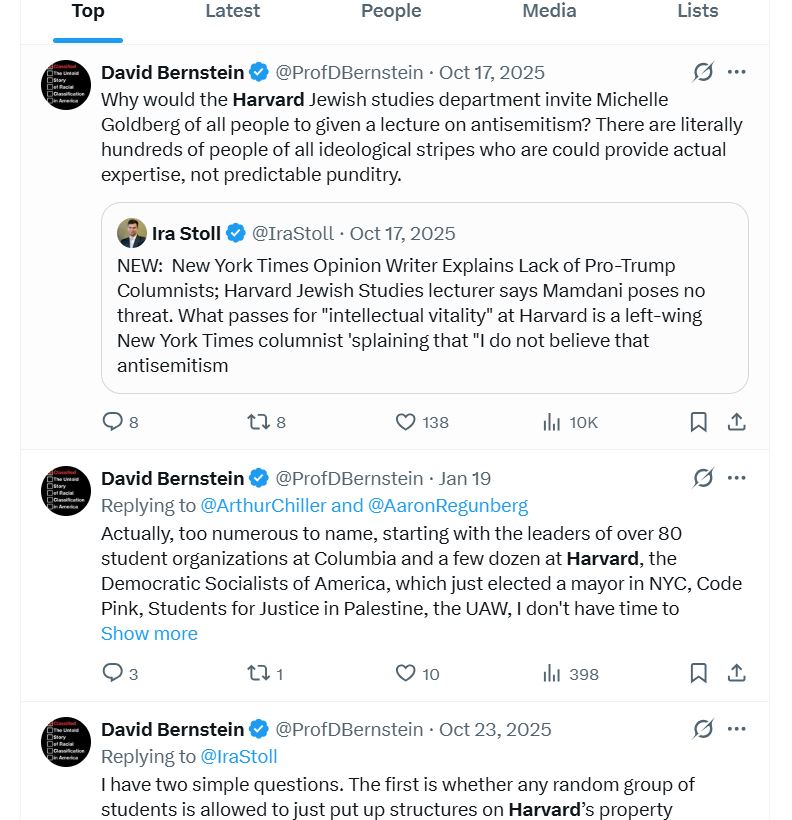
(the previous is only a sample - there are dozens of such tweets)
About SMU? Not so much.
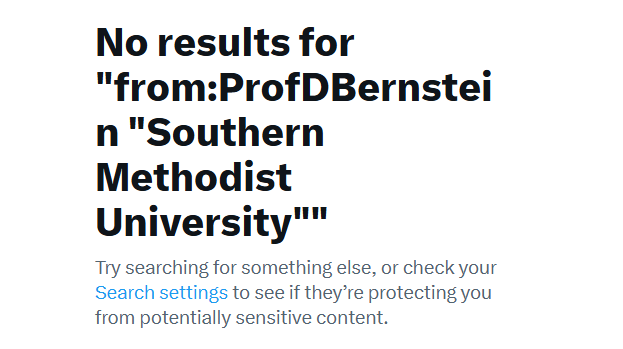

While David Bernstein is bemoaning “our” loss of Harvard, normal Jewish kids are going to Tulane, SMU, Vanderbilt, and Wake Forest.
I seem to have strayed from the topic - but I really haven’t. Jews are done with the Democratic party, and the Democratic party is done with the Jews.
That doesn’t mean Jews will abandon the party en masse right now. I saw an older lady in the part near the Museum of Natural History the other day. I can’t be sure she’s Jewish but… I think so. She wore big pink plastic earrings that spelled out “FUCK ICE.” They looked something like this:

I wanted to ask her if I could take a picture of them, posing as an ally, but I didn’t because I couldn’t. I just can’t do that sort of thing.
I wanted to ask her if she thought that changing America’s demographics to welcome large numbers of people who want her dead was a good idea but I didn’t because I don’t do that nonsense anymore. (I used to. I realized somewhere along the line it was dumb.)
I just looked at her and made a mental note to tell you.
She is representative of the millions of American Jews who hate Republicans because its a core part of their identity.
Earlier I said I’ve never seen anything like this in the US. But I have seen it in Jewish history. Allow me the following analogy.
In 1391, anti‑Jewish pogroms swept through the Christian kingdoms of Castile and Aragon — from Seville and Córdoba to Valencia and Barcelona.4
The Jews of Christian Spain deserve much more attention than they’ve gotten. Suffice it to say they presaged uncannily the Ashkenazi accomplishment of pre-WW2 Germany. They were hyperliterate and concentrated in law, medicine, and trade.
The pogroms were triggered by a clerical firebrand, Ferrand Martínez, whose years of Jew-hating agitation in Seville — ignored or weakly checked by the crown — primed a volatile urban population already strained by economic crisis, plague aftershocks, and political instability. When local authorities failed to stop him, the violence he’d been stoking finally exploded.
Shocking scenes of violence spread to the major cities of Christian Spain — Seville, Córdoba, Toledo, Burgos, Valencia, Barcelona, Palma. Everywhere the pattern was the same: Jews were given a choice — convert or die. Some chose death.
Most chose conversion.
We know this from two independent sources. First, the written records: baptismal rolls, municipal reports, royal correspondence, inquisitorial files. Spain kept meticulous documentation. The documentation is confirmed by genetics: modern Iberian Jewish‑descended populations show clear signatures of mass 14th–15th‑century conversion — exactly what the written record describes.
It’s not the story that Jewish historians like to focus on: Jews bravely choosing death or exile over conversion. Roughly half to two-thirds of the Jews in Castile and Aragon chose conversion. I personally think it’s the higher bound. Just for the completists among us, some Jews did survive. Upshot: 65% converted, 20% remained Jewish, and 15% were killed.
The Jews’ loss was Spain’s gain: these conversos contributed greatly to Spanish culture. The old line was that Spanish humanism was thin, derivative, and imported. An American academic, Kevin Ingram says no.
He believes that Spanish humanism was not thin and not derivative — and that you simply can’t understand it without the conversos. They were everywhere in the intellectual, legal, and administrative strata that incubated the movement. Their marginal status pushed them toward interior spirituality, toward texts, and reform. What emerged was rich, deep, indigenous — and unmistakably shaped by Jews.
American Jews aren’t faced with “convert or die.” They’re faced with “vote for a party you’ve been raised to think is foreign to everything that’s ‘Jewish’ or suck it up and stay where you are.’
I say they’ll stay where they are. And staying with the Democratic Party isn’t continuity; is a modern form of conversion. By clinging to a tribal affiliation that’s now controlled by hostile groups, the American Jews perform an agonizing act of self-abnegation (such as apologizing for daring to register dismay at Nazi symbols on Democratic candidates), surrendering historical memory in exchange for the hollow comfort of the familiar and the empty promise of inclusion and security. It is the tragic hope that by adopting the new language of the orthodoxy, the converted might finally be spared the hostility that has already taken root at the party’s core.
I’ll discuss MAGA’s smashing primary wins with respect to my theory of American party politics in upcoming days.
There’s something about the sixth decade of the century….
Some did see defending South Africa as a defense of Western Civilization, but they were a fringe on the hard right.
Strange to those who hadn’t been paying attention, which means most American Jews, especially the ones who give money to the top 20 universities.
Not Granada, which survived as an independent Muslim emirate, a diminished remnant of the once‑expansive al‑Andalus. Al‑Andalus was the Muslim‑ruled part of the Iberian Peninsula — once covering most of today’s Spain and Portugal, and by the late 1300s reduced to Granada alone. This is not meant as a paean to Al-Andalus, which itself underwent repeated anti-Jewish spasms, it’s simply a fact.