
Someone was so triggered by my response that he blocked me.
I think that a dystopian future in which Jews will need people to hide them is inconsistent with American history. It’s superimposing a European template on American reality and I’m not interested in engaging with that because it’s just catastrophizing and engaging with other people’s catastrophizing is a waste of my time.
America is not antisemitic. It’s not likely to become antisemitic — unless we import huge numbers of Muslims, which I’m not dealing with here. I’m speaking about the America that exists, as we know it.
The treatment of Jews in America, while occasionally exclusionary and prejudiced, doesn’t amount to organized, legal exclusion: preventing them access to education, housing, occupations, or general participation in American life.
The US has two such models, which have been thankfully relegated to the dustbin of history: Jim Crow and the organized violence against Catholics in pre-Civil War America. Jim Crow is well documented. For whatever reason, the anti-Catholic hysteria of the 1840s and 1850s is less well known. Jews have never experienced anything close to either of these in America.
Jewish history in America begins with George Washington’s Letter to the Hebrew Congregation of Newport, written in 1790.
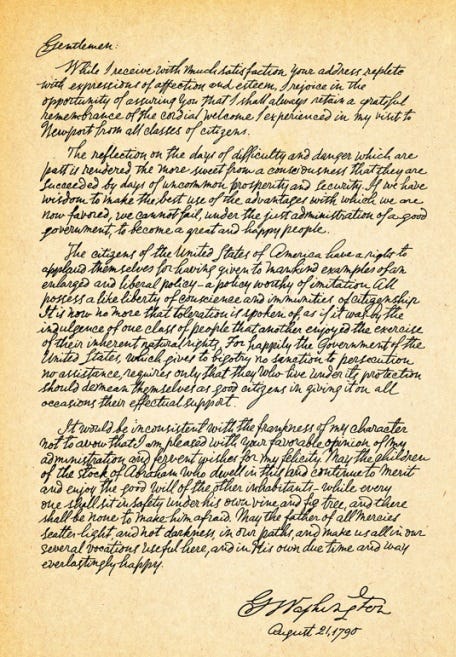
the Government of the United States, which gives to bigotry no sanction, to persecution no assistance, requires only that they who live under its protection should demean themselves as good citizens in giving it on all occasions their effectual support.
It would be inconsistent with the frankness of my character not to avow that I am pleased with your favorable opinion of my administration and fervent wishes for my felicity.
May the children of the stock of Abraham who dwell in this land continue to merit and enjoy the good will of the other inhabitants—while everyone shall sit in safety under his own vine and fig tree and there shall be none to make him afraid.
May the father of all mercies scatter light, and not darkness, upon our paths, and make us all in our several vocations useful here, and in His own due time and way everlastingly happy.
May the children of the stock of Abraham who dwell in this land continue to merit and enjoy the good will of the other inhabitants—while everyone shall sit in safety under his own vine and fig tree….
What a prince! And a slave-owner. That is a central contradiction that we cannot deny. Jews as Jews were welcomed by Washington. Washington owned slaves. It’s a contradiction and people must live with contradictions.
Restrictive covenants, Ivy League quotas, and social exclusion? Sure, but they were applied to the Irish, Italians, and many other groups. These were private or institutional biases, not laws.
Not one U.S. statute ever targeted Jews explicitly. Books like North of Slavery, David Bernstein’s Classified, and Daniel Sharfstein’s The Invisible Line cover the creation of anti-black laws comprehensively. The Constitution has three amendments drafted to normalize the legal status of the freedmen and their descendants. No one else ever needed that.
The WASP establishment hemmed Jews in alongside other non-preferred groups—never with the singular, racialized focus that defined anti-Black policy.
Let’s talk about something that’s been swept under the carpet—the anti-Catholic violence of the 1850s. I knew nothing of this until I read America Aflame. I recommend this book highly. Riots in Philadelphia, Louisville’s Bloody Monday were only a few of the anti-Catholic riots in which mobs burned churches, killed dozens, and terrorized neighborhoods, fueled by nativist movements like the Know-Nothings. One of the most prominent Know-Nothings was Lewis Charles Levin, who:
played a leading role in inciting the Philadelphia nativist riots which led to the killing of over 20 Irish Americans; the burning of many of their homes; and the destruction of three Catholic churches associated with their community.
Oy! Not exactly tops on my list of “Great Jewish Americans.”
Anti-Catholic violence was a movement, with political muscle and street-level chaos. Antisemitism in the U.S. leaned more toward exclusion (covenants, quotas) than torches and pitchforks. America Aflame goes as far as linking the anti-Catholic hysteria of the pre-CW era to the outbreak of war – many of the Protestant clergymen who whipped up anti-Catholicism became ardent abolitionists. All that emotion had to go somewhere. It’s an interesting theory, if unproveable.
The Tree of Life synagogue shooting in 2018—11 dead, explicitly antisemitic—was monstrous, no question. But it wasn’t part of a broad-based organized movement like the Know-Nothings, nor did it have Jim Crow’s legal backbone.
Mass shootings in America are a veritable plague — schools, malls, churches, synagogues, young, old, black, brown, yellow, white —all are fair game for one nutjob with a gun and an imagined grievance. The Tree of Life fits that grim pattern more than it signals a uniquely antisemitic uprising. Compare it to, say, the 1921 Tulsa Race massacre (a whole community leveled) or even the 1844 Philadelphia church burnings — systemic, mob-driven. Or Russia’s Black Hundreds for that matter.
I’ve made my point, but for emphasis here are a few more examples:
The New Orleans Lynching (March 14, 1891)—the largest mass lynching in US history.
It’s the deadliest single lynching event in U.S. history—bigger than any single anti-Black lynching in raw numbers and it reflected deep anti-Italian prejudice. This lynching shows how immigrant groups could face explosive, collective violence. Not one perpetrator was ever prosecuted.
The New Orleans lynching was a peak of anti-immigrant rage, but it’s still a different beast from Jim Crow or the organized anti-Catholic street wars of the 1850s.
Father Coughlin
I’m certainly not going to put a good word in for Father Coughlin’s ranting during the run-up to the worst period of Jewish history. I will simply point out that his heyday was during a period when America was dominated by a WASP elite that still openly despised “Romanism” and saw Irish Catholics as a fifth column for Rome. Coughlin leaned into that tension, casting himself as a martyr for the faithful against secular, Protestant, or Jewish “elites.”
But here’s the thing: the Church hierarchy saw him as a pain in the ass, not a spokesman, and in 1942, the Archdiocese of Detroit ordered him to cease his radio broadcasts and shut down his publication, Social Justice, which had been banned from distribution by mail for violating the Espionage Act.
No defense of Coughlin. His antisemitism was vile and deliberate. But what whipped up mobs in Europe didn’t in the US. His listeners were angry Catholic working stiffs who had a legitimate beef with the system. But instead of joining mobs to invade ghettoes and kill Jews, they turned off the radio, went to a ball game, and voted FDR. With the Jews. (And blacks.)
Leo Frank—Antisemitism or Yankee Hate?
Now I’ll really step into it. Leo Frank’s lynching in 1915 wasn’t purely antisemitic; it was entangled with class tensions and anti-Yankee bile.
What set off the explosion? Governor John Slaton commuted his death sentence to life in 1915, aware that the evidence was shaky. A mob—calling themselves the “Knights of Mary Phagan”—kidnapped Frank from prison and lynched him in Marietta, Georgia. Antisemitism was surely in the mix: newspapers like Tom Watson’s Jeffersonian railed against Frank as a “Jew pervert,” and trial crowds hissed anti-Jewish slurs. But it wasn’t the whole story.
Frank was also a Yankee—a Brooklyn-born outsider in a South still licking Civil War wounds. Atlanta’s industrial boom drew Northerners like him, and locals resented these “carpetbaggers” running factories, exploiting cheap labor (like Phagan). Class was involved too: Frank was educated, middle-class, managing a pencil factory, while Phagan’s people were poor whites. The mob didn’t just see a Jew—they saw a rich, northern interloper defiling a Southern girl. Watson’s rants hit all those notes, not just the Jewish one. Antisemitism fueled the fire, but anti-Yankee animus and populist rage lit the match.
How can I possibly say this? The history of Jews in the Confederacy supports this. Jews weren’t “outsiders” in the Confederacy – they were a part of the power structure. Judah P. Benjamin served as the Confederacy’s Secretary of War and State—a very big deal. He had a strong friendship with Jefferson Davis. Jewish communities in Charleston, Richmond, and New Orleans thrived, supported the war effort, and sent their sons to battle.
The female matron of the largest Confederate military hospital was Jewish.
The South’s “blind poet laureate” was Jewish.
Bernard Baruch’s father, Simon, was an unreconstructed Reb:
Bernard Baruch recalled how his father, a former surgeon in the Confederate Army, would at the sound of the song "Dixie" jump up and give the Rebel Yell, no matter where he was: “As soon as the tune started Mother knew what was coming and so did we boys. Mother would catch him by the coattails and plead, ‘Shush, Doctor, shush.’ But it never did any good. I have seen Father, ordinarily a model of reserve and dignity, leap up in the Metropolitan Opera House and let loose that piercing yell.”
The Hebrew Confederate Cemetery in Richmond, Virginia—dedicated in 1866, is the only Jewish military cemetery outside Israel.
Frank’s lynching, then, clashes with that history—his Jewishness marked him, but his being a Yankee made him alien in a way Southern Jews weren’t. Frank was one of those Jews, not one of our Jews. Frank’s fate wasn’t a national antisemitic crusade—or even a Southern one — it was a regional multifactorial explosion. And it passed.
But couldn’t things take a turn for the worse? Couldn’t there be a massive nudge from the elite, not coordinated but a shove out the door nonetheless? A “cold war” — no formal declaration, no marching armies, just a persistent pressure —ebbing, flowing, sometimes freezing Jews out of spaces they’ve fought to enter.
A society doesn’t need Tsarist edicts or Nazi race laws to be effectively antisemitic in practice. No ovens or exile decrees here; instead, it’s exclusion with a handshake, a glass ceiling, a decorous 'here’s the exit' with a polite smile. It’s not Jim Crow’s iron heel or the Know-Nothings’ blazing torches against Catholics — genteel disdain, a door closed behind you, with your face flushing.
I think it’s already happening.
But here’s where the optimist in me steps up. “America” isn’t showing Jews the door: only a certain part of it is. The worst part. And I say, good riddance to them.
There’s liberation in being turfed out of the stuffy, snotty halls of the Ivy League. Let them keep their oak-paneled cages. The real story — the vibrant, gritty, American one — unfolds elsewhere. SMU has our back. Vanderbilt hums with Southern intellect unbound by coastal elitism. Iowa and many other state universities are quiet powerhouses — they hum along, doing their jobs, while Columbia rots. Greatness doesn’t need a New England zip code. Quite the contrary — I think our finest hour academically was at City College, not Harvard.
Exclusion can breed freedom, a chance to build something better outside the gatekeepers’ shadow. And again: we won’t be excluded from American society—in fact, we’ll be forced into it. The ghetto is Harvard. Time to step out of the walls and breathe fresh air. Thanks for the memories. We can stun the world from somewhere else.
“The US has two such models, which have been thankfully relegated to the dustbin of history: Jim Crow and the organized violence against Catholics in pre-Civil War America.” On the topic of legal exclusion let’s not forget the Chinese Exclusion Act of 1882 and the Johnson Reed Act of 1924.