
Happy New Year.
I’m starting something new tomorrow because I’m tired of the way I conduct this Substack and lately I’ve been wondering what I’m doing here.
Most of what I write about is negative. That’s not good. I started writing here to be analytical, to get stuff off my chest, and I fell into the rut of thinking that what I say is important. It’s not.
But I don’t want to stop writing. So I’ve decided that I’ll write diary-type entries once or twice a week. This (hopefully) will be an antidote to my tendency to ramble, plus it will continue to function as my mental safety valve.
I thought I’d end the year with a movie review/impression. It doesn’t really have a point. Yes, it will ramble. As I said, it’s the end of a chapter.
Believe it or not, I never saw When Harry Met Sally when it came out and in those days, I saw every one of those “you gotta see this” movies and WHMS was a “you gotta see this” movie. After the terrible news about Rob and Michele Reiner I thought I should give it a go.
Those of you who adore WHMS should stop right here because…
I wasn’t crazy about it.
Let’s start with the good stuff: the two lead actors.
Meg Ryan. Was anybody ever prettier than Meg Ryan in this movie? She made a character that really could grate on your nerves lovable because you just wanted to gawk at her. She even made 1980s hair look great!
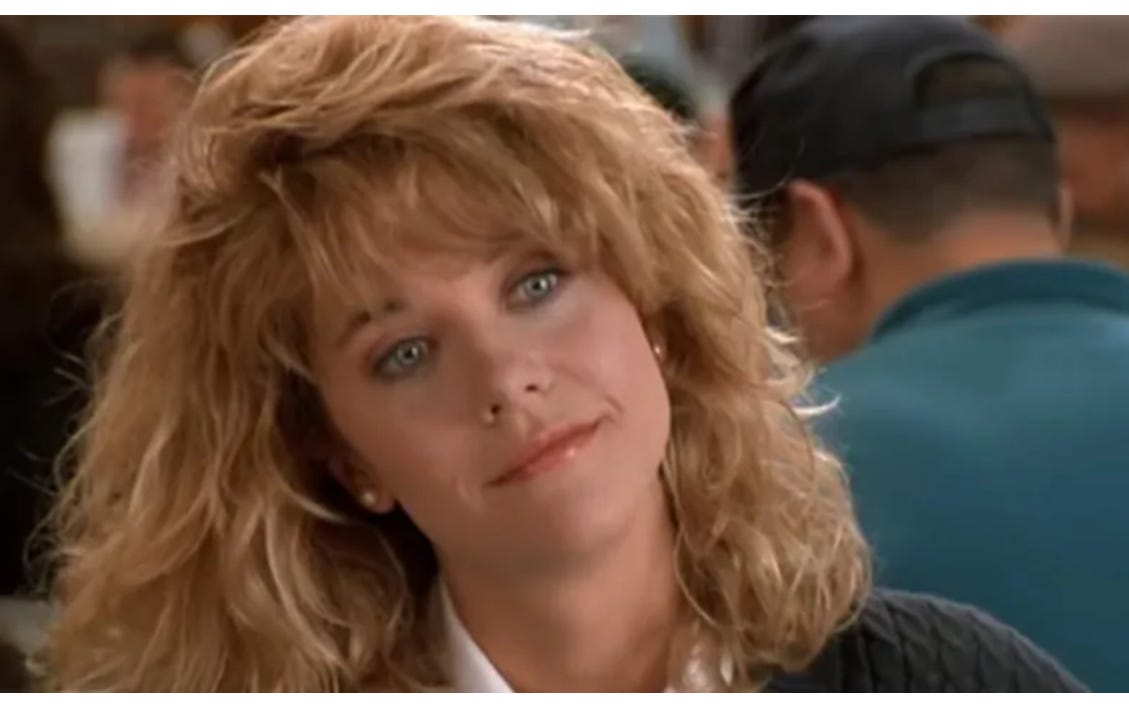
IMO, Meg Ryan leaves Julia Roberts in the dust.
Billy Crystal was great because he’s primarily a comic and being a comic is all about dominance. The rom-com genre is about getting hitched, i.e., the man loses (LOL).1 In bad rom-coms, men become cyphers2. In a good rom-com the guy’s got to assert dominance. She wins the war but he dominates the battles.
Crystal gets all the points, Ryan wins the match.
The rest of the movie was standard: boy meets girl, loses girl, meets girl, loses girl, gets girl, and so on, updated to 1980s NYC. And that’s where my problems were: its depiction of the city and of life in NYC during the 80s. Those of you who aren’t from NYC (like, the majority of the world) might not mind this, but they put me off.
Glamorization is one thing but total distortion is another. After their epically horrible 18-hour car trip, the characters enter New York to the sounds of Louis Armstrong and they part. That’s it, nothing more.
Coming to NYC, as I’ve been told by many a non-NYer, is a true shock, not an abstract culture shock, but a physical jolt. First of all, simply entering Manhattan is an ordeal. It’s an island. You have to either drive over a bridge or through a tunnel. Then you get inside and you are surrounded by bedlam; a great big bubble that envelops you and replaces everything you had taken for granted with a new reality. We saw none of that.
Washington Square was a site of quiet, leafy strolls. In the real 80s it was noisy, crowded, full of buskers, drug dealers, and far from serene. In the scene in the Met’s Temple of Dendur they were the only ones in the place. It’s always a mob scene. Central Park in the 1980s was unsafe and generally avoided. The apartments were spacious and beautifully kept up. Not one clanking radiator.
Which brings me to the drug-free The New Year’s Eve party. NYC in the 80s was sodden with drugs. Many reasons for this but the major one was, in my opinion, that that the culture was obsessed with work. It was the first decade of billionaires, and NYC was the epicenter of the finance part of that.
Scout’s honor, I never snorted cocaine during the 1980s, but you had to be comatose not to be aware of it. And I was absolutely part of the work-centric culture, where staying after 6:30 PM (with a company paid dinner and car service home) was routine.
Then there was club culture, from uptown’s Studio 54 to downtown’s CBGBs to everything in between. There is zero reference to any of that. Again: I was not heavily into club culture but I did my share. I didn’t expect documentary accuracy, but a few offhand observations would have really helped.
I think it’s because it was really a Nora Ephron movie; not a Rob Reiner movie. She was 48 when she wrote it. Nora grew up in Beverly Hills as the daughter of two Golden Age screenwriters. She lived in NYC for a few years after Wellesley during the early 60s. The years of our 20s are particularly powerfully imprinted on our brains. This movie really channeled 1962 more than 1988. Even so, the director and the DOP should have given us more of the real city.
Here are three examples of movies that truly do give you an authentic feel of Manhattan: Barefoot in the Park (1967); Three Days of the Condor (1975); and Harry and Tonto (1974). Barefoot in the Park depicted a surprisingly authentic picture of the shabbiness of apartment life: the exhausting climb up five flights of stairs, the peeling paint, the bathroom with no bathtub, the crack in the skylight that lets in snow, the crazy neighbors, NYC’s stoop culture. Manhattan’s canyons and brownstones formed the spooky cat and mouse backdrop of Three Days, and if you want to know what NYC looked like in 1974, see When Harry Met Tonto Harry and Tonto.
It’s a weird way to end 2025, a review of a movie I didn’t see in 1989, by a director whose death came in the middle of other terrible events. But it’s what came out.
See you next year.
My resolution: stop caring. It’s gonna happen anyway. But I won’t stop writing.
“A man runs after a woman until she catches him.”
Which happened in My Big Fat Greek Wedding.
You are dead right about Julia Roberts, she is not pretty, she is weird. I would take you before her any day.