February 10, 2026
The Day Australia Ceased To Exist

The predictable happened in Sydney yesterday. When more than two pro-Palestinians get together, it’s a demonstration riot. That’s axiomatic.
However…
I question the wisdom of inviting Israel’s president on a state visit and linking it explicitly to Bondi. It is a question of citizenship and belonging. Bondi was clearly antisemitic and linked to Israel — but Israel does not formally represent Jewish citizens of Australia and it’s hazardous to conflate the two.
That doesn’t excuse the violence of the demonstrators. They were offered a permit and of course, rejected it, preferring confrontation. I despise these people.
None of this happened in a vacuum. Australia itself has been under attack since the Mabo decision.1 I might as well let this rip. I was going to publish it on Australia Day and chickened out. But since we’re all riled up, why not go for it?
The Day Australia Ceased to Exist
The Mabo decision wasn’t a “step forward” for justice; it was a legal suicide note for a sovereign nation. By overturning terra nullius — “land belonging to no state” — Australia’s High Court didn’t just broaden property law to recognize the rights of Aborigines, they yanked out the very foundation upon which the Australian house was built. “Terra nullius” never claimed that Aboriginal people didn’t exist or weren’t recognized by the Crown. They clearly did and were, but they were divided into hundreds of clans. “Terra nullius” encompassed a recognition that no “state” existed and the land therefore belonged to no one. And that’s the heart of the matter.
When a High Court tells a people that their country’s birth was a mistake, they’ve abolished the future. Australia as a coherent, sovereign project ended in 1992; what’s left is an administrative zone that is collapsing under pressure. There is no secret sauce to Australia’s existence. They don’t grow stronger with American-style centrifugal force. They don’t benefit from chaos as the US does. They unite or die. And the reason for unity was killed by Mabo.
The Fiction of Sovereignty
We are told that “Crown Sovereignty” remains absolute. This is a pathetic legal lie. You cannot claim to be the sole sovereign power of a continent while simultaneously admitting your original claim to that land was based on an original sin (my words; they called it a “legal fiction”). If the foundation is a lie, the entire structure is illegitimate.
By acknowledging a pre-existing title that the state didn’t grant2, the Court ruled that the Australian State is an interloper on its own soil and opened the door to an ever-expanding labyrinth of legal decisions which, bizarrely, privilege conquest over settlement. Such language appears throughout the ruling — “settled colony,” “acquired by settlement,” and most notably “not acquired by conquest or cession.” The implication is clear: Mabo structurally favors conquest as the only legally “clean” origin.
What an irony. The High Court essentially ruled that if the British had been more violent — if they had declared a formal war of conquest and signed a treaty of surrender — Indigenous rights would have been legally extinguished. Instead, because the British chose the comparatively peaceful path of settlement, the Court decided they left the legal door unlocked. Australia is now a nation being punished for the “sin” of not being a conqueror, leaving the modern state to manage a legal system that it admits is built on a hollow foundation.
A Nation Without a Center
Every successful nation requires a “myth” in the sense of a central, unifying story taken as truth by its citizens. For America, it was the revolutionary break from monarchy and the birth of popular sovereignty. For Australia, it was the peaceful settlement of a continent under a single, unified legal system inherited by the mother country, Britain, whose sovereign was ever-present in spirit and substance. Mabo replaced a unified identity with a fractured landscape of “Native Title” and “Radical Title,” creating a country that is now just a collection of competing legal claims held together by a “Crown” that exists only on paper.
The Collapse of the State
To say the government can “extinguish” these rights is a hollow consolation. It’s an admission of brute force, not lawful right. Australia has moved from being a nation with a culture and a core identity to a zone of perpetual litigation and all the cheery talk of polls now showing support for Australia Day are self-serving. “Dying societies accumulate laws like dying men accumulate remedies.”
I do feel — and yes, I use the word “feel” without shame, for these are things that tear at the human heart — that the Aborigines were treated by Australia in a cruel way that the natives of the US, Canada, and New Zealand weren’t. We need not go into the whole story. It’s enough to say that their very humanity was questioned until recent memory.
Martin Luther King said that the black American was given a bad check. I think that Australia was, to the Aborigines, a deadbeat dad3. But killing dad is no way to run a home. As for political solutions to human tragedies, Groucho’s my man: “Politics is the art of looking for trouble, finding it everywhere, diagnosing it incorrectly, and applying the wrong remedies.”
You can make good on a bad check. It’s hard to make up for deadbeat dads.
Australia isn’t a house divided, it’s a house destroyed, and Australians black and white are orphans in a vast continent with a dead center.
It should be obvious that I’m on Australia’s side here. But I must acknowledge the logic and courage of the Aboriginal case: they had a claim, they fought for it, and they won. “Non-Indigenous” Australians, on the other hand, are fighting for the right to party on the day the British arrived with convict ships. Perhaps they should save the celebration for the day they finally cut the cord.
Opening that link will force you to click through this, now ubiquitous reminder of Australia’s illegitimacy.
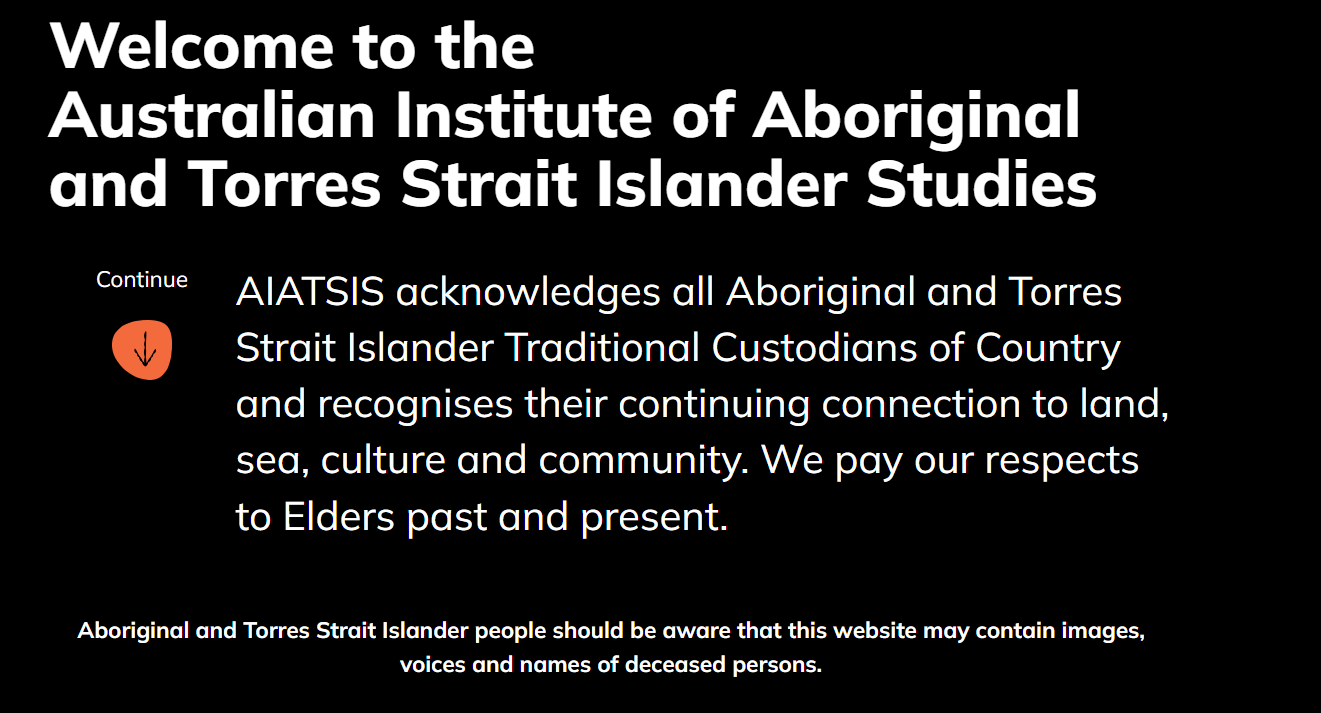
Can someone please explain to me why only Aboriginal people must be warned that a website contains pictures of deceased persons? Are they the only people who are upset by the departed?
Who or what did? Beats me.
I mean this literally — most Aborigines are mixed race, some of them majority European genetically — and figuratively (“Protectors”, etc.)