
In my review of A Complete Unknown, I left a lot out because I just wanted to give a rough impression of the movie.
A Complete Unknown
I just saw A Complete Unknown and I want to review it before my impressions grow stale.
It — simply going to see the movie, that is — was actually something of a “return of the semi-repressed.”
I was a kid — literally — during the “folk boom” and it never quite left me. As one of the younger-middle Boomers, there were many older kids around who were far more into the scene and who translated the style to us younger kids. Plus I had older siblings and cousins. One of my earliest memories was seeing this intriguing cover in one of their houses.
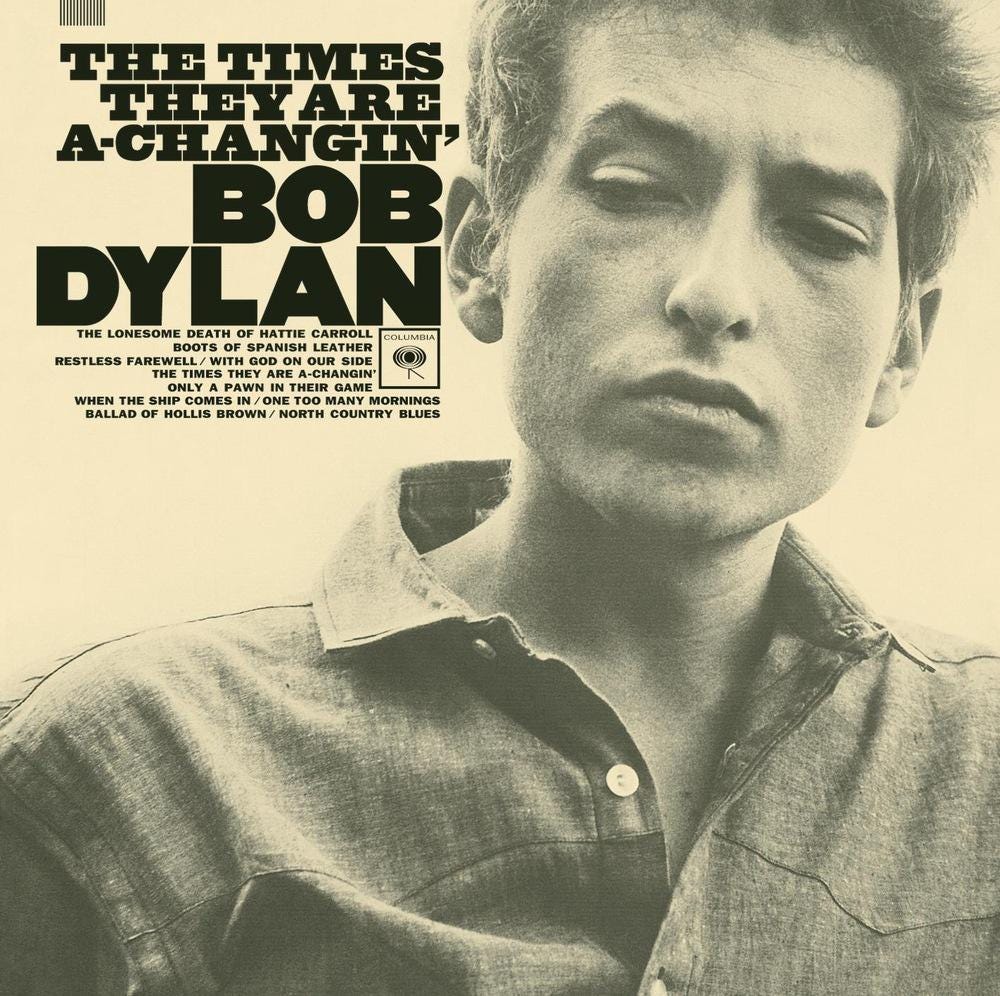
That was different! Work shirt, unsmiling, not looking into the camera… In short, I was a baby folkie. We all were: camp songs, guitars, that stuff. That didn’t stop me from losing my shit over the Beatles. Kids’ minds are roomy. And it turned out that mine was the exact demographic that presaged the change in the music industry… but I get ahead of myself.
As I matured, I turned against it. Folk was for dorks. And it was a bit of a joke. Every girl at camp had long hair, every group had its wannabe Joan Baez or Joni Mitchell, trying so desperately to be original, copying their every tic and move…
I’ve been reading a bunch of books about the era. The reading, plus seeing A Complete Unknown and the two movies I’m going to review here, convinced me I have some rethinking to do. And in any case, there’s truth and there is falsehood, and it’s always important to distinguish between the two.1 We must “remember correctly accurately.”
OK, get to the subject! I haven’t quite worked out all my feelings yet so I’ll just say that this is being written from the perspective of a penitent.
Folk music: I am sorry I hated you. Will you forgive me? Take this as an offering.
Inside Llewyn Davis and A Mighty Wind couldn’t be more different — the first is a Coen Brothers tragicomic odyssey, the second a Chris Guest mockumentary — but under the hood, they share the same sneering contempt for folk music and its practitioners. Both treat the folk boom not as a genre with quirks, but as a fundamentally embarrassing mistake.
A Mighty Wind is a roast minus the affection. Christopher Guest doesn’t just parody folk’s awkward earnestness; he dismisses the whole genre as kitsch. Every song is a pitch-perfect imitation of commercial folk at its flattest. They are all phonies faking sincerity. There is not one nod to the genre’s heart, no space for the bits of sad beauty as there is, at least fleetingly, in Llewyn Davis. Even the most “emotional” moments—Mitch’s breakdown, the final reunion—are immediately undercut by gags.
Making fun of stuff that already sucks is punching down, and punching down is not satire. The Rutles, a spoof of the world’s greatest band, was hilarious because it punched up. The Beatles’ reputation in music history is so rock solid nothing can damage it. And, it was funny.2
The canned mockumentary jokes come rapid fire; every word is a snark, even the words “and” and “the.” When everything’s funny, nothing is. The characters aren’t people — they’re crude caricatures with punchlines. The harmonies, the banjos, the group names—it’s all setup for a joke, and the joke is folk music, music for dorks.
Llewyn Davis could have been something: the core idea was great, and the Brothers have the talent, but the execution was abysmal. The main character was dreadful and the framing was worse. Two fatal mistakes, I’d say.
The Coens wrap everything in bleakness: icy sidewalks, sour faces, and the chill tones of a musical movement already on life support. When Justin Timberlake and Carey Mulligan take the stage to sing with “Troy Nelson,”3 , they look as fake as anyone out of A Mighty Wind.
Llewyn sings eerie Child ballads with depressing names (“Hang Me, Oh Hang Me”) to bored audiences. Folk isn’t alive, it’s embalmed. The Gorfeins, his Upper West Side academic friends, don’t live, they perform: their friends, their food, it’s all a desperate attempt at embodying authenticity. (“Have some of my wife’s famous moussaka!”), the invited guests are always a curated sampling of diversity before diversity. Some of this is mordantly funny, but in a mean-spirited way. I found myself ashamed of my own chortling.
Then comes the final kick in the teeth: the new guy shows up—young, vital, luminous—and suddenly you realize Llewyn wasn’t passing the torch. He was never holding one. How could he be? Folk is for dead people and Llewyn’s just the last poor bastard still singing at the funeral.
The isn’t cynically revisionist, it’s a distortion. Greenwich Village in the early ‘60s wasn’t a graveyard. It was a magnet. It was electric. A petri dish of ideas and attitudes that would take over the culture and shake up the world.
Folk was the soundtrack of a moment in time — some raw and real, some derivative, some original, sometimes preachy, sure, but alive. The Village was a crossroads for beatniks, poets, kids from everywhere chasing something they couldn’t name. That’s what A Complete Unknown hinted at and didn’t fully depict. But at least there was a hint.
Coffeehouses like the Gaslight and Gerde’s Folk City weren’t filled with aimless losers — they were packed with kids dreaming big, jamming, arguing politics. Many of the early folkies had crossed over into the scene from other, demanding fields. It was a high-IQ crowd.
America was a cauldron. It’s easy to look back and see that Jim Crow was on its last legs but it didn’t seem that way then. Put yourself in their sandals: in 1961, some states still had legal racial segregation. The Klan’s latest iteration was getting thousands of recruits. They didn’t just do tiki-torch marches. They killed people.4 Going down south was going into a war zone.
In Washington, the wise men who won WW2 were firmly in power – and they were about to send draftees to Vietnam. Oh yeah, there was a draft. You couldn’t afford to be disinterested about the draft board breathing down your neck. The draft was an albatross around every American man’s neck in those days.
And yet, everything felt possible. Kennedy was in the White House. The civil rights movement was gaining steam. There was energy and hope. It wasn’t the end of something. It was the beginning.
Inside Llewyn Davis takes place in winter ’61 — peak folk revival, peak Village buzz — and turns it into a grayscale dirge. The Village here isn’t a magnet, it’s a void. No crowds, no hootenannies, no overflowing cafes. Just Llewyn, scowling through the slush, couch-surfing and blowing every opportunity. The clubs are cold and quiet. The people are bitter, cynical, and range from indifferent to critical. The Village—the Village—is stripped of its heat, its community, its pulse.
Where’s the throbbing scene that pulled kids from across the country? Where’s the fire, the optimism, the weirdos with notebooks and guitars and autoharps (!) crammed into tenements with cold-water flats and shared toilets in the hallways, convinced they were changing the world? Where is Harry Smith?
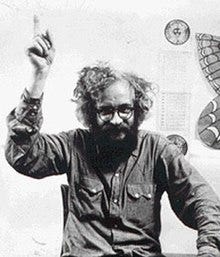
Llewyn is not a tragic figure. He’s a schmuck. He impregnates two women, loses track of one of them, loses his Merchant Marine license because he handed it to his sister and forgot, then screams at her when she throws it out with his old trash — after he told her to. Then he turns down a plum job offer from Albert Grossman (“Bud” in the movie).
His problems aren’t structural; they’re personal. He wants to fail. He’s not crushed by the system. He’s just insufferable.
Which might have been a terrific script, this schmendrick bumbling around a gold mine, except… there’s no gold mine.5
It’s almost as if the Coen Brothers and Christopher Guest had to tear folk down just to make Dylan look bigger. Saint Bobby enters and infuses his divine spark into a necropolis. But isn’t this is a diss on his talent in a way? What’s the glory in being the best of a bad lot? Where’s the challenge in demolishing a termite-riddled house?
That’s not what happened. Dylan was a talented but wet-behind-the-ears kid who blew into a hyper-competitive field that was being watched carefully by the biggest names in the recording industry. He learned fast, took advantage of every opportunity, and raced to the top. That’s an accomplishment, not beating out shlubs like Llewyn Davis.
By the late 50s, disillusioned with bebop, John Hammond, the godfather of the American music industry, was hungry for new ideas. John Hammond — who had signed Billie Holiday, Count Basie, Benny Goodman, Bessie Smith and Robert Johnson to contracts at Columbia Records! A picky guy, he signed only two artists, Dylan and Carolyn Hester. He wouldn’t have wasted his time on a crap scene with lousy musicians. He saw potential.
Jac Holzman ran Elektra, a prestige label. He signed Judy Collins, a trained classical musician who became a folkie. Why? She saw potential.6 Holzman later signed Tom Paxton in 1964.7
Peter, Paul & Mary is a slam-dunk example of the commercial viability of Greenwich Village folk. Put together by Dylan’s manager, Albert Grossman, their polished sound gets them flak for being “folk-lite.” Doesn’t matter — they came right out of the Village revival. They introduced Dylan to a mass audience with their cover of “Blowin’ in the Wind.” Released as a single in 1963, it reached #2 on the Billboard pop chart and sold over a million copies. The song became the anthem of the civil rights movement. The trio performed it at the March on Washington in August 1963, where Martin Luther King Jr. delivered the "I Have a Dream" speech.8 That was a true confluence of music and history that indelibly etched itself in the nation’s consciousness.
It was a pivotal moment for both PPM and Bob Dylan. Dylan idolators don’t want to acknowledge that this cover, issued by a “folk-lite” trio who shared a manager with their Savior, helped to translate his music to the broader public.
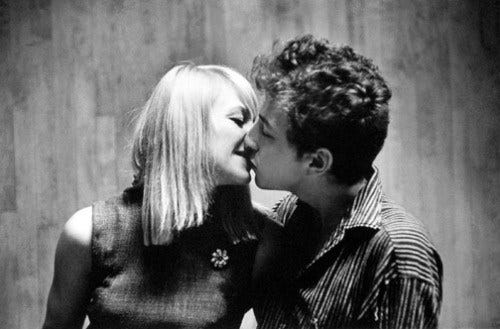
Warner Bros. scooping them up in 1961, alongside Columbia with Dylan and Hester, and Elektra with Collins, paints a clear picture: heavy-hitter labels were all in on folk, no smirking allowed.
Peter, Paul & Mary’s debut album went double platinum, topping charts for months—hardly an embarrassing mistake. Columbia, with Hammond’s gut driving Dylan and Hester9, bet on rawer edges but still saw folk’s weight. Elektra, more niche but prestigious, gave Collins a platform that screamed “credibility.”
Three big labels, three different angles—gritty, commercial, traditional—all treating folk like a cultural and commercial juggernaut in ’61-’62.
Oops, I almost forgot to mention Joan Baez, who became a massive name. At her height, she was selling out the Hollywood Bowl, which seated 20,000.
Double oops, Simon and Garfunkel. Paul Simon had been bumming around Tin Pan Alley for years — he and Garfunkel began recording in 1957 as bubble-gum rockers “Tom and Jerry.” But Simon was always a folkie at heart (or maybe he saw potential?) and in 1964, he and Garfunkel released their first album, Wednesday Morning, 3 A.M., which initially flopped but later gained momentum after the single "The Sound of Silence" was redone with electric instrumentation. Who signed them? John Hammond.
“But no one denies that folk sold out,” say Llewyn Davis’s defenders. “That’s what Llewyn Davis is all about.”
Answer: My problem with the movie is that it shows a scene so dreary no one would pay two cents for it. You can’t sell out if no one is paying you.
These signings torch the Llewyn Davis/Mighty Wind revisionism. No one’s couch-surfing in a dead scene here — big labels were signing big talents, pumping cash into studios, producers, and tours because folk was competitive and bankable. The folk boom wasn’t a joke then, and it’s only later cynics who’ve tried to rewrite it as one. That’s what made Bobby Zimmerman give up his electric guitar back in St. Paul and pick up an acoustic. That’s where the cool kids were.
None of these artists were starry-eyed idealists — they were all hustlers. They wanted success. They also wanted to change the world, but they wanted those record deals. That’s what the Village offered: a chance at the brass ring.
I struggle to explain how a genre that produced some of the biggest names in popular music became punch-line. It’s complicated, but I think it’s this:
All that idealism became embarrassing.
Thinking of Peter, Paul, and Mary singing “Blowin’ In The Wind,” with all the stuff that came after is excruciating. Were we ever that young and starry-eyed? Yeah. Folk is the proof. Yuck. Put on some head-banging heavy metal. Anything but folk.
Has any other genre been so rejected, derided, and mocked — yet influential?
For folk was massively influential. Its ethos, its style bore into the very marrow of society.
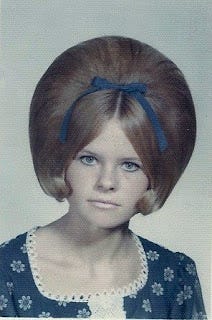
Folk influenced everything. When you see a girl with long, straight hair — that’s because of Joan and Mary, who shocked people when they appeared in public without hairspray and makeup.
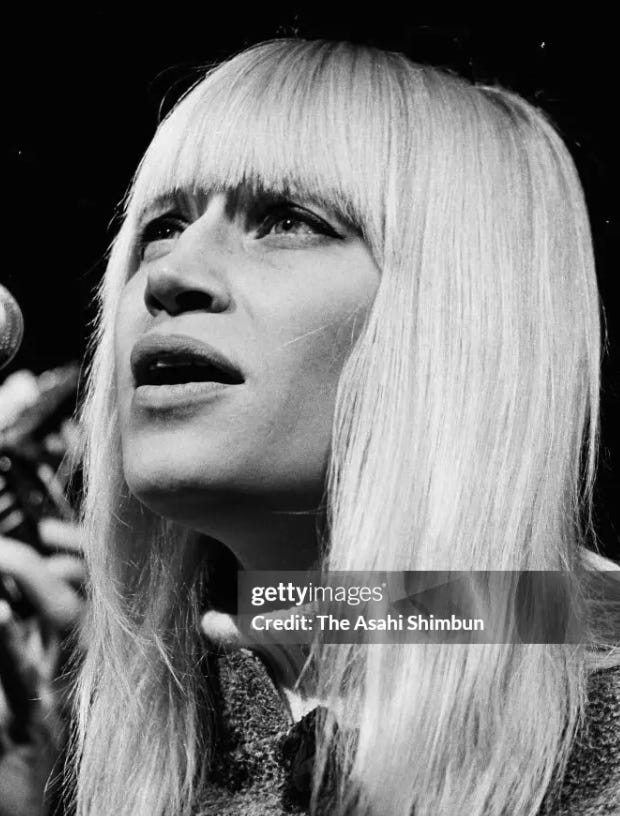
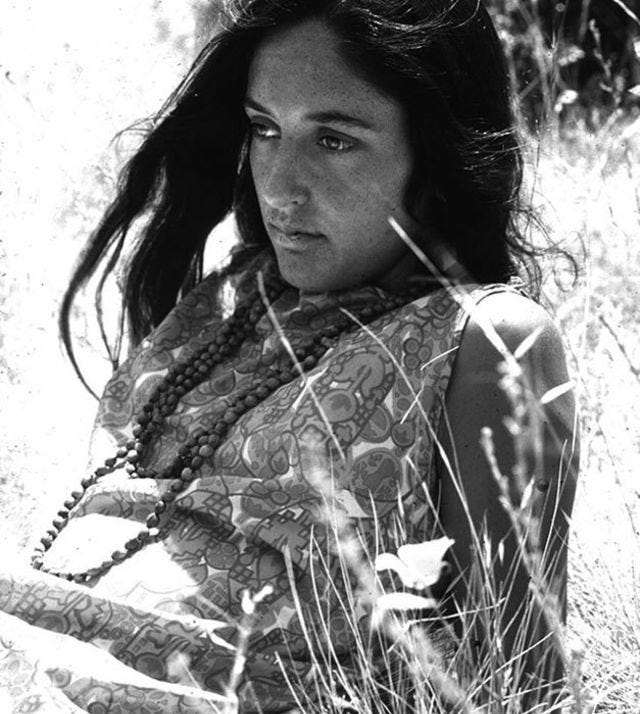
Notice a resemblance?

Girls didn’t wear their hair like this before Joanie and Mary. They sprayed it, they teased it, they tortured it. (“Look up “ratting and teasing.” Ugh!)
When you see grandparents wearing denim, that’s because of folk. Denim was for manual laborers (on the job). Before folk, people dressed formally off the job.
Punk rock - three chords and a garage. Folk.
Singer-songwriters. Folk.
Protests, sit-ins: Folk.
Sure, there was plenty to mock in the folk scene—its sanctimony, its pretensions, the inauthenticity in a scene that prized authenticity (something I’ll write about later) but Guest and the Coens mistake distance for insight, smugness for critique. You can parody a thing and still appreciate it—This Is Spinal Tap and The Rutles prove that. A Mighty Wind is devoid of love, and Inside Llewyn Davis is devoid of heat. They don’t feel like artists wrestling with a complicated past; they are cool kids laughing at the dorks.
But dorks built that scene. Dorks with talent, ambition, and something to say. (And the money men who took a chance on them.)
That matters.
Because if the folk revival was just a graveyard, a joke, then so is everything it helped launch: Dylan, Baez, Simon and Garfunkel, Joni Mitchell, the entire singer-songwriter movement (Taylor, Nyro, many others), and the crossover of folk values into rock, country, and protest music. You can’t burn the roots and pretend the tree still stands.
So here I am, rethinking. Not nostalgic. Not even entirely forgiving. But willing to see that what I wrote off as embarrassing might have been of lasting value. And what I spurned as corny might have been courageous.
That’s why A Complete Unknown hit me. Not because it was perfect — it wasn’t—but because it took folk music seriously, even if it was a little afraid to admit it. It dared to suggest that this stuff mattered. And maybe, if I’m honest, part of me always knew it did.
Books: Down the Highway, Howard Sounes; Dylan: A Biography, Bob Spitz; Positively 4th Street, David Hadju; And A Voice To Sing With, Joan Baez; Sweet Judy Blue Eyes, Judy Collins. On the cart: Woody Guthrie, Joe Klein. I might read The Mayor of MacDougal Street, Elijah Wald if I haven’t maxxed out.
I didn’t think the follow-up, All You Need Is Cash, was as good, because it fell into the show biz trap of self-congratulatory “in” jokes, which is exactly what doomed A Mighty Wind.
Based directly on Tom Paxton.
Llewyn actually does participate in one commercially viable recording, a horrific novelty song. Naturally, he signs away his royalties.
Her debut album? A Maid Of Constant Sorrow — what could be more folk?
Paxton was one folkie that Dylan never dared to put down - he was too good a songwriter. His stuff is covered by everyone, especially bluegrass artists. After folk lost steam, Holzman branched into rock, discovered The Doors; his progression from classical/folk to West Coast rock is instructive.
Their rendition also won two Grammy Awards in 1964: Best Folk Recording and Best Performance by a Vocal Group.
Why Carolyn Hester never hit it big along with Baez and Collins is a long story. She should have.
Terrific piece!
Excellent. I really enjoyed this piece.
Hollywood making fun of folk musicians for being pretentious? That’s pretty. Its Hollywood’s self righteousness that keeps me away from “critically acclaimed” TV and movies.
I loved Dylan and the Village when i was young. Hung out there. In the 70’s. Loved folk music.
Thanks for this !!