March 12, 2026
Indigeneity; Australian Jews From An Amateur and Haphazard Australia-Watcher

I’m a haphazard Australia watcher1. Sparing you the tedious details, I’ve been watching Australia from afar since I was a teenager. After the Bondi terror attack, I became more systematic and I admit it: I knew nothing about Australia.
I was only vaguely aware of Australia’s continuing relationship to the United Kingdom — the Crown lands, the Royal commissions, the Governor General. In my defense, it’s hardly mentioned in most writing about the country. Apparently Australia-watchers take it for granted that people know this — well, we don’t, and I think that acknowledging this is foundational to understanding Australia’s current problems with social cohesion. It never truly completely cut the cord to the mother country.
Anyway, post Bondi, in the process of reading about Australia’s Jewish community I learned about one Mark Leibler, a very prominent Australian Jew.
Leibler is a partner at a law firm Arnold Bloch Leibler.
The firm is historically associated with Melbourne's Jewish community….
… The firm additionally has a strong association with law affecting Indigenous Australians, particularly the law of native title. It has practised in the area for 30 years, with a long-standing pro-bono practice.
The firm was additionally involved in the setting up of Australia's Reconciliation Action Plan program, the Uluru statement from the heart, and its partner Mark Leibler has made public statements in support of the Voice to Parliament.
The “Voice to Parliament is the informal name for the Aboriginal and Torres Strait Islander Voice referendum, held on October 14, 2023. The proposal sought to alter the Constitution to recognize the “First Peoples of Australia” by establishing an advisory body known as the Aboriginal and Torres Strait Islander Voice.
It lost bigtime.
The loss was a massive body blow to an entire generation of “Reconciliation” activists.
Note the date: the vote was a mere seven days after the Black Saturday (October 7), the Simchat Torah massacre.
Leibler is a staunch Zionist who framed his Zionism beyond support for the current state, but in terms of modern political indigeneity: “Jews are Indigenous to Israel.” 2
Here’s my take on that and some thoughts about the Jewish/Indigenous connection in Australia.
Indigeneity is a distortion of Judaism
The main problem with “Jews are Indigenous to Israel” is that distorts Jewish tradition. I won’t call it an outright lie, but the distortion is so essential that it amounts to one.
The Jewish historical connection to the land is real, deep, and central to Jewish identity. But that connection has never rested on the logic of indigeneity, and importing that framework into a modern secular state is misleading.
The Jewish relationship to the land of Israel is covenantal, i.e., legal, formal, and transactional. In the Hebrew Bible, the land is not described as an ancestral territory occupied since time immemorial. It is a gift granted by God under specific moral conditions. Abraham himself is not portrayed as a native inhabitant; he is called from elsewhere, enters the land as a stranger, and receives it through divine promise rather than primordial belonging.
This covenantal model is consistent across the biblical narrative. The land is conditional on ethical behavior. Exile is not merely possible; it’s an inevitability if the children of Israel violate the covenant by violating Torah. Redemption in the form of return is possible only if behavior is satisfactory. Outsiders who join the covenant share equally in its obligations and privileges. The claim is not biological, not autochthonous, and not based on continuous habitation. It is a moral, legal, and theological framework, not an anthropological one. It doesn’t map onto modern sensibilities, but so what? Jews have always been their own stubborn selves. To cop a phrase, “Always was, always will be.”
Interestingly, the same logic applies to other peoples. The Bible describes Moab and Edom as receiving their lands through divine assignment as well. Their legitimacy is not based on indigeneity either. The framework is universal and covenantal, not ethnic or territorial in the modern sense.
For all of of Jewish history, this was the accepted understanding. The idea that Jews are “indigenous” to the land is not a recovery of ancient self‑conception; it is a 20th‑century reinterpretation that retrofits a modern political category onto a religious tradition that never used it.
“Indigeneity” is a modern, constructed category
The contemporary concept of indigeneity emerged in the 20th century, largely in response to “settler colonialism” in the Americas, Australia, and other regions where European powers displaced existing populations. (Since I want to keep this clean and avoid footnotes, I’ll only add that this movement has landed mostly on the Anglosphere, ignoring other displacements. But it so happens that most of the world’s Jews live in those countries.)
Indigeneity is a political and moral category, not a timeless anthropological one. It presumes a particular historical pattern: a native population, an external settler population, and a structure of dispossession.
This framework does not map neatly onto the ancient Near East, where populations moved, intermarried, conquered, assimilated, and reconfigured themselves over millennia. Nor does it map neatly onto Jewish self‑understanding, which is rooted in covenant, law, and collective memory rather than in claims of primordial occupancy.
In fact, this argument is exactly one that Zionists employed to sidestep the “Arabs are indigenous” argument. No one is really indigenous to Canaan/Palestine/Israel - whatever you want to call it. It was always a place of competing identities. In any case, it never applied to the Jewish claim to the Land of Israel.
(Nationalists like Matt Walsh use this argument to deny the claims of the “Indigenous” - humanity has always moved, churned, replaced, and mixed. This is true but again, a side issue to my point, although I’ll take it up at some point because I agree with him.)
Even if one accepts the modern concept, it has no operative meaning in a secular state
Modern democracies do not allocate rights based on indigeneity. Citizenship, not ancestry, is the basis of political belonging. A naturalized American has the same rights as someone whose ancestors arrived on the Mayflower. A secular state does not distinguish between “original” and “later” populations; it recognizes individuals as equal under the law.
If one insists on using the modern indigeneity framework, it becomes irrelevant the moment one enters a civic, secular political order. A state cannot be both a modern democracy and a polity that assigns political privilege based on ancient origin stories. The categories are incompatible.
This is the reason for the overwhelming rejection of the “Voice.”
This is why invoking indigeneity in contemporary political debates is conceptually incoherent. It mixes a religious covenant with a modern identity category and then tries to apply both to a secular legal system that recognizes neither as a basis for rights.
Conclusion
I do not deny Jewish history, attachment, or legitimacy. I do not question Jewish presence in the land of Israel or the depth of Jewish cultural memory. I simply argue that the modern indigeneity framework is the wrong tool for understanding the Jewish relationship to the land of Israel and the wrong tool for grounding political legitimacy in a secular state.
The Jewish connection to the land is strong enough on its own terms. It does not need to be retrofitted into a category that neither Jewish tradition nor modern democratic theory actually uses.
Nor am I critiquing “Indigenous” Australians history, attachment, or legitimacy, or their presence in Australia, or their depth of cultural memory. I do question how their culture has been presented for modern political reasons, but that’s not my issue here. They have a right to their national story just as Jews do. Let’s just be honest about what that story is.
Addendum
This is far bigger than personalities, but I’ll focus on two personalities to illustrate the situation as I see it: the aforementioned Mark Leibler, and Gary Foley.
On the surface, Leibler is the ultimate insider,3 and Foley, the ultimate outsider, gadfly, radical activist. He’s been a central figure in the Aboriginal rights movement since he and three allies founded the “Tent Embassy” in Canberra on the grounds of the Parliament House.
You could write a history of the movement from its start as “Aboriginal” to the current “First Nations” by Foley’s biography.4
In 1979, Foley made common cause with the Palestinian movement, framing both the Indigenous and the Palestinian as partners in the struggle against “settler colonialism.”
Foley now refers to himself as “Gumbaynggirr” — which reflects evolution from an amorphous “Aboriginal” identity to nation‑based sovereignty as the primary public marker of Indigenous identity.
(Following are photographs of Foley’s putative tribal ancestors from the site, Coff’s Collections, where I didn’t have to click through an acknowledgement, although they do have one on their home page.)
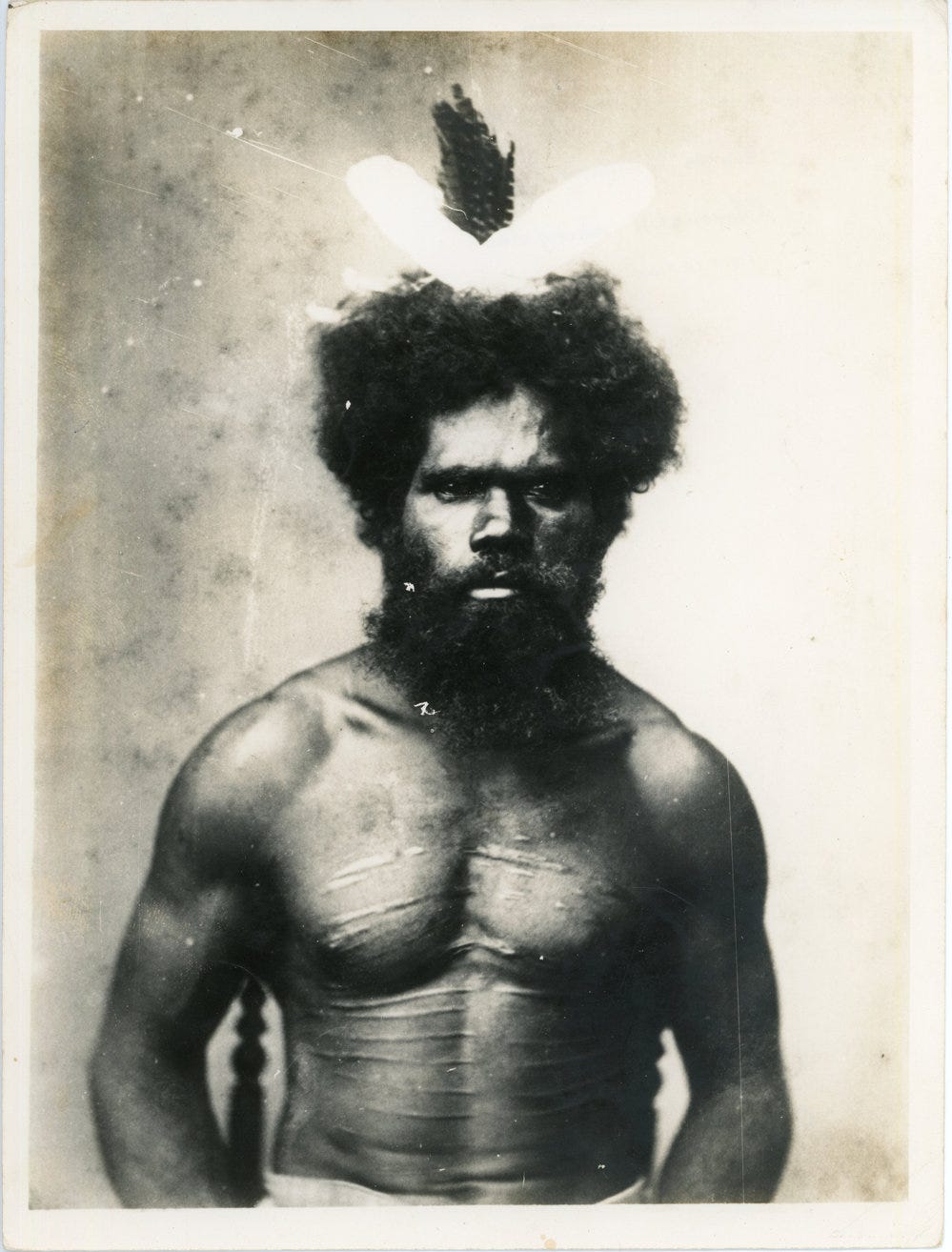
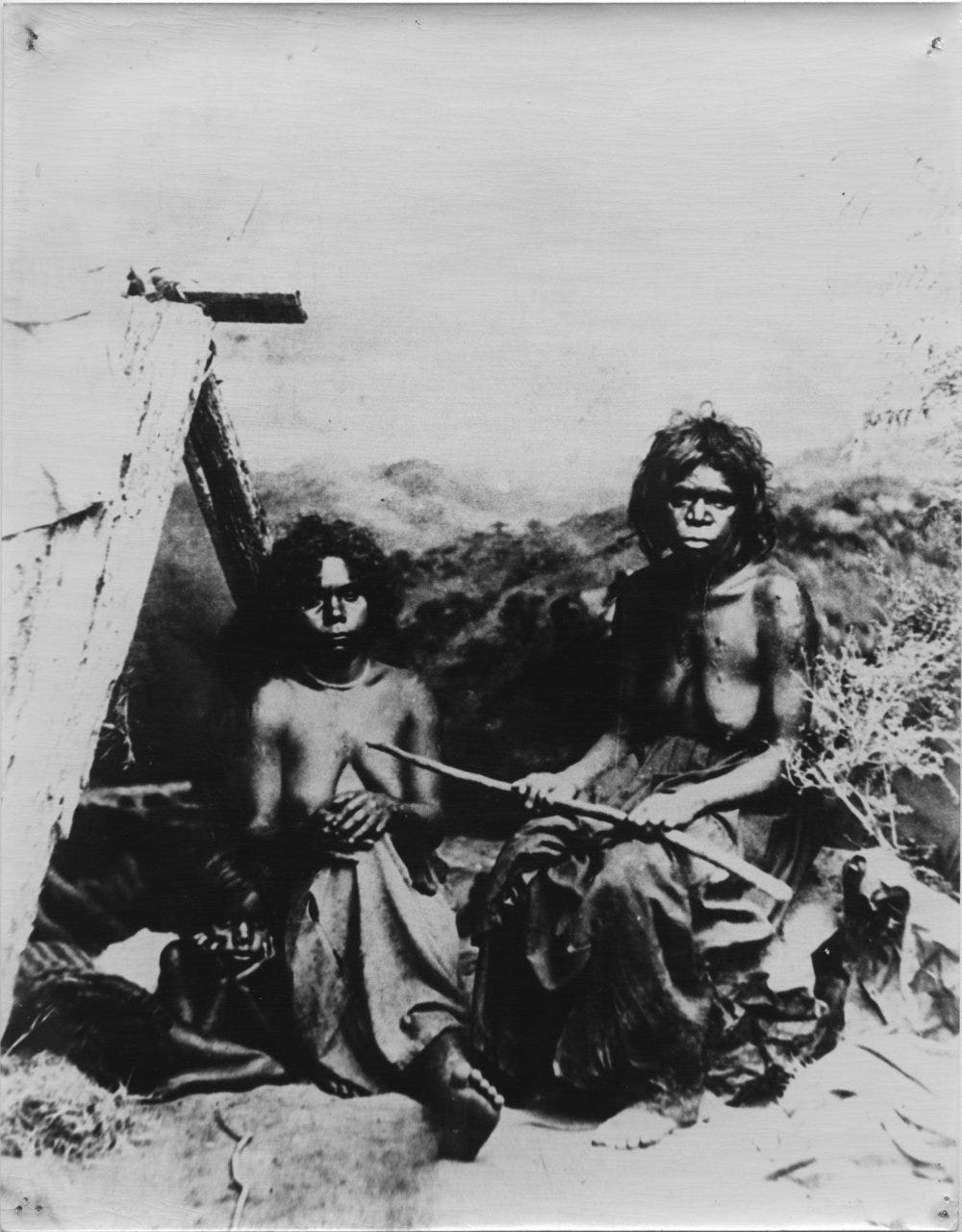
The above were taken by J.S. Lindt.
If you want to see his prints of the Gumbaynggir at the State Library of NSW you need to click through this:
Back to Foley. He opposed the “Voice” on grounds of sovereignty and the fact that he regards Australia as illegitimate.
He may be fringe in the sense that he’s never held formal office. But he’s on the winning side.
Did you click on the “Tent Embassy” link above? You must click through a land acknowledgement first. That, and the fact that something once considered radical rates a respectful inclusion in the website of the National Museum of Australia is testament to his success.
You must now click through and accept land acknowledgements in every Australian cultural website. You must listen to “Welcome to Country” speeches at every Australian event. Sports events, ANZAC day events, you name it, white Australians are “Welcomed” to their country by “Indigenous elders.” Some of these Elders damn your ancestors as “devil worshipers” at “Invasion Day” gatherings.5 Indigenous “cultural heritage advisors” of dubious qualifications must be included in every construction project and can threaten to kill you, with zero consequences.6
So, although the radicalization of the “Blak” movement in Australia has been going on for some time, the intensification since October 2023 has increased by an order of magnitude. Foley’s linkage between the pro-Palestinian movement and Indigenous rights is now dominant. There are a few old Aboriginal holdouts who are pro-Israel but they’re marginalized. Who’s fringe now?
Mark Leibler used to be at the center of Australian politics — a player, a fixer, a influencer, and a connector. Maybe on paper he still is, but I see him as a vestige, a shell of his former self. He’s between a hard left rock and a soft left hard place, which are converging to exclude Jews entirely.
“One Nation” populism is growing but I don’t see Australian Jews as going there. Ever.
The “Jewish-Indigenous” partnership is dead. It was always a fraud, based on an inauthentic framing of Jewish history. Always was, always will be.
But consider the source. What do I know? I’m just an amateur, haphazard Australia watcher.
The concept is lifted from Imshin who refers to herself as an “haphazard Gaza watcher.” I beg to differ. She’s a keen observer.
I’m fully aware of the fact that “Aborigine” is now considered anywhere from old hat to offensive. I’m using it anyway.
There is too much in this article to tackle now. I’m putting in here as a placeholder.
And of Australia’s high culture, from staunch Anglo conservatism to modern radical leftism.
From Wikipedia: “In 2021 Foley was awarded the Jerusalem (Al Quds) Peace Prize, which “recognises the inspirational and lifelong contributions of an individual advocating for Palestinian freedom, justice and self-determination”.[18]
He was elected a Fellow of the Australian Academy of the Humanities in 2024.”
Progress!


Foley didn’t say that. He was, of course, present at that demonstration.
“Prominent Indigenous activist Gary Foley said this year’s ”Invasion Day” was historic due to the shared struggle with the Palestinian people. We have invited our Palestinian brothers and sisters to be here today as an act of solidarity,” Mr Foley told the crowd.”
It was Bill Nicholson, a “Wurundjeri Elder”:
Two other protesters were also seen ripping apart another Australian flag before throwing it to the ground. Wurundjeri Elder Bill Nicholson, after his Welcome to Country, told the gathering that Australia had been settled by “devil worshippers”.
“The government gains its authority from rape, murder and theft. What sort of sovereignty is that? The authority they have imposed over Aboriginal land for two centuries doesn’t make any sense,” he said.
Here’s an archived link to the original in The Australian, which is behind a paywall. There’s a photograph of the gent in this, and I dunno, I somehow got the feeling he was an ex-con. I was right. The issue did come up in the NSW parliament where the fact that the “Indigenous Elder” was an offender was brought up. Nothing happened.
While largely in agreement, you seem to conflate indigenous with autochthonous. It may be a difference without a difference, no one outside of myth or folklore really emerges out of the ground, but indigenous is not the equivalent in meaning of “being from there since forever.”
There is no legally accepted definition of indigeneity that I could find, not even in the 29 pages of the UN’s Convention on the Rights of Indigenous Peoples.
https://www.un.org/development/desa/indigenouspeoples/wp-content/uploads/sites/19/2018/11/UNDRIP_E_web.pdf
The only serviceable one I can come up with is that group self-identifying as a distinct people resident in a distinct area longer than any other distinct group. It’s some version of “oldest man standing”
So, as applied to the Jews, they have lived continuously in the land of Israel while their predecessors and contemporaries (Canaanites, Moabites, Edomites, Jebuzites, etc) have long since disappeared.
Whether that makes any practical difference is anyone’s guess, but my sense is that this particular debate is a response to those who claim that the Arabs are indigenous and Jews are not.
Another point is that Judaism has evolved over time, and I suspect that a subject in the old Kingdom of Judea might give a different response to your question than a subject in the old Kingdom of Israel let alone a modern day Ashkenazi Jew living in a culture heavily suffused in Christian concepts.
In a deeper sense, this entire discussion is meant to distract us from a fact with which we in the West are ambivalent about: might does make right. The Jewish claim ultimately arises out of conquest as does every similar claim, including the Arabs. Debates about covenants or indigeneity pretend to elevate the discussion into the realm of abstraction where many feel more comfortable in arguing about other abstractions such as fairness, justice and the like.
Or perhaps I’m just being cynical, even as self-identify as skeptical.
“The Jewish relationship to the land of Israel is covenantal, i.e., legal, formal, and transactional.”
Agreed. The land belongs to the Jewish god. Any legal claim to it begins and ends with him. The difficulties the Jews are having inhabiting the land is a result of them getting crossways with their god. Many of us are hopeful that situation will be resolved soon.