March 16, 2026
Quickie Geezer Movie Reviews: A Man For All Seasons, Escape From New York, Gallipoli

Lately I’ve been rewatching movies that I saw as a kid and as a young adult. It’s always interesting to see whether what you saw measures up to your mature1 sensibilities. I was going to say it’s a mixed bag, but actually, it’s not - it’s more of a case that the vision clarifies; the good parts sharpen and the reservations harden. Without further ado, here are three “Quickie Geezer Movie Reviews.”
My mother took my bros and me to see this when it first came out in 1966. (1966 was something of a holdover from 1965 — a golden year for movies - and Broadway - we were big theater fans.)
A Man For All Seasons won six Academy Awards when that meant something. Sure, they’ve always been silly and political, and great actors were ignored (Richard Burton never got an Oscar despite being nominated seven times, nor did Peter O’Toole) but usually the guys who won deserved it.
This movie deserved it in spades. I’m not an expert on Thomas More, the Reformation, or Henry VIII (although I have seen his pre-obesity armor at the Met) but I thought the issue of conscience v. state was brilliantly handled.
The acting was - how shall I say it? - towering. The production values were next level. I will not offer one criticism although my incessantly nitpicky brain did come up with some. NOT TODAY SATAN.
This is a great movie. See it.
Most satisfying was the visual feast this film offers. It’s a movie of colors, gold, velvet, textures… you can feel the moisture of Britain in the walls and the earth.
But the most important part of the movie, the part that stands above all the rest, which lifts it from great to immortal, is this scene:
The scene made a profound impression on my kiddie brain and watching it as an adult, I’m even more impressed. I return to it every often when I need a boost.
And, it’s distorted to mean “liberal” and Miranda Rights and whatever the ACLU has cooked up.
Example. One of the commenters wrote: “A very important and oft overlooked point. If society can't offer due process of law to the most despised, it can't offer it to anyone.”
No, that’s not what More was saying. He was saying we apply man’s law to everyone equally. We leave moral judgements to God. (“Father, that man’s bad!” “There’s no law against that.” “There is - God’s law.” “Then God can arrest him.”)
And we defend the powerful as well as the weak.
The Devil isn’t despised, and he isn’t weak. He’s powerful and adored. It’s easy to be sympathetic to the wretched of the earth — not to the Devil. But even the Devil is due the benefit of the law.
There must be something more powerful than the powerful - man’s law.
While this movie was showing, the US was undergoing trauma in the South because Southern states were flouting the law, as Minnesota and the sanctuary cities are doing now. The President could have cut down the law and arrested the Klansmen who killed Schwerner, Chaney, and Goodman. They were obviously guilty. But he couldn’t. The law had to grind its way to a conclusion; eventually it did, somewhat unsatisfactorily, which is what happens with the law. Same deal in Minnesota. Like Roper, I would absolutely love for the President to put Minnesota under martial law and arrest every ICE protester. But I have Thomas More to tell me that we can’t do that. Perhaps if Renee Good and Alex Pretti had seen this movie they’d be alive today.
Kiddie review: Wow!
Adult review: Double wow. If you want to see peak British/American cinema with pre-woke casting and sensibilities, A Man For All Seasons is your movie.
I saw this the night it opened, or maybe the night after, in July 1981. I had a comp ticket but I’d have paid to see it if I hadn’t. It was a must see movie in my crowd.
We loved it. The audience laughed out loud at the depiction of dystopian 1997 New York because it was so accurate. When one of the characters said to Snake, the main character, before they drop him in Manhattan (paraphrasing): “Avoid the subways. That’s were ‘the crazies’ sleep” the audience broke up. True then, true now.
OK, so how did I rate it as an adult?
It held up surprisingly well. Very enjoyable even from the perspective of two generations in which its dire predictions didn’t come true. NYC in 1981 was a total horror story, a nerve-wracking nightmare of a place. By 1997, NYC had become livable and walkable with a radically lower violent crime rate.
Don’t believe the hipster assholes who say that it got “Disneyfied,” cleaned up, and lost its authenticity after Giuliano.
I am a native and I am telling you the truth here. That never happened. NYC is uncleanupable. It is inherently chaotic and dirty, but not inherently violent and nihilistic - quite the opposite. What characterizes “Nieuw Amsterdam” is a broad tolerance of just about anything as long as it doesn’t get in the way of the common good, which is what happened from 1970 to 1992.
What did happen is that the crime rate, via good hard police work and political will, was crushed, and the prostitution in the Times Square area was banished. That bothers leftists because they love chaos, crime, and perversion, but NYC never became the sanitized white picket fence nightmare that dumbass leftists write about. It can’t.
My adult review of Escape: Carpenter did a great job of showing what a catastrophe NYC had become in 1981. The production values and location choice were good.
When I first saw it, I wondered where he filmed it because I was thinking “close but no cigar.” My estimation of the location choices is went up. NYC is a hard place to replicate and Carpenter did as good a job as possible of finding locations that evoked the most blasted out parts of 1981 lower Manhattan. The CGI of Manhattan Island with helicopters swooping overhead was surprisingly good.
There’s a scene that takes place in Central Park. I remember in 1981 saying to myself, “That’s not Central Park.” This time the scene didn’t bother me as much because Carpenter actually did find a place that resembled standing on Sheep Meadow’s south looking north, where you can see apartment blocks looming on the west side. Apologies if this is too NYC-centric. (The link shows an east to west POV.)
Kurt Russell’s performance was mesmerizing then and it didn’t age. I noticed the second time around that the character hardly says anything: it’s a physical, inhabited performance, quoting straight from Clint Eastwood’s characterization of “The Man With No Name.” I didn’t know about the quotation at the time; it’s something that occurred to me on second viewing. (I’m late to the party; it’s been extensively documented.)
Last word: I had misremembered who played the punk character, Romero. I misremembered the actor as Rockets Redglare, a LES denizen, or perhaps he was a local punk who hadn’t been above 14th Street for 20 years.
No, the part was played by the late character actor, Frank Doubleday. He was terrific. Doubleday was, for an actor, a very normal human being, and he played a denizen of Lower Manhattan better than the real thing ever could have. I’m in awe.
Upshot: Escape From New York totally did not suck. Worth a view.
This is one of those cases where reservations I felt watching a movie crystallized on second viewing — I’ll explain exactly why, but I must preface my review with this: movies are acted, and the actor is a huge reason for one’s responses to what one sees on film, no matter what else goes on.
And it would be dishonest not to point this out:
Mel Gibson was my generation’s heart throb. Watching Gallipoli after (too many) years, it’s easy to see why. His early appeal doesn’t date. He’s a crazy, steroid-addled bellowing nutcase now, but in 1981, this was Mel Gibson:

There’ll always be a little place in my heart, not for him (that’s dead and gone), but for the girls who swooned over him in the movies, because I was one. As long as you don’t fall into kooky erotomania it’s a benign part of life.
I wasn’t watching Gallipoli in 1981: I was watching Mel Gibson in Gallipoli. In 1981 I had quiet reservations about both the storytelling and the final scenes in Gallipoli (which was a relatively small part of the movie - 20 minutes out of 111 was devoted to the Dardanelles campaign). I found Mark Lee to be dull. It’s one thing to be self-effacing, it’s another to be… dull.
In 2026, I watched both, but with older eyes. Gibson had the same raw magnetism that I’d seen in 1981.2 Mark Lee was as nondescript as he was in 1981. The stuff about his running was a pack of cliches. I enjoyed the Australia scenes because I enjoy Australia scenes. Who doesn’t?
My major reservation is that the movie misrepresented the story it was telling, and that’s a big deal.
Gallipoli tells us more about post-Vietnam Australia than it does about 1914. That’s his prerogative as a filmmaker - it’s my prerogative to point out that the picture is inaccurate.
He portrayed the men of the First Australian Imperial Force (AIF) as gullible dupes of a “war fever” instigated by a distant power rather than as participants in a global cause they believed in fervently.
In Weir’s narrative, the protagonists Archy and Frank are presented with a pastoral, innocent simplicity. Their journey toward enlistment is framed through the lens of sport—running, competition, and a thirst for adventure.
These boys were lured into a slaughterhouse they didn’t understand by a propaganda machine they couldn’t see through. This is leftist-Commie distortion.
In 1914, Australia was a highly literate, politically engaged society. The men who joined the AIF were not simply “boys looking for a lark”; they were citizens of a Dominion who followed international news, debated the “German Menace,” and understood the geopolitical stakes of a shattered Europe. (Below I’ll give you a truly fascinating document of the time which underscores this.)
The most significant historical omission in Gallipoli is the genuine, widespread fervent loyalty to the British Empire. In the film, the British are often portrayed as the “other”—callous officers and incompetent planners who treated Australian lives as disposable. This reflects a post-Vietnam cynicism toward “big power” military leadership, but it ignores the cultural reality of the time.
In 1914, most Australians viewed themselves as “Independent Australian Britons.” Their loyalty to the Crown was not a submissive “cringe”; it was a foundational part of their identity. To them, the British Empire was the greatest vehicle for civilization, law, and liberty in the world.
Australians signed up in huge numbers (38% of the male population; over 400,000 men) and every one was a volunteer. They weren’t fighting for a foreign power; they were fighting for their world. By failing to articulate this deep, sincere conviction, Weir makes their sacrifice seem like the result of a trick rather than a principled stand.
While the tactical failures at Gallipoli were very real, the film’s emotional core relies on the idea that these men were betrayed by a system they shouldn’t have trusted - because they were Australian and they were being exploited by a hostile foreign power.3
In reality, the volunteers of the AIF were so committed to the cause that even after the horrors of Gallipoli were known, they chose to keep fighting as volunteers. (It is true that enlistment numbers went down, but they never stopped.) This ideological commitment that goes far beyond being a “dupe.”
They weren’t running toward a finish line; they were fighting for an Empire they considered their own.
Upshot: See it for Mel. Make up your own mind. I’m not seeing this one again.
Here’s that bit of historical documentation I promised you.
It appeared in The Advertiser, Friday 28 August 19144 24 days after the King declared war on Germany. Matthew Kropenyeri, described as “an aborigine from Point McLeay Mission Station.. a self-educated man of more than ordinary mental capacity, although, a full blooded native”5 analyzed the situation clearly:
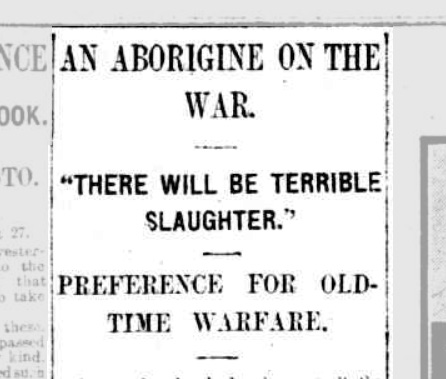
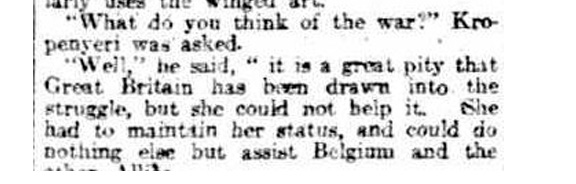
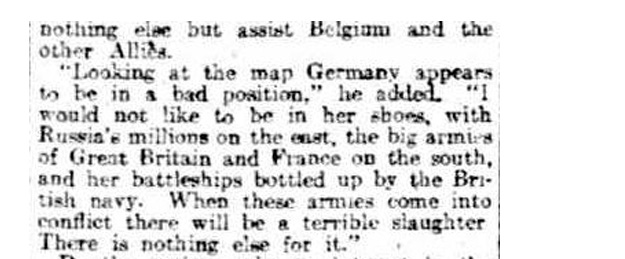
He didn’t like the newfangled way of war.
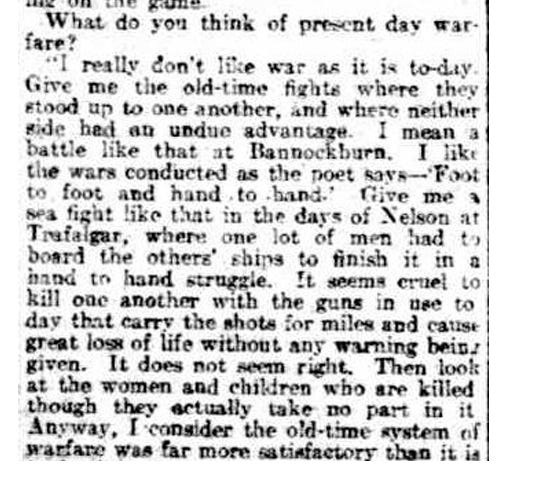
Looks like Kropinyeri called it right on the nose. An Aborigine from a Mission knew the stakes and he knew what was going to happen.
Maybe there were others.
I’d enjoy seeing this scene in a movie. How about you?
A nice word for geezer
Although a lot of his tics, embryonic then, have since become a tiresome bag of actor’s tricks.
I’m not a military expert so I’m not going there, but many experts have criticized Weir’s depiction of the Nek campaign as being a case of “cruel Brits drinking tea on the beach while brave Aussies died.”
Sorry for that, their words, not mine.
I’ve been wanting to rewatch Gallipoli for a while because I was just a young teen when I saw it and barely remember the story, but the emotion has stuck with me.
Now that I know it was given a Third Worldist spin, I’m less keen on it, but still probably will watch.
My question: did you purchase a physical copy or stream it? When I searched for it on streaming, about a year ago, I couldn’t find it anywhere.