
I was debating whether to write about this. Then I came across this note which convinced me to scribble my thoughts down. Synchronicity.
All writing is personal writing. Some is great, some is good, most is forgettable.
All writing connects the interior to the exterior. The subject matter dictates the degree to which the personal is the subject. Writing about one’s journey through the medical industrial complex is going to be more interior than being a war correspondent. But even in the case of a personal medical journey-odyssey, if everything is about me, me, me, I get off the train right there. I like to read about the personal experience anchored in the external world.
In her note, Elizabeth Hamilton referred specifically to “confessional writing” — a genre that took off in the post-WW2 era. There’s nothing new under the sun, so there was probably confessional writing in the days of the Romans, but the one that heavily affects latter-day writing is this post-war confessional genre.
In my opinion, the effect has been baleful. It’s dragged down the general level of writing in general and attracted an army of hacks.
On the other hand, there have been great confessional writers. And you know what you’re getting. If you don’t want to read about Sylvia Plath’s daddy, don’t read her poetry. I was in a class once when some grouchy middle-aged guy harrumphed dismissively, “I think Sylvia Plath was insane!” Well, name me a great poet who wasn’t at least half-tetched. It comes with the territory.
In the hands of a skilled practitioner, the confessional is like a loaded gun but one bullet is enough. I think Joni Mitchell was the greatest confessional song-writer ever — and a little Joni goes a long way. One day, I put away my Blue album. “Enough of this,” I said. That was 35 years ago! Recently, I began listening to her again and I’m amazed at her craft and musicality.
I can’t say whether confessional writing actually dragged down the general level of writing or whether the lowering of standards was merely a correlation, but I can say that it’s attracted an army of hacks and a hack confessional writer is especially annoying in a way that a hack sports journalist isn’t. It’s seeped into and corroded the most anodyne, inoffensive genre of writing imaginable: food writing.
Nowadays every recipe is preceded by a flood of verbiage about what that recipe means to the cook and how she came about to know it and her mother-in-law and her kid’s first tooth and any number of irrelevant trivia. “Jump to recipe” have become my three favorite words in food writing.
Julia Child’s sole meunière experience has become legendary in the foodie world. I’m not going to trawl through 1,400 pages of Mastering the Art of French Cooking to find it, but I remember reading it: it consisted of two or three pithy paragraphs precisely describing how an American unfamiliar with French cooking fell in love with it over a simply prepared dish. Nothing about her grandmother, her life in California eating bland food, the weather that day — just the story. Her generation of lady food and baking writers (M.F.K. Fischer, Flo Braker, Marcella Hazan) were similarly incisive. Personal but not self-indulgent.
Here’s an example of food writing that combines the personal with the factual to explain something puzzling: The title of the dish “refried beans.” I love refried beans and I’ve always wondered where the odd name derived from. What is a refried bean?
I stumbled across the answer in a comment to a YouTube video.
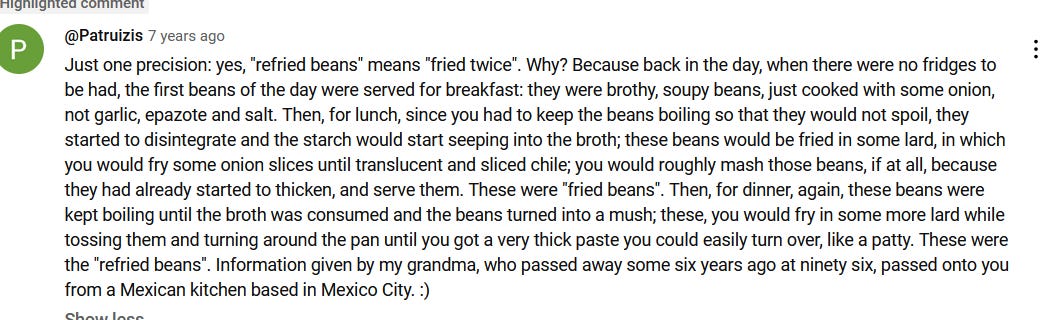
That’s not great food writing. It’s great writing. “Refried beans” makes total sense.1
I’ve veered off into tangents. Joni Mitchell, food writing… what do they have to do with personal writing?
I wanted to illustrate something with examples. If you think that the reader’s comprehension of the subject will benefit from adding a personal anecdote, put it in. If you’re writing about a sore subject that’s hotly contended, be honest about your personal perspective. Not to the point of beating a dead horse, but to clarify. Always be clear and upfront honest about paraphrasing. Be honest about what you clearly remember and what’s hazy. Engage us with your reasoning process if you think it will help the reader understand the subject: how I came from believing this to not believing it.
In America, we produce pampered hacks like Alison Bechdel, author of Dykes To Watch Out For. Oberlin grad.
China has given us Yu Xiuhua, a disabled woman from the countryside who became famous on a fluke. Her poems are personal and magnificent. Her brain is wider than the sky indeed. She contains multitudes.
Here is “Crossing Half of China to Sleep With You.” I’m sure there are the nuances lost in translation but still, it’s a great poem, a perfect marriage of external and internal. This poem is a loaded gun, it shoots… you crack open.“Then the light gets in.”
It’s all personal, but let me see the connections between you and something else, anything else, a cloud, cat litter, the divine.
Crossing Half of China to Sleep with You by Yu Xiuhua
To sleep with you or to be slept, what’s the difference if there’s any?
Two bodies collide – the force, the flower pushed open by
the force,
the virtual spring in the flowering – nothing more than this
and this we mistake as life restarting. In half of China
things are happening: volcanoes
erupting, rivers running dry,
political prisoners and displaced workers abandoned,
elk deer and red-crowned cranes shot.
I cross the hail of bullets to sleep with you.
I press many nights into one morning to sleep with you.
I run across many of me and many of me run into one to sleep
with you.
Yet I can be misled by butterflies of course
and mistake praise as spring,
a village like Hengdian as home. But all these,
all of these are absolutely indispensable
reasons that I sleep with you.
The writer also responds with calm authoritativeness to a grammar-smartass further down in the thread.
Crossing Half of China has got to be the best poem I've read in years! I wish I could read it in the original but as it is the translation seems smooth and effortless (it takes a lot of effort to seem effortless)
Joni Mitchell and refried beans, yes yes yes yes yes YES! And that poem, beauty itself.