The Wall of Hatred
Poets Are The Unacknowledged Legislators Of The World

Several commenters came by recently expressing dismay at the turn of my writing. Thanks for your concern, but I write about what I want to write about. I don’t write for clicks. I’ve lost dozens of followers in the last few weeks. I don’t care.
“If you do not tell the truth about yourself you cannot tell it about other people.”—Virginia Woolf
I’ve lived most of my life being that Jew: “Stop catastrophizing. Use the word ‘antisemite’ sparingly, if at all. Even when it’s true, it does no good, and most of the time it isn’t true. And stop with the Holocaust talk. It ain’t happening here.”
And it’s not because I never experienced antisemitism. I grew up in a mostly non-Jewish neighborhood from the mid-60s on. It was full of racial and ethnic epithets. You develop a thick skin and move on.
But things have changed. And although I don’t think that the US will ever have anything approaching what happened in Europe, there are always new forms of group hatred. That’s something humans are very inventive about. This is my attempt to understand what’s going on and in the process, get some control over it. Those who don’t like it can read someone else.
A few months ago I learned about the salience network, set of brain regions that acts like an internal early warning system. Its job is to scan the environment and internal states for what matters most: threats, rewards, or urgent signals. Threats run the gamut from obvious things to social slights. The SN decides what gets attention, directing resources either toward focused, goal-directed thinking or inward reflection and imagination. When it works well, it keeps you safe and helps you prioritize. When it gets hijacked, it can dominate the mind and drown out everything else.
Since August 17th, when I read a supremely idiotic post about Candace Owens by Elizabeth Nickson, I’ve allowed my salience network to be dominated by external events. Since the aftermath of the Charlie Kirk assassination, it’s been literally hijacked. And I’ve got to put a stop to it. But first, I’m the type that needs to understand what’s going on. I can’t just say, “Salience network overload!” I’ve got to understand it. So here’s what I came up with.
When I encounter someone like Elizabeth Nickson lionizing Candace Owens, or Alex Berenson allowing his buddy Tucker Carlson to perform innocence theater to tens of thousands of followers, I’m not just irritated. Two primal signals collide in my nervous system. On one side is moral disgust: my insula and amygdala light up because the content feels contaminating — lies, cultish framing, conspiracy bullshit. This is not metaphorical; those brain regions evolved to keep us away from rotten food and bad actors alike. They tag the material as dangerous.
On the other side is social envy, or more precisely, sensitivity to reward and status. My ventral striatum and orbitofrontal cortex can’t help but register the numbers: 30,000 for Nickson, 241K for Berenson. The latter is raking in anywhere from $500K to $1M in royalties. That’s a massive dose of social proof, a signal our species spent a million years evolving to notice. The SN brings on the dopamine.
Dopamine’s earned a latter day rep for being the happy brain chemical. That’s wrong. Dopamine doesn’t signal joy — it signals relevance. In this case, it says: “someone high-status is gaining ground.” My brain treats that as survival information. It says: you’re a loser. You’re telling the truth—and it gets you nowhere. Talk about Illuminati Pedo Scum or My Buddy Tucker and you might get somewhere.
Those two signals converge in the salience network. When it’s functioning well, it toggles me cleanly between my default mode network (the one I use to imagine, reflect, and write fiction) and my executive network (the one I use to plan and execute tasks).
But moral disgust plus social envy is like sending it two conflicting emergency alerts at once. It jams the switchboard.
What does that look like from the inside? I feel compelled to keep reading, scrolling, analyzing, because my brain thinks “forewarned is forearmed.” Cortisol and norepinephrine rise, keeping me vigilant. Meanwhile, the default mode network — the one that provides the mental space for imagining and connecting ideas — goes offline. (Obviously, writing a novel requires higher executive function, but the DMN is the preparatory ground.)
Appetite regulation gets sloppy under stress hormones. Motivation collapses. I end up badly nourished, fatter, angrier, and further from my work, even though I “know better.”
This is wiring. Moral disgust evolved to keep me safe from poison and cheaters. Social-status tracking evolved to help me orient in hierarchies. When both fire at once, I get one of the most powerful attention hijacks humans experience: the urge to keep watching the very thing that disgusts me, and the paralysis that follows.
That’s why it feels so different from curiosity or even ordinary outrage. I’m not simply rubbernecking. I’m running an ancient survival program in a modern media environment designed to exploit it.
There’s a cruel irony in what’s happening inside my head. My salience network — the part of the brain that’s supposed to keep me safe — is doing the opposite. It’s supposed to alert me to danger, to guide me away from harm. Instead, it’s screaming nonstop, and the world has handed it a never-ending buffet of outrage, betrayal, and identity threat.
The more I pay attention, the more it feeds me signals I cannot ignore. Elizabeth Nickson lionizing Candace Owens. Alex Berenson defending Tucker Carlson. The endless right/left cacophony. And this, which I can’t honestly deny: Netanyahu himself. He could not resist shoving his face in front of the camera, trying to leverage benefit from Kirk’s death—and then calling attention to the insane conspiracy theories by personally denying them, when a curt statement from a spokesman would have done. This truly pushed me into salience network overdrive.
Each spike of moral disgust lights up my insula and amygdala. Every instance of social reward — tens of thousands of followers for someone I see as hollow (or malevolent, such as Fuentes) — spikes my ventral striatum and orbitofrontal cortex. The salience network treats all of this as urgent, survival-relevant information. My default mode network, the one I need in order to imagine, reflect, and write fiction, is relegated to the back seat. My executive network — the one that allows me to focus and act — gets muted.
My brain is scanning these converging signals and saying: “Threat to my group. Worst-case scenario imminent.” That lights up every alarm circuit, driving pattern-seeking and worst-case simulations. Suddenly, it doesn’t matter that the Holocaust isn’t imminent. The circuitry treats the threat as existential and it modulates. I “know better” — there will be no Holocaust here. But there might be—no, there is—a constant questioning of our place in the US, our motives, and our very American identity. The kind of stuff that brings on the Berensons: “Hey buddy, hey dude, it’s me, your friend. You can’t really be saying this, can you?”1
The result is predictable. I can write essays about it. I can analyze, dissect, and document every betrayal and every moral outrage. It doesn’t help. It deepens the chokehold. My creative work suffers. My novel waits. My focus evaporates. I gain weight. I feel trapped in the loop.
And, while we’ve all been tearing each other apart about Charlie Kirk, Gaza, recognizing Palestine, the amoral world of power competition doesn’t stop. The Ukraine situation has taken a sharp turn for the worse. Trump has flip-flopped a full 180. There are Russian drones in Poland. Pete Hegseth is gathering military leaders in the Pentagon.
And you know who will be blamed? Take one big fat guess.
It doesn’t matter that Israel’s actual policy toward Ukraine has been cautious, neutral, even hesitant. In the conspiratorial logic, facts are irrelevant. All it takes is one identity marker — Zelenskyy is Jewish — and suddenly the entire complex geopolitical situation collapses into a single agent: Mossad = Israel = “the Jews.”
The network my brain evolved to detect threats to my in-group lights up immediately. Salience circuits, pattern detectors, and historical memory combine to scream: this is dangerous, and it could be directed at me, at us, the Jews. The logic is old, but its neurobiological impact is immediate: I feel the chokehold again, because my brain is recognizing a pattern that, in the past, carried real survival stakes.
Maybe this time it won’t fall on us, but the wall of hate is real. It’s there. I can’t do a thing about it. Other than warn you, and tune it out.
So that’s what I’m doing. I can’t afford to get on a plane to the Mojave desert.
I’m just going into internal exile.
If you don’t want to hear about this, read someone else.
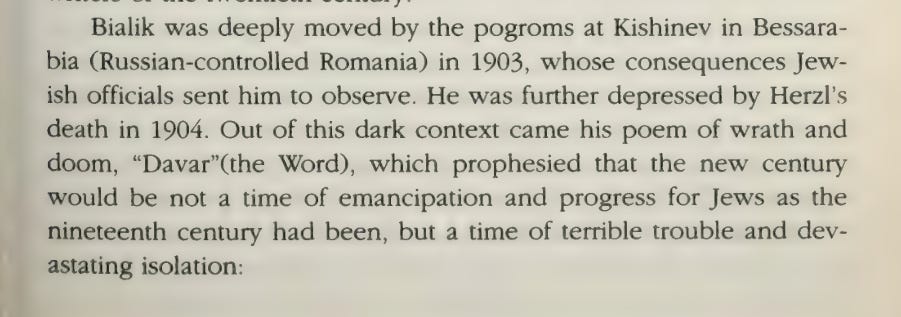
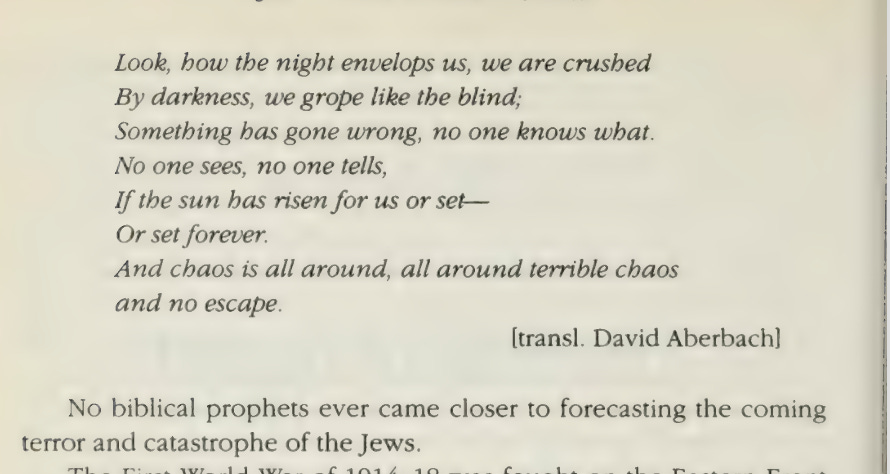
In 1994 the Medieval historian Norman Cantor wrote a flawed but interesting historiography of the Jews, The Sacred Chain. The chapter about the Holocaust, “The Wall of Hatred,” is probably the best thing I’ve ever read about the gathering storm in Europe. He begins the chapter with a quotation from the great poet, Chaim Nachman Bialik, because poets tell the truth when no one else can or will.
“Poets are the hierophants of an unapprehended inspiration; the mirrors of the gigantic shadows which futurity casts upon the present; the words which express what they understand not; the trumpets which sing to battle, and feel not what they inspire; the influence which is moved not, but moves. Poets are the unacknowledged legislators of the world.”—Shelley, A Defense of Poetry
This space is free, apart from novel-in-progress excerpts.
If you’d like to contribute, you can do so here:
Buy Me A Coffee
Support is optional, non-transactional, and non-binding.
The kind of thing that Bibi Netanyahu loves.